
Such AI models are changing at a speed that it is very probable that we will have by 2026 systems that will be able to understand information in a way that is much more intuitive, flexible, and “human-like”. At present, generative AI is concentrated either on text or on images, but subsequent models will be able to deal with text, voice, video, 3D data, and sensor inputs simultaneously.
So what will this advancement look like?
AI will observe, listen, analyse, and respond intelligently across formats. This opens massive opportunities for businesses using generative AI development services or building custom models with a generative AI development company. Imagine tools that can create a product video from a text prompt, analyse customer feedback across voice calls and emails, or help engineers visualise complex system designs instantly.
Here’s what this shift means in everyday business scenarios:
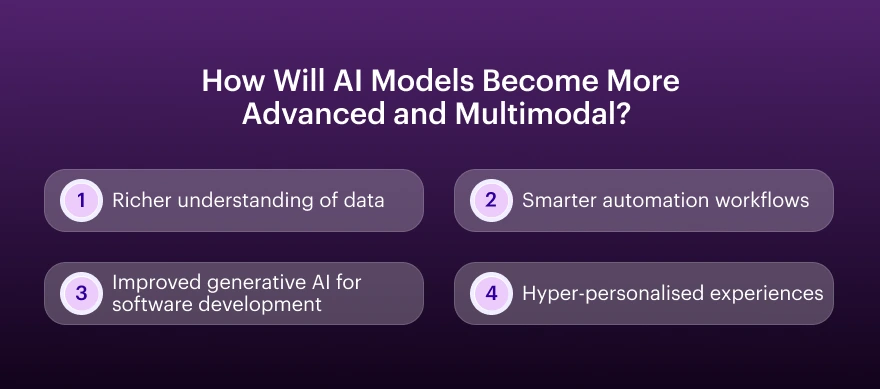
Richer understanding of data
Models will interpret text, images, and audio together, giving more accurate and context-aware outputs.
Smarter automation workflows
AI will handle complex tasks like generating UI mockups, drafting documentation, and analysing customer sentiment in one unified process.
Improved generative AI for software development
Developers will get multimodal coding support, including architecture diagrams, test cases, visual prototypes, and even user journey simulations.
Hyper-personalised experiences
Systems will adapt to user behaviour across touchpoints, improving customer service, product recommendations, and support interactions.
And for anyone wondering how generative AI works, multimodal systems are built by training neural networks on mixed training datasets so they can recognise patterns across formats. This means the usual “what is generative AI vs AI” comparison won’t matter much by 2026; traditional AI and generative AI will naturally blend into a single, more powerful ecosystem.
In a nutshell, multimodal AI will make technology feel less like a tool and more like a creative partner, helping businesses innovate faster while reducing manual effort. As the saying goes, “the sky’s the limit,” and in this case, AI is climbing fast.
Generative AI is causing a stir in different sectors right now; however, its influence on business functions is still expected to be massive by 2026. As per recent corporate surveys, the number of global corporates, which have either used or intend to use generative AI soon, is over 50%, thus signalling that the technology is being phased out from the experimental stage and is entering the mainstream domain.
Companies understand that generative AI is not a brief hype, but rather a major factor that will change the way employees relate, develop, and acquire a competitive advantage. To figure out its impact, one may consider the actual worth that generative AI delivers.
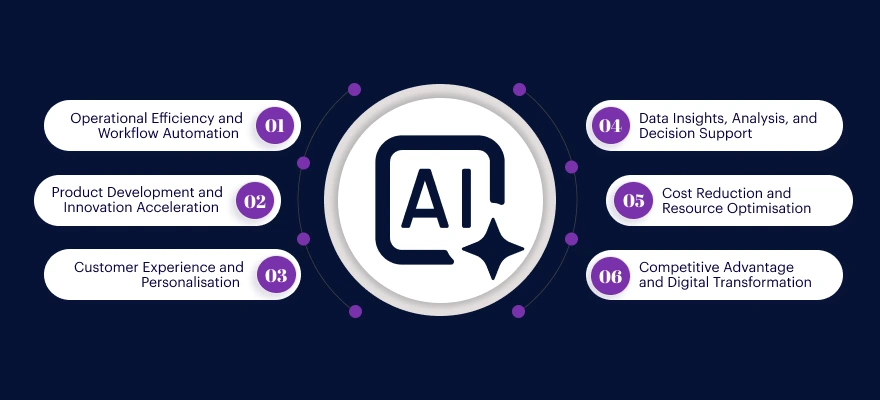
Operational Efficiency and Workflow Automation
One of the most significant changes firms will notice is how effortlessly workflows perform when powered by generative AI. Those enterprises which intimately integrate generative AI are going to see increased output. This is because AI acts as a “digital colleague” which carries out the less interesting tasks while the human workers focus on innovation and strategy.
- For starters, it frees the workers from dull and repetitive jobs via automation. For example, it can generate reports, draft papers, handle customer care questions, and enter data without requiring human intervention.
- Second, it improves job quality by minimising errors and increasing overall process speed.
- Third, AI-generated proposals make decision-making easier and allow workers to reply faster.
Product Development and Innovation Acceleration
For many companies, generative AI for software development is becoming a game-changer. This helps product teams innovate faster without sacrificing quality, something every generative AI development company is enabling through custom models and tools.
- AI can generate code snippets, test cases, system diagrams, and prototypes
- Faster debugging and quicker iteration cycles
- New product ideas can be simulated and validated before development begins.
Customer Experience and Personalisation
Customers require more rapid, intelligent, and personalised experiences, all of which generative AI is capable of delivering. Enterprises that utilise tailored generative AI development solutions have the potential to generate interactions that sound more human and are of a higher degree of personalisation.
- AI-powered chatbots and virtual assistants can provide interactions that are not only fast but also take the context into consideration
- Extreme personalisation in recommender systems via AI leads to higher user engagement and conversions.
- Generative AI models facilitate multilingual communication by automating translation and localisation processes.
Data Insights, Analysis, and Decision Support
Generative AI is essentially the tool that transforms raw data into insightful information that is then used by leaders to make decisions. In fact, by the year 2026, the use of such skills will enable executives to grasp complicated data in no time as opposed to the traditional way of sifting through hundreds of lines of text or spreadsheets.
- It can bring a long text, report, or database down to a few words.
- Predictive analytics can predict demand, hazards, and performance patterns.
- Automatically creates visual dashboards and insights.
Cost Reduction and Resource Optimisation
Automation helps businesses to do more with less. Simply said, generative AI allows organisations to invest more wisely and develop quickly.
- Lower operational costs due to reduced manual effort
- Faster development cycles mean lower production costs
- AI-powered quality checks reduce rework and operational waste
Competitive Advantage and Digital Transformation
At this point, the distinction between generative AI and AI won’t be a major question for businesses, as generative AI will be ubiquitous. Companies using generative AI software development and advanced automation tools will:
- Launch products faster
- Innovate more efficiently
- Deliver better customer experiences
- Adapt quickly to market changes
The biggest breakthroughs in generative AI in 2026 will not come from bigger models, but from superior data. Premium data is fast turning into the main driver of innovation, and companies that make a move by putting their money on neat and properly structured datasets are already experiencing the favourable results of their generative models.
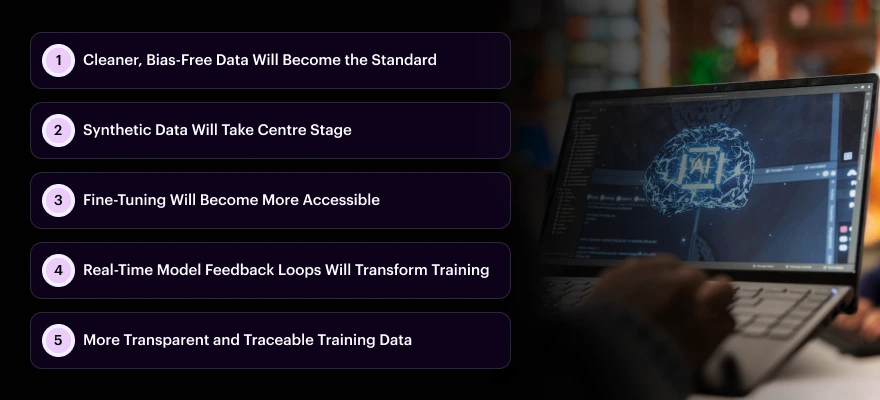
Cleaner, Bias-Free Data Will Become the Standard
AI project failures are driven by poor data quality, which is predicted to decrease considerably as organisations implement automated data-cleaning processes powered by AI.
Models will learn from datasets that are balanced, diversified, and context-rich, resulting in fewer biased replies, fewer errors, and significantly more reliable outputs, particularly for consumer-facing tools such as chatbots, content generators, and decision-support systems.
Synthetic Data Will Take Centre Stage
Since real-world data is often hard to collect and expensive to label, businesses are increasingly turning to synthetic data created by generative models. Gartner predicts that by 2026, nearly 60% of all AI training data will be synthetic.
Synthetic data allows generative AI development companies to train models on scenarios that don’t yet exist in the real world, like rare medical cases, uncommon edge cases in autonomous driving, or highly customised user behaviour patterns.
Fine-Tuning Will Become More Accessible
Fine-tuning the process of teaching a model, particular tasks will be easier, faster, and much more affordable. Thanks to techniques like LoRA (Low-Rank Adaptation) and parameter-efficient tuning, companies won’t need massive hardware to achieve high accuracy.
This evolution means even small businesses can leverage generative AI development services to build domain-specific models tailored to their industry, whether it’s finance, retail, education, or healthcare.
Real-Time Model Feedback Loops Will Transform Training
Instead of static training cycles, models will learn continuously from real-time user interactions. This “live learning” approach will help fine-tune model behaviour, instantly correcting errors, refining tone, and improving relevance over time.
For example, a customer-support model may automatically adjust its responses after observing what users mark as helpful or not.
More Transparent and Traceable Training Data
Explainability will also improve. As businesses demand more accountability, training datasets will be logged, tagged, and version-tracked. This ensures users understand how generative AI works, what data shaped its responses, and how decisions are made, closing the gap in the “what is generative AI vs AI” confusion.
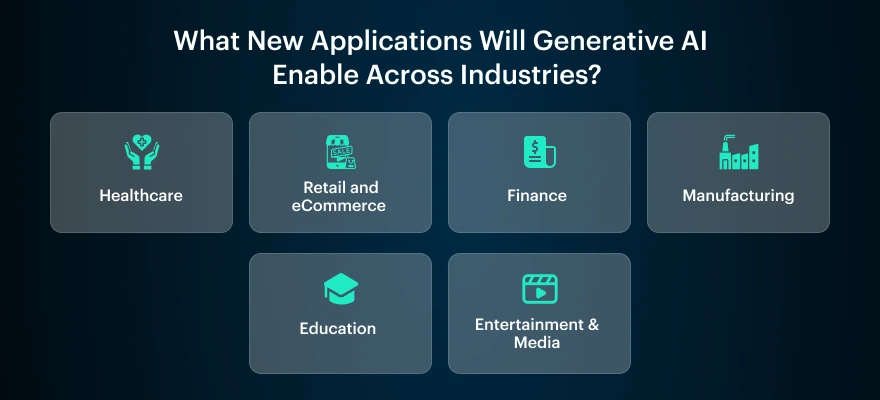
As the quality of generative AI is improving, the use of technology will be far beyond the mere existence of chatbots and content creation tools. Numerous sectors are going to launch new apps for their clients in the following year, which will compel companies to reconsider their strategies in operations, product development, and customer services.
1. Healthcare
Healthcare is entering an era where generative AI helps design personalised treatment pathways. Generative models will simulate treatment outcomes, summarise medical histories, and even assist doctors in identifying rare diseases faster. Hospitals and research labs will increasingly rely on generative AI software development to generate synthetic medical images for safer model training, thereby minimising the risk to patient privacy.
2. Retail and eCommerce
Brands will be able to use generative AI to facilitate the process of product recommendation interactively, offer customers deals depending on their up-to-the-minute behaviour, as well as create marketing content automatically. To consumers, this will be the extremely targeted suggestions of products, AI-designed outfits, and personalised shopping assistants that know the customer’s preferences more and more every day.
3. Finance
Banks will use generative AI to simulate financial risks, detect fraud, and generate instant reports from vast unstructured datasets. Generative models will also create synthetic financial data to help analysts test their systems more accurately, strengthening security and transparency.
4. Manufacturing
Generative design tools are set to transform manufacturing. Such models can generate a product variation in several thousands, where each of these variations is optimised either for cost or for durability or for sustainability. On the other hand, factories, which are going to use generative AI development solutions, will be able to automate predictive maintenance as well, thus they will reduce their downtime and improve their production quality.
5. Education
In 2026, the use of generative AI in educational institutions will have changed classrooms to a great extent. Teachers will be facilitated in producing individualised lessons, pictures for learning, tests, and notes through AI, based on the abilities and the speed of the students. This change has the effect of making education more attractive, easier, and fun for the learners.
6. Entertainment & Media: Real-Time Content Creation
Entertainment is going to be among the major beneficiaries. Generative AI can be used for the writing of scripts, the creation of VFX scenes, the designing of characters, and even the production of the whole storyboards. Various studies indicate that as much as 45% of the digital content will be AI-assisted by 2026, thus enabling creators to accomplish their projects in less time and at lower costs.

15 IoT Solutions for Business to Transform Your Smart Warehouse Operations
In the rapidly evolving landscape of global logistics, the traditional warehouse is no longer just a storage facility; it has

IoT Solutions for Business: 10 Things to Know Before Hiring Engineers
The landscape of IoT solutions for business has undergone a radical transformation. As we move through 2026, the Internet of

Why DevSecOps is a Must for Bespoke Software Development in 2026
In the rapidly evolving digital landscape of 2026, the traditional boundaries between development and security have not just blurred, they
