
Table of Contents
- Custom AI Agents vs Standard Chatbots
- How the Agent Factory Engine Works
- How Custom AI Agent Development Works
- How AI Agents Personalize Experiences
- What Are the Types of Custom AI Agents?
- How Can AI Agent Development Companies Work with Custom AI Agents?
- What are the Benefits of Building Your Personalized AI Agent?
- How to Integrate Custom AI Agents with Existing Systems?
- Wider UK Use Cases for Custom AI Agents
- The Reality of Costs: Investing in Custom AI Agents
- Common Mistakes UK Enterprises Make with AI Agents
- Conclusion
- FAQ
Custom AI Agents. That is the real story here, and UK enterprises are moving quickly from generic, off-the-shelf bots to bespoke systems built for the way their business actually works. The old model was simple: plug in a chatbot, ask it to be useful, and hope for the best. The new model is far more practical and far more powerful: design purpose-built agents that understand workflows, integrate with internal systems, support teams intelligently, and deliver measurable business value.
Think less one-size-fits-all bot, more precision-built digital workforce.
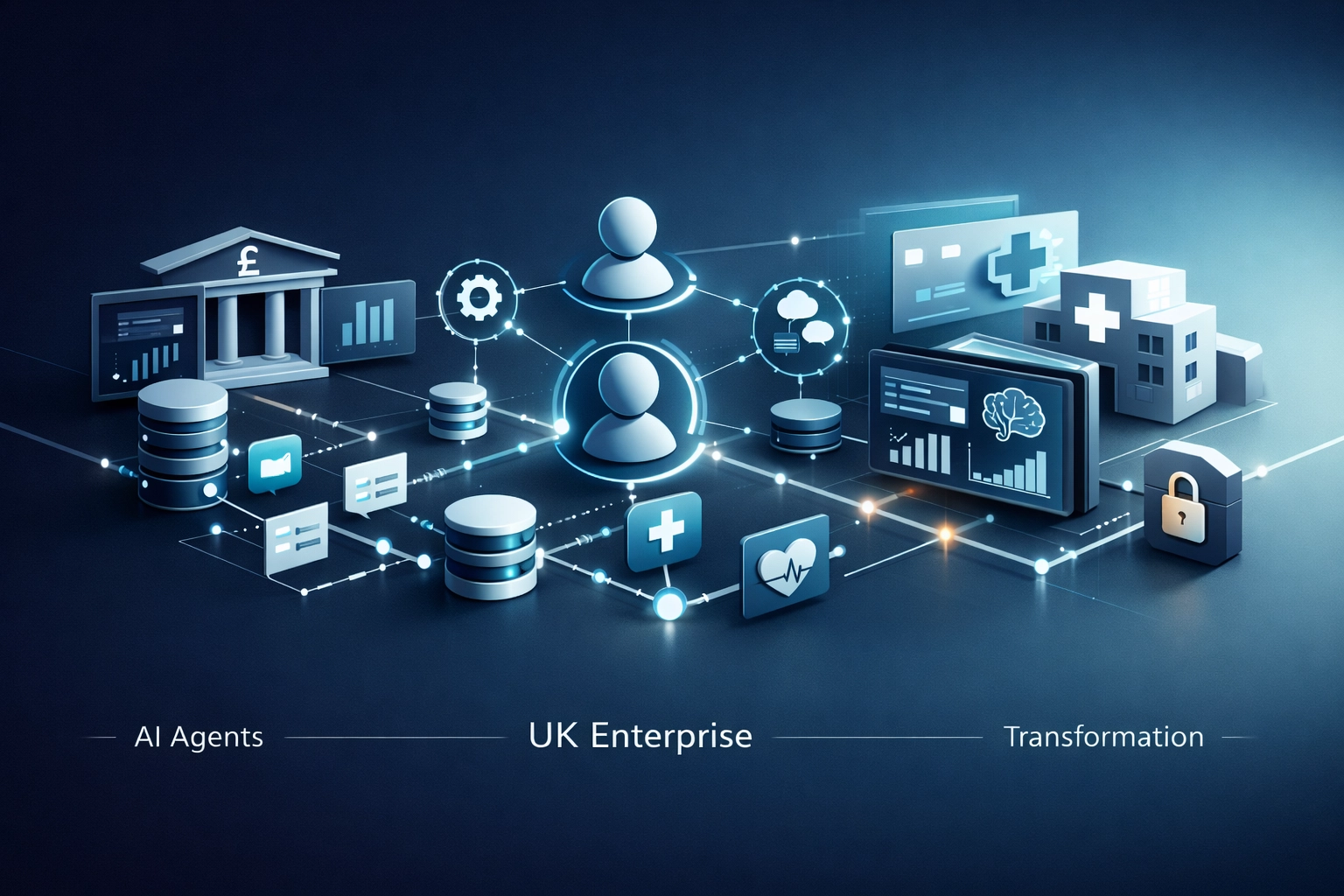
Across banking, healthcare, and public services, organisations are treating custom AI agent development as a serious digital transformation priority rather than a shiny side project. That is where Agent Factory thinking enters the picture. For businesses looking at the momentum around institutions like NatWest and the wider digital transformation push surrounding organisations such as the NHS, the signal is clear: scalable advantage comes from building agents tailored to real operational needs, not from rolling out generic tools and calling it innovation.
That shift matters to everyone involved. Business owners get a clearer route to efficiency and growth. Developers get a structured framework for building scalable, secure, and dynamic agent workflows. Hiring managers get a realistic way to extend team capacity without turning every process bottleneck into a recruitment problem. In short: fewer clunky handoffs, fewer repetitive tasks, and a lot less “why are we still doing this manually?” energy.
An Agent Factory is the evidence. Custom AI agent development is the core focus. When the two come together, digital transformation stops being a boardroom buzzword and starts becoming a lightning-fast, controlled, and genuinely useful operating model for modern UK enterprises.
Problem: Generic bots answer questions but rarely move work forward.
Solution: Build bespoke agents that retrieve, reason, act, and integrate with the systems your teams already use.
For developers, this is about designing a modern orchestration layer instead of another isolated chatbot. For business owners, it is about turning AI from a boardroom talking point into measurable operational efficiency. For hiring managers, it is about creating dynamic support capacity without endlessly expanding headcount. The result is a more seamless customer experience, better internal workflows, and a competitive edge that is difficult for slower-moving firms to copy.
Custom AI Agents vs Standard Chatbots
Let’s make this simple: a standard chatbot follows the script. A custom AI agent helps write the next move.
| Feature | Custom AI Agents | Standard Chatbots |
|---|---|---|
| Decision style | Dynamic reasoning based on context, goals, and live inputs | Fixed scripts and predefined conversation trees |
| Data usage | Pulls from internal knowledge, documents, systems, and real-time sources | Mostly limited to what was manually scripted in advance |
| Actions | Can trigger workflows, call APIs, update CRMs, and coordinate tools | Usually responds with information only |
| Adaptability | Learns from changing business logic and handles more complex tasks | Breaks quickly when conversations leave the expected path |
| Enterprise fit | Built around specific UK business processes, compliance needs, and user journeys | Generic by design, with limited operational depth |
That is the big shift UK enterprises are waking up to. If you are a developer, this means building systems with actual operational logic. If you are a business owner, this means moving beyond FAQ automation. If you are a hiring manager, this means adding scalable digital support where teams are already overloaded.
How the Agent Factory Engine Works
An Agent Factory is not magic. It is a well-designed engine made up of models, data pipelines, orchestration layers, and business tool integrations that let custom AI agents do useful work in the real world.
1. Retrieval-Augmented Generation (RAG)
RAG is the part that keeps agents grounded in the right knowledge instead of letting them confidently guess their way through your operations. It allows agents to retrieve relevant company information before generating a response or taking the next step.
For UK enterprises, that can mean:
- Pulling from internal policy documents
- Referencing product knowledge bases
- Accessing support documentation
- Surfacing approved answers for regulated workflows
- Using the latest operational information instead of stale training data
In plain English: RAG gives your custom AI agents a better memory and better judgement. Handy combination.
2. Tool Integration with APIs and CRMs
This is where agents stop being conversational extras and start becoming productive digital workers. Through secure tool integration, agents can connect with business systems and take action across the stack.
That can include:
- CRM platforms for customer updates and lead tracking
- Ticketing systems for support workflows
- ERP and finance tools for operational data
- Internal dashboards and analytics platforms
- Third-party APIs for scheduling, messaging, routing, or inventory updates
This matters because a custom AI agent that only talks is interesting. A custom AI agent that can retrieve, reason, and act is where the business value really shows up.
3. Orchestration Inside the Agent Factory
Once RAG and tool integration are in place, the Agent Factory coordinates how agents work together. One agent can retrieve context, another can evaluate intent, another can trigger a workflow, and another can summarise outputs for a human decision-maker.
That makes the system:
- More scalable
- More controllable
- Easier to govern
- Better suited to enterprise-grade deployment
In other words, it is less “random AI helper” and more “structured digital operations layer.”
Problem: AI without orchestration becomes a clever demo with no operational backbone.
Solution: Use an Agent Factory approach to connect models, tools, approvals, and governance into one scalable system.
How Custom AI Agent Development Works
If the phrase custom AI agent development sounds a bit like a mysterious lab experiment, good news: it is actually a structured delivery process. The best projects do not begin with “let’s add AI somewhere” and a dramatic PowerPoint flourish. They begin with a practical lifecycle that ties business outcomes to data, systems, governance, and continuous improvement.
For UK enterprises, that lifecycle usually moves through four core stages: discovery, data grounding, orchestration, and iterative deployment.
1. Discovery: Define the Real Business Problem
Before a single workflow is automated, the development team needs to identify where an agent will create meaningful value.
- Business goal alignment: Pin down the use case that actually matters.
- Reduce support backlog
- Speed up underwriting checks
- Improve logistics planning
- Automate repetitive internal admin
- Stakeholder mapping: Involve the people who will live with the system.
- Developers define technical constraints
- Business owners define ROI expectations
- Hiring managers identify team pain points
- Compliance leads flag governance requirements
- Process analysis: Study the current workflow before trying to modernise it.
- Where are the bottlenecks?
- Which tasks are repetitive?
- Which decisions need human approval?
- Which systems hold the required data?
This stage matters because the wrong use case creates a very expensive digital assistant that nobody actually needs.
2. Data Grounding: Make the Agent Useful, Not Guessy
Once the use case is defined, the next step is grounding the agent in trusted business data. This is where bespoke beats generic every single time.
- Knowledge source mapping: Identify what the agent should learn from.
- Internal documents
- Product and policy libraries
- CRM records
- Historical tickets
- Operational dashboards
- Data preparation: Clean, structure, and permission data correctly.
- Remove duplicate or stale records
- Apply access controls
- Define which data can be surfaced to which users
- Create retrieval pipelines for secure access
- Domain tuning: Align the outputs with business language and context.
- Finance teams need accuracy and auditability
- Healthcare teams need privacy and escalation logic
- Logistics teams need live conditions and operational timing
- Manufacturing teams need equipment and maintenance context
For a UK enterprise, data grounding is not just about relevance. It is also about governance, traceability, and making sure the agent does not wander off into fantasyland with too much confidence.
3. Orchestration: Connect Reasoning to Action
This is the stage where the agent becomes more than a smart search box. Orchestration defines how it retrieves information, chooses tools, triggers actions, and escalates when needed.
- Workflow design: Break tasks into reusable decision steps.
- Understand intent
- Pull context
- Check rules
- Call systems
- Summarise outputs
- Route to a human if confidence is low
- Tool chaining: Link the agent to the platforms that power the business.
- CRMs
- ERPs
- Scheduling systems
- Document stores
- Payment and finance tools
- Customer support platforms
- Governance controls: Build in the guardrails from day one.
- Audit logs
- Approval checkpoints
- Role-based permissions
- Risk thresholds
- Monitoring for hallucinations and drift
A modern agent stack should feel seamless to the end user, but under the hood it needs dynamic decision logic and a surprisingly boring amount of structure. That boring structure is exactly what makes it enterprise-ready.
4. Iterative Deployment: Launch, Learn, Improve, Repeat
The smartest AI programmes are not “one and done.” They roll out in phases, measure performance, and refine continuously.
- Pilot launch: Start with a narrow use case and controlled user group.
- One department
- One workflow
- One customer segment
- Performance testing: Measure what matters to the business.
- Resolution speed
- Accuracy
- Escalation rate
- Adoption rate
- Time saved
- Feedback loop: Improve based on real usage rather than assumptions.
- Update prompts
- Improve retrieval sources
- Add new tool integrations
- Adjust escalation rules
- Scaled deployment: Expand to more teams and workflows once outcomes are proven.
- Regional teams
- Multi-brand operations
- Partner-facing support
- Cross-functional internal processes
That is the development lifecycle in plain terms: find the right problem, ground the agent in real data, orchestrate it properly, and deploy it in a way that gets smarter over time. Less chaos, more measurable progress. A refreshing change, frankly.
How AI Agents Personalize Experiences
The biggest difference between a generic AI tool and a bespoke agent is not just intelligence. It is context. A custom agent can use role, history, preferences, transaction records, previous interactions, and live operational signals to tailor what it says and what it does.
That means your users are not getting the same broad, generic reply served to everyone with a pulse and an email address. They are getting a response shaped around who they are, what they need, and where they are in the journey.
What personalization actually looks like
- User-aware responses: The agent adapts based on role and intent.
- A customer sees relevant service guidance
- A support rep sees account history and suggested actions
- A sales manager sees lead priority and deal context
- A finance lead sees risk, approvals, and audit details
- Historical context: The agent remembers previous interactions and patterns.
- Past support tickets
- Earlier purchases
- Prior onboarding steps
- Existing account status
- Known preferences or recurring issues
- Next-best-action recommendations: The agent does not just answer; it helps move things forward.
- Suggest the right product
- Route the issue to the correct team
- Trigger a follow-up workflow
- Recommend a retention step
- Surface a relevant policy or document
- Consistent omnichannel behaviour: The same context can follow the user across touchpoints.
- Website chat
- Customer support portal
- Internal employee tools
- Mobile app experiences
- CRM-driven communications
For UK enterprises, that level of personalization can improve both UX and business performance. Customers feel understood. Teams waste less time repeating themselves. Developers can build a more seamless digital layer across systems that already exist. Everyone wins, and nobody has to pretend a scripted chatbot counts as “premium service.”
Problem: Generic replies make customers repeat themselves and frustrate internal teams.
Solution: Use bespoke agents grounded in historical data and live context to deliver tailored, lightning-fast interactions.
What Are the Types of Custom AI Agents?
Not every agent should do everything. In fact, that is often the quickest route to complexity, confusion, and the sort of project meeting everyone mysteriously “forgets” to attend. The smarter approach is to design agents around clear roles.
| Agent Type | Primary Purpose | Best For | Typical Integrations |
|---|---|---|---|
| Task-oriented agents | Execute specific actions or guided workflows | Support operations, booking flows, service requests | CRM, ticketing, scheduling, ERP |
| Knowledge-retrieval agents | Surface trusted answers from internal knowledge | Policy lookup, employee enablement, regulated customer support | Document stores, knowledge bases, SharePoint, intranets |
| Autonomous workflow agents | Handle multi-step processes with minimal input | Approvals, claims routing, lead qualification, back-office automation | CRM, finance tools, workflow engines, email systems |
| Analytical agents | Interpret business data and generate recommendations | Forecasting, pricing, performance monitoring, anomaly detection | BI platforms, dashboards, data warehouses |
| Customer-experience agents | Personalize interactions across channels | Sales journeys, onboarding, retention, support | CRM, customer data platforms, messaging APIs |
| Compliance and governance agents | Monitor rules, flag risks, and support auditability | Finance, healthcare, legal, public sector workflows | Audit tools, policy libraries, case management systems |
A practical way to think about these agent types
- Task-oriented agents: Best when speed and consistency matter.
- Handle repeatable tasks cleanly
- Reduce manual handoffs
- Improve service responsiveness
- Knowledge-retrieval agents: Best when accuracy matters more than flair.
- Pull approved answers
- Reduce misinformation risk
- Support regulated industries
- Autonomous workflow agents: Best when multiple systems and steps are involved.
- Evaluate conditions
- Trigger actions automatically
- Escalate exceptions to humans
- Analytical agents: Best when teams need insights, not just outputs.
- Spot trends
- Surface anomalies
- Recommend next moves
- Customer-experience agents: Best when UX and retention are priorities.
- Tailor interactions by user history
- Shorten time to resolution
- Increase satisfaction and conversion
- Compliance and governance agents: Best when audit trails are non-negotiable.
- Track decision paths
- Flag policy violations
- Support reporting and accountability
Most enterprises do not need one mega-agent trying to run the world. They need a smart portfolio of specialised agents working together with proper orchestration.
How Can AI Agent Development Companies Work with Custom AI Agents?
This is where the partnership model matters. Businesses bring the domain knowledge, operational priorities, and internal systems. An AI agent development company like Chimpare brings the engineering talent, architecture experience, and delivery discipline needed to turn that knowledge into a working product.
What the partnership usually looks like
- Discovery workshops: Align the commercial goal with the technical roadmap.
- Define use cases
- Prioritise quick wins
- Identify risk and compliance needs
- Agree success metrics
- Solution architecture: Design the right stack for the business.
- Model selection
- Retrieval design
- Workflow orchestration
- API and data integration
- Security and access controls
- Rapid prototyping: Build a pilot before scaling.
- Validate the UX
- Test business logic
- Measure technical fit
- Reduce delivery risk
- Full development and integration: Move from pilot to production.
- Connect systems
- Deploy secure environments
- Train and refine the agent
- Set up governance and monitoring
- Ongoing optimisation: Improve performance after launch.
- Tune prompts and workflows
- Add new capabilities
- Expand to new departments
- Measure ROI continuously
Why this model works for UK enterprises
- Business owners get a scalable route to innovation without building a specialist AI team from scratch.
- Developers get access to delivery frameworks, architecture support, and integration expertise.
- Hiring managers get a way to expand capability without placing every operational challenge on recruitment.
Chimpare’s role in this kind of engagement is straightforward: help businesses move from concept to deployment with a practical, affordable, engineering-led model. That includes planning, building, integrating, and iterating bespoke AI systems that fit the realities of the business rather than forcing the business to fit the tool.

What are the Benefits of Building Your Personalized AI Agent?
A personalized agent is not just a flashy front end. When built properly, it becomes a scalable operational asset.
Key benefits for modern UK enterprises
- Scalability: Handle more interactions without linear headcount growth.
- Support teams can manage higher volumes
- Sales workflows can qualify more leads
- Operations teams can automate repetitive decisions
- Competitive advantage: Build experiences your rivals cannot easily copy.
- Use proprietary internal data
- Reflect your exact workflows
- Deliver faster, more relevant service
- Internal efficiency: Remove repetitive tasks that drain teams.
- Draft responses
- Summarise tickets
- Route cases
- Update records
- Trigger workflows
- Better customer experience: Make support and service feel more seamless.
- Faster resolution
- More relevant responses
- Less repetition across channels
- Improved decision-making: Surface context and recommendations in real time.
- Highlight risk
- Recommend next steps
- Reduce delays caused by fragmented systems
- Stronger governance: Build for oversight from the start.
- Role-based access
- Audit trails
- Human approvals where needed
Problem: Teams stay trapped in repetitive work while competitors automate smarter.
Solution: Build a personalized AI agent that scales operations, improves UX, and creates a durable strategic edge.
How to Integrate Custom AI Agents with Existing Systems?
Integration is where a lot of AI projects either become genuinely useful or quietly drift into demo territory. If a custom agent cannot connect with the systems your business already depends on, it will struggle to deliver real operational value.
Start with the systems that already drive the business
- APIs: The fastest route to live business actions.
- Pull customer information
- Trigger workflows
- Update records
- Send notifications
- CRMs: Essential for sales, support, and customer context.
- Retrieve account history
- Log interactions
- Score leads
- Trigger follow-ups
- ERP and finance platforms: Critical for operational and financial workflows.
- Order status
- Inventory visibility
- Invoice handling
- Procurement steps
- Legacy UK business software: Often messy, still important, and absolutely not going anywhere overnight.
- Older databases
- On-prem systems
- Industry-specific tools
- Custom internal software
- Document and knowledge systems: Vital for grounded answers.
- SharePoint
- Internal wikis
- Policy libraries
- Contract repositories
Practical integration principles
- Map the workflow first: Do not start with connectors; start with the business journey.
- What does the user ask?
- What data is required?
- What action should happen next?
- Where should a human step in?
- Use secure middleware where needed: Not every legacy platform was designed with elegant AI connectivity in mind.
- Build adapter layers
- Use service wrappers
- Apply token-based authentication
- Log every action
- Design for permissioning: The agent should only access what the user is allowed to see.
- Role-based controls
- Department-level restrictions
- Data sensitivity labels
- Approval checkpoints
- Monitor and iterate: Integration quality improves with usage data.
- Track failure points
- Refine prompts and tool calls
- Improve response logic
- Expand integrations gradually
For many UK firms, especially those juggling modern SaaS with legacy infrastructure, integration is not glamorous. It is simply where value gets unlocked. A polished AI front end means very little if it cannot speak to the CRM, update a case, pull the latest pricing, or interact with that strangely ancient but business-critical platform nobody dares to touch.
Wider UK Use Cases for Custom AI Agents
The momentum is not limited to banking and healthcare. UK enterprises across sectors are finding that custom AI agent development works best when it is tied to clear operational use cases.
Predictive Maintenance in UK Manufacturing
For manufacturers, custom AI agents can monitor machine data, maintenance logs, and performance signals to identify patterns before a breakdown turns into an expensive mess.
A purpose-built agent can:
- Flag unusual equipment behaviour
- Pull maintenance history through connected systems
- Recommend next-best actions based on risk patterns
- Escalate issues to engineering teams before downtime spreads
That creates a more seamless maintenance model, reduces disruption, and improves asset utilisation without relying entirely on reactive firefighting.
Route Optimisation for Logistics
For logistics and supply chain businesses, custom AI agents can combine live delivery conditions, route data, order volume, and fleet constraints to improve planning and execution.
A bespoke agent can:
- Analyse delivery routes in real time
- Recommend faster or more cost-efficient schedules
- Adjust planning based on traffic, delays, or demand shifts
- Feed updates into operational systems and customer workflows
That is especially valuable for UK logistics operators balancing cost pressure, customer expectations, and the ongoing need for lightning-fast service delivery.
Intelligent Patient and Admin Support in Healthcare
Healthcare organisations and health-tech providers can use bespoke agents to reduce admin overload while supporting safer, better-coordinated service experiences.
A purpose-built healthcare agent can:
- Summarise appointment history and admin notes
- Help patients find the right service path
- Surface policy-approved guidance for staff
- Escalate sensitive or urgent scenarios to human teams
- Support internal admin workflows around documentation and scheduling
For UK healthcare environments, the value is not about replacing professionals. It is about reducing friction, improving information access, and helping overloaded teams spend more time on care instead of paperwork.
Risk and Service Automation in Finance
Financial services firms are already dealing with high volumes of compliance checks, customer queries, and internal decision workflows. That makes them ideal candidates for custom AI agents.
A finance-focused agent can:
- Pull account context from secure systems
- Assist with onboarding and document collection
- Flag exceptions for manual review
- Support internal teams with policy and process guidance
- Personalize service interactions based on account history and intent
For banks, insurers, and fintech firms, this creates a more dynamic model for customer support and operations while keeping humans in control where risk is higher.
The Reality of Costs: Investing in Custom AI Agents
Let’s talk money without wrapping it in too much consultant fog. Yes, bespoke AI agents usually cost more upfront than off-the-shelf bots. That is because you are paying for discovery, solution architecture, custom integration, workflow design, data grounding, testing, and governance. In other words, you are not buying a clever little widget. You are building a modern operational asset.
The important bit for managers, directors, and anyone preparing for a board meeting with a nervous finance slide is this: upfront cost is only half the story. The more useful question is what the business keeps paying if it does not invest properly.
Initial Development vs. Ongoing ROI
Off-the-shelf tools can look wonderfully affordable in the first demo. Then reality arrives wearing a lanyard and carrying a stack of workaround documents.
| Cost View | Off-the-Shelf Bots | Custom AI Agents |
|---|---|---|
| Upfront investment | Lower initial spend | Higher initial spend due to discovery, architecture, and integration |
| Fit to workflow | Generic, often awkward | Designed around actual business processes |
| Hidden cost risk | High due to manual fixes, poor adoption, and seat-based pricing | Lower because the system is tailored to business value |
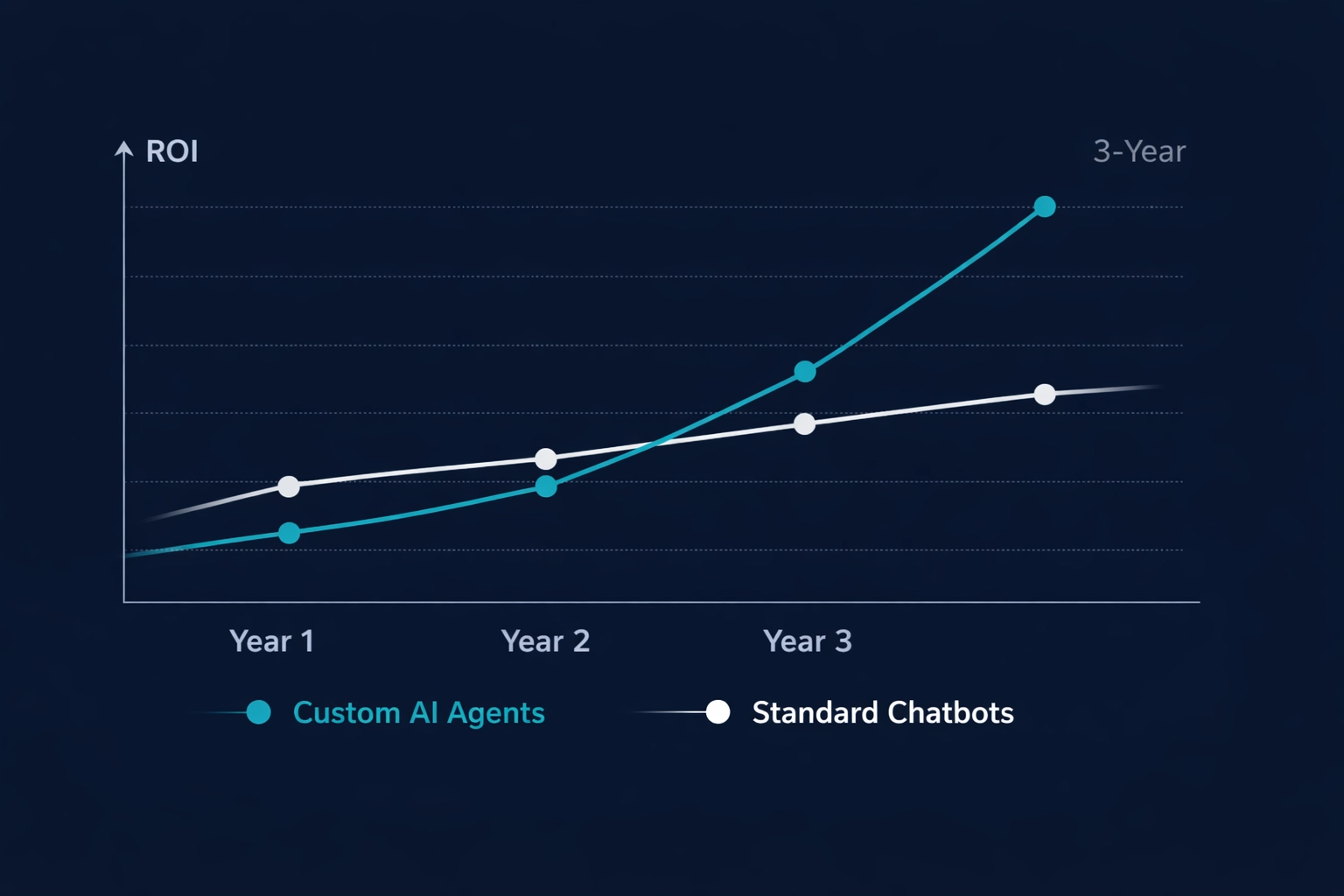
| Long-term ROI | Often flattens quickly | Improves as usage, automation, and integrations expand |
| Strategic value | Limited and easy to replicate | Stronger competitive advantage built around proprietary workflows |
A generic bot may be cheaper on day one, but the hidden costs can pile up fast:
- Manual workarounds: Teams still copy, paste, chase approvals, and fix broken process gaps.
- Poor performance: If the bot cannot access the right systems or understand the workflow, staff end up doing the work anyway.
- Seat-based licensing creep: Pricing can rise as more users, teams, or features get added. Funny how that happens.
- Low adoption: People ignore tools that are clunky, generic, or unhelpful, which turns “cost-saving software” into shelfware with branding.
By contrast, custom AI agent development costs more upfront because it tackles the actual job. For a board, that is a much easier budget story to defend: spend more to remove recurring inefficiency, not to create a shinier version of it.
Key Cost Drivers
The cost of a bespoke AI agent programme depends on how ambitious the solution needs to be. There is no single flat number, because a lightweight internal support agent is very different from a multi-system autonomous workflow engine.
The biggest cost drivers usually include:
- System integrations: The more platforms the agent needs to connect with, the more engineering work is involved.
- CRM platforms for customer context
- ERP systems for operations and finance
- Internal tools, ticketing systems, and legacy databases
- Workflow complexity: Simple Q&A is cheaper than multi-step decision automation.
- Approval chains
- Escalation logic
- Role-based permissions
- Multi-agent orchestration
- Data grounding quality: The agent is only as useful as the data behind it.
- Cleaning documents and records
- Structuring knowledge sources
- Applying permissions and access rules
- Maintaining fresh, trusted retrieval pipelines
- Governance and compliance needs: Regulated industries need stronger controls.
- Audit logs
- Human-in-the-loop checkpoints
- Security reviews
- Policy enforcement
If you are explaining budget internally, the practical framing is this: cost rises with complexity, but so does value. The goal is not to build the biggest agent imaginable. The goal is to build the right one first.
Operational Running Costs
Once the agent is live, there are ongoing running costs, but these are usually far more scalable than adding headcount for every new process bottleneck.
Operational costs typically include:
- API and token usage: Costs vary based on how often the agent is used, how much data it processes, and how complex each interaction is.
- Maintenance and monitoring: Workflows need tuning, integrations need checking, and governance rules need occasional updates.
- Enhancements over time: As teams adopt the system, businesses often add new workflows, data sources, or departmental use cases.
The good news is that these costs generally scale with usage. If the agent is doing more useful work, the spend is tied to actual business activity rather than dead software weight sitting untouched in a dashboard no one opens after month two.
Problem: Cheap-looking AI tools often create expensive hidden inefficiencies later.
Solution: Invest in a bespoke system that is engineered for ROI, not just for a lower line item on a procurement form.
The Chimpare Edge
This is where the delivery partner matters. Working with Chimpare gives UK enterprises a more predictable, engineering-led route into custom AI agent development. Rather than trying to boil the ocean on day one, the focus is on identifying high-impact use cases first, shaping the right architecture, and delivering measurable value quickly.
That means:
- Predictable budgeting: Clear scoping around use cases, integrations, and rollout stages.
- Engineering-led delivery: Practical build decisions grounded in business outcomes, not AI theatre.
- Fast ROI focus: Start with the workflows most likely to reduce cost, speed up work, or improve service.
- Scalable expansion: Prove value in one area, then extend to other teams and processes with confidence.
For managers justifying budget to the board, that is the key message: this is not spend for the sake of innovation theatre. It is a strategic investment in operational efficiency, service quality, and scalable competitive advantage. Or, put more casually, it is the difference between paying once to modernise properly and paying forever for clunky workarounds.
Common Mistakes UK Enterprises Make with AI Agents
Even strong businesses can trip over the same avoidable mistakes when rolling out AI initiatives.
- Starting with technology instead of the problem: Fancy models do not rescue weak use cases.
- Define the workflow pain first
- Set measurable success criteria
- Build around business value
- Ignoring data quality: Poor grounding creates poor outcomes.
- Clean knowledge sources
- Review permissions
- Remove stale content
- Skipping governance: Fast deployment without controls is not innovation; it is risk with better branding.
- Add audit trails
- Set approval thresholds
- Define escalation logic
- Trying to automate everything at once: Start narrow, then scale.
- Pilot one workflow
- Validate results
- Expand incrementally
- Underestimating integration complexity: The shiny front end is the easy bit.
- Map systems early
- Involve technical stakeholders
- Plan around legacy software realities
Problem: Enterprises often chase AI hype and end up with disconnected tools, weak adoption, and very expensive disappointment.
Solution: Focus on grounded use cases, secure integration, iterative rollout, and measurable business outcomes.
Conclusion
UK enterprises are no longer asking whether AI belongs in the business. They are asking whether generic tools are enough, and the answer is increasingly obvious: not if you want a real competitive edge.
Custom AI agent development gives organisations a more modern route to automation, personalization, and operational scale. It turns AI from a generic interface into a structured, dynamic, business-specific capability. For developers, that means building systems that do more than chat. For business owners, it means creating measurable value from internal data and workflows. For hiring managers, it means adding scalable support without relying only on recruitment to solve every bottleneck.
The shift is already happening across UK manufacturing, logistics, healthcare, and finance. The question is not whether bespoke agents are relevant. The question is whether your business wants to lead, follow, or spend another year watching competitors automate the work you are still doing manually.
Now is the time to move from experiments to architecture. If your organisation is ready to explore custom AI agents built around real workflows, real systems, and real outcomes, Chimpare can help design and develop the right solution.
FAQ
What is custom AI agent development?
Custom AI agent development is the process of designing, building, integrating, and improving AI agents tailored to a business’s specific workflows, systems, and goals. Unlike off-the-shelf bots, these agents are grounded in company data and can often take action across connected platforms.
How are custom AI agents different from chatbots?
Chatbots typically follow predefined scripts and mainly provide information. Custom AI agents can use context, retrieve live knowledge, call APIs, update systems, and support multi-step workflows with more dynamic decision-making.
Can custom AI agents integrate with legacy systems?
Yes. With the right middleware, APIs, adapters, and security controls, custom AI agents can integrate with CRMs, ERPs, internal databases, document repositories, and older line-of-business tools often used by UK enterprises.
Which industries benefit most from bespoke AI agents?
Manufacturing, logistics, healthcare, finance, retail, and professional services are strong candidates, especially where there are repeatable workflows, fragmented systems, high admin volume, or a need for personalized service.
How should a UK enterprise start with AI agents?
Start with one high-value use case. Define the workflow problem, identify the required data and systems, build a controlled pilot, measure results, and then scale gradually once the business case is proven.