Category: Web Application Development

  • How Is AI in Web Technology Redefining the Future of the Web?

    How Is AI in Web Technology Redefining the Future of the Web?

    How Is AI in Web Technology Redefining the Future of the Web
    [ez-toc]

    AI is the main tool of contemporary online interactions, which has been transformed in a way that is much faster than anticipated. These AI features, such as product recommendations while purchasing, the chatbot that welcomes you on a customer service page, or the manner in which a site is automatically adjusting to your usage, make the digital world not only easier but also more user-friendly and personalised.  

    Multiple industry surveys have reported that 70% of businesses now use AI in web technology to improve their websites. This shows just how quickly this technology has become part of everyday web development. 

    For web technology teams, the shift is more noticeable. They used to work on tasks that took hours, like testing, bug fixing, or analysing user behaviour. This can now be automated or assisted with AI tools. This allows web development companies to build features faster while keeping user experience at the centre.  

    Businesses planning an MVP net development project or estimating website redesigning prices are deliberating AI features because they have an instant impact on performance, engagement, and long-time period scalability. 

    Along with the excitement, AI brings a brand-new set of responsibilities. Developers ought to consider records safety, transparency, and the extent of management delegated to automated tactics. As AI becomes completely integrated into web development services, the ultimate intention will be to locate the proper balance among the usage of AI to better the web at the same time while keeping the human contact that adds fee to virtual interactions. 

    Slow loading websites and poor user engagement can drive visitors away.

    Empower sites with AI optimization.


    Book Your Free App Consultation

    What Does AI in Web Technology Mean?

    AI in the website era includes using intelligent systems to make websites smarter, quicker, and greater useful to customers. Rather than depending without a doubt on manual coding or set guidelines, AI allows websites to analyse from person to person, adapt in real-time, and create more customised experiences.  

    In practice, this will vary from automated chat assistance to smarter seek bars, predictive analytics, stepped forward security, and even AI-driven design guidelines to assist builders assemble higher interfaces. 

    To put it simply, AI functions as an extra brain that websites may utilise. It observes patterns, studies how visitors interact with sites, and then allows developers to adjust without starting from scratch. This has become especially important as businesses compare web developer costs, plan MVP web development, or consider the website redesign cost for upcoming projects.  

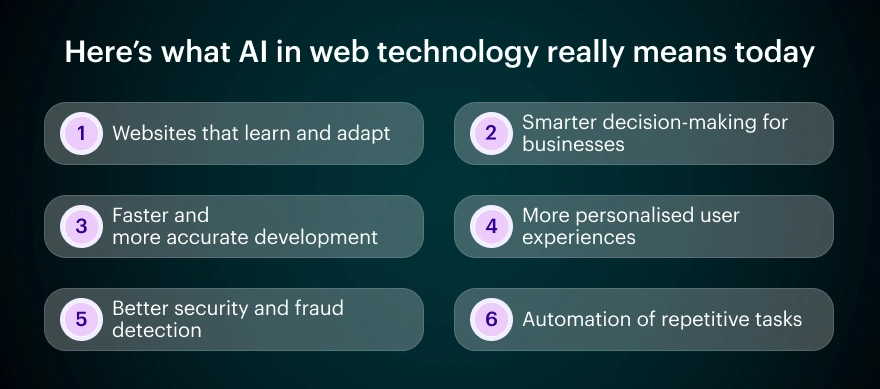
    Here’s what AI in web technology really means today: 
    Here’s what AI in web technology really means today

    Websites that learn and adapt: 

    AI ‍looks at the way users navigate, click, search, and engage and customise layouts, content, and points accordingly to meet their individual needs.

    Smarter decision-making for businesses: 

    AI-powered analytics opens the users’ behaviour to view. Firms are implementing AI-powered analytics to direct web-related decisions, thus changing their digital strategy into a data-driven approach.

    Faster and more accurate development: 

    Developers might avail of AI tools to automatically locate their mistakes, give the code a neat look, and test the features. Thus, the time for development is halved, and the reliability of the online applications is enhanced.

    More personalised user experiences: 

    AI is responsible for making websites less generic and more relevant to you through a wide range of ways, starting from product suggestions to personalised landing pages.

    Better security and fraud detection: 

    By far, the AI technology can recognise unusual activities or security issues quickly than conventional methods, thus giving businesses the chance to businesses to better protect their data and customers.

    Automation of repetitive tasks: 

    AI takes away the need for engineers to manually test each feature and analyse every data set, by which teams are given the freedom to concentrate on strategy and ‍innovation.

    What Key Web Technologies are Being Influenced by AI?
    What Key Web Technologies are Being Influenced by AI_

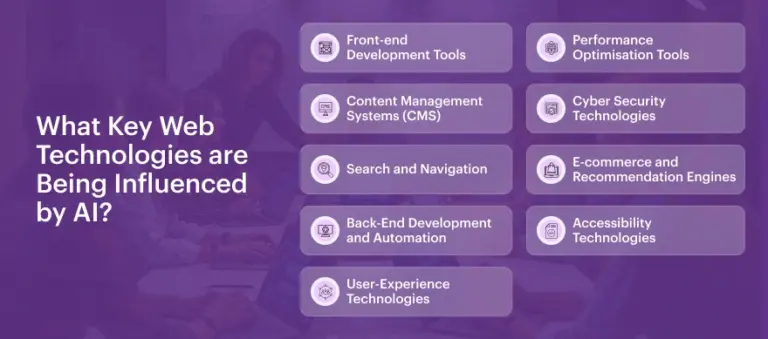
    AI ‍is becoming less of a separate thing and more of a core component for almost every aspect of the web. AI-powered solutions are revolutionising basic web technology, such as user interaction and site loading. These are the few industries which are frequently mentioned, as those where AI has a major influence. 

    1. Front-end Development Tools: 

    AI is speeding up how developers build interfaces and layouts. This means faster MVP web development and cheaper web developer charges for businesses looking to launch quickly.  

    • AI-assisted code generation: Development time can be reduced by up to 55% with GitHub Copilot and other alternatives. 
    • Automated UI creation: AI can convert wireframes, sketches, and written prompts into useful code.  
    • Smarter debugging: AI techniques quickly identify damaged components, accessibility problems, and inconsistent user interfaces.

    2. Content Management Systems (CMS): 

    Contemporary CMS platforms are employing AI to free by automation of daily tasks. This is very efficient in the situation of a website restructuring when a large volume of content needs to be refreshed. 

    • Smart content recommendations by user behaviour, and thus engagement rates are getting better by 30-40% on average. 
    • Automated SEO suggestions that help websites rank better. 
    • AI content auditing, checking tone, readability, and duplicate content Humanzie ai text before publishing.

    3. Search and Navigation: 

    Search functions are becoming more conversational and accurate. This enhances website usability without dramatically increasing web development service costs. 

    • AI-powered semantic seek is familiar with consumer intent as opposed to simply terms. 
    • Voice seek optimisation is vital considering the fact that it’s expected that by means of 2026, speech-based queries will make up half of all searches. 
    • Personalised navigation that adjusts suggestions and menus based on user options. 


    4. Back-End Development and Automation: 

    AI is helping developers build smarter, more stable systems. These improvements help web development companies deliver more reliable and secure platforms. 

    • Predictive analytics help servers scale automatically during high traffic. 
    • Regression bugs can be cut by up to 75% using AI-driven testing. 
    • Vulnerabilities are identified by automated security scanning before they become actual risks.

    5. User-Experience Technologies: 

    AI is enhancing how people experience websites. This kind of personalisation is now expected, not optional. 

    • Content blocks that are tailored according to browser history, location, or behaviour.
    • AI-driven A/B testing that predicts the best version without carrying out extensive testing.
    • With round-the-clock support, intelligent chatbots can increase customer satisfaction by up to 60%.


    6. Performance Optimisation Tools: 

    AI plays a major role in keeping websites fast and smooth. This directly reduces bounce rates and improves conversions.

    • AI predicts which pages visitors will open next with predictive caching. 
    • Smart picture optimisation can lower an image’s size by up to 40% while maintaining its quality. 
    • Dynamic content delivery optimises website load speeds across several devices.
       

    7. Cybersecurity Technologies: 

    As threats increase, AI is essential for protection. For businesses comparing website redesign cost options, AI-enabled security is now a must-have.

    • AI-based anomaly detection spots unusual user activity instantly. 
    • Automated threat response, blocking attacks in real time. 
    • Bot management tools protect forms, payment gateways, and logins.

    8. E-commerce and Recommendation Engines

    AI drives many revenue-boosting features that online stores rely on. E-commerce websites are among the biggest beneficiaries of AI-driven web capabilities.

    • Product suggestion systems can boost sales by up to 35%. 
    • Dynamic pricing technologies alter prices based on demand and competitive trends. 
    • Smart inventory prediction reduces stockouts and waste.

    9. Accessibility Technologies

    AI is helping make the web more inclusive. This is especially useful for companies that want to follow global accessibility standards without huge additional development costs.

    • Automatic alt-text generation for images. 
    • AI-powered screen readers that interpret context more precisely. 
    • Real-time captioning of audio and video information.

    Why AI is Important in Front-End & Back-End Development?

    AI is the engine behind the drastic change of the internet infrastructure in general. From the very visible to the users and to the barely noticed by them, backend systems, AI is not taking over the role of developers; instead, it is accelerating, enhancing, and deepening their output. 

    Here’s why AI has become such a big deal in both front-end and back-end development.

    Faster Front-End Development Without Compromising Quality

    Creating similar components, fixing UI alignment issues, and making sure websites are responsive on all devices are just some of the repetitive activities that front-end developers put a lot of work into.  

    With AI, this labour is greatly reduced. AI expedites and improves front-give up paintings at a fair price for businesses that want to save money on web development or meet deadlines. 


    • AI-assisted code pointers make it less complicated to write down clear, bug-free HTML, CSS, and JavaScript. 


    • MVP web development can be accelerated by converting hand-drawn mockups or text prompts into functional interfaces using layout-generating technology. 


    • Automated user interface testing expedites the process of testing a page’s behaviour across many browsers and screen sizes, which often takes hours. 

    Smarter and More Efficient Back-end Systems

    On the back end, AI plays an even bigger role because this is where automation and intelligence truly shine. This not only makes websites more reliable, but it also reduces the long-term maintenance and backend troubleshooting expenses for any web construction business. 

    • Websites can automatically handle traffic increase through predictive server scaling, making sure reliability even in the event of sudden peaks. 


    • AI-powered tracking systems song performance, discover problems before they get worse, and regularly remedy them robotically. 


    • Smart security structures use machine gaining knowledge of to locate unusual styles, inclusive of suspicious logins or bot attacks, much quicker than humans. 

    What Role Does AI Play in Creating Personalised Web Experiences?
    What Role Does AI Play in Creating Personalised Web Experiences_-1

    Perhaps the single largest reason why AI has become an indispensable part of the tech stack for the web of the future is its capacity to generate personalise interactions in a very human-like manner, instead of being mechanical or impersonal. Users nowadays demand that websites “comprehend” their requirements, be it by suggesting the right products, delivering the most suitable content, or simply by making the interface ‍intuitive. 

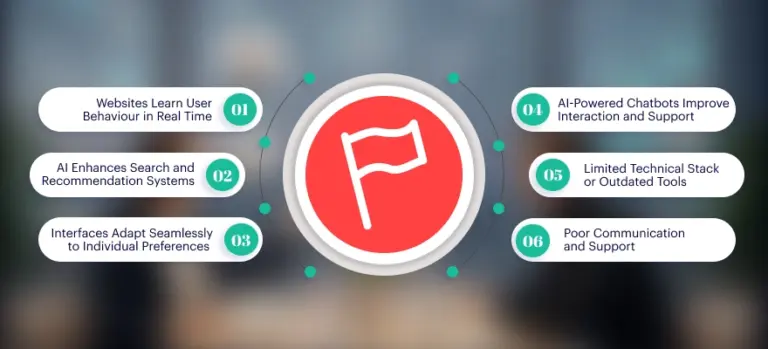
    1. Websites Learn User Behaviour in Real Time

    AI lets websites stumble upon and examine consumer interactions as they occur. It tracks which pages users visit, how long they remain, where they go away from, and which gadgets they use. This behavioural awareness permits you to provide extra applicable content material, make centred product pointers, and customise the layout to fulfil person preferences.   

    These upgrades not only increase engagement but additionally assist organisations in enhancing their digital presence without requiring a full redevelopment or incurring excessive website redecorate expenses. 

    2. AI Enhances Search and Recommendation Systems

    Search bars and product pointers have evolved well past easy keyword matching. Natural Language Processing strategies allow websites to better understand and reply to conversational queries.

    AI-powered advice structures also analyse browser records, purchasing habits, and similar consumer profiles to propose relevant products or articles. These talents are critical in MVP web development, as companies require immediate wins and features that drive user retention.

    3. Interfaces Adapt Seamlessly to Individual Preferences

    AI personalisation extends beyond content and includes the interface itself. Modern websites can also now mechanically reply to user alternatives, consisting as activating dark mode in low-light conditions or converting to a lightweight layout when the internet connection is poor.  

    They can also adjust text length and spacing for accessibility, making the enjoy more cushty for human beings with special desires. These adaptive interfaces give compelling motives for corporations to apply clever web development services, since they directly improve usability and pleasure. 

    4. AI-Powered Chatbots Improve Interaction and Support

    AI chatbots outperform traditional textual technology. They use natural language processing and machine learning to assess user requests, conduct discussions and provide accurate answers in real time.

    AI assistants help users find suitable products, navigate the website and solve persistent challenges, helping them meet their needs efficiently. Businesses benefit from reduced support workload and better customer experience, all of which are compelling reasons to include chatbot capabilities in any modern web development service.

    5. Predictive Insights Help Improve the Website Continuously

    AI does more than merely tailor experiences; it also gives you clean insights into why consumers behave in one-of-a-kind ways. Predictive analytics systems identify styles such as where users depart, which pages receive the maximum attention, and which features require development.  

    These insights empower corporations to make better decisions, optimise client experiences, and boost conversion rates. For any organisation centred on long-term scalability, these AI-driven insights extensively enhance the effectiveness and reliability of destination net improvement offerings planning. 

    6. AI Brings Personalisation and Performance Together

    One of the biggest challenges with heavy personalisation in the past was the impact on performance, slow loading times, heavy scripts, and laggy interactions. AI has changed this completely. 

    It ‍optimises images, manages caching intelligently, and distributes resources in a very efficient way, which allows personalised content to be loaded quickly and without interruption. Such a combination of speed and relevance is exactly the experience that modern customers expect, thus organisations are assured to get a real return on their digital transformation expenditures. 

    Visitors abandon slow, generic websites.

    Personalize speed with AI tools.


    Talk to Our Experts Now

    How Do AI Tools Improve Coding, Testing & Deployment?

    They decide on pages that take into account their choices, display relevant clothing, and offer trustworthy navigation. According to current industry surveys, more than 70% of online consumers decide upon websites with tailored hints, and corporations that utilise AI-powered customisation experience a 20-25% growth in engagement. 


    1. AI Helps Developers Write Better Code Faster? 

    Modern AI coding assistants perceive trends, provide pointers, and generate code snippets to help developers avoid repetitive tasks. They can hit upon unproductive exercises, suggest extra green options, and forecast the next line of code based on context.   

    This notably reduces improvement time and web developer fees for projects that require a brief turnaround, consisting of MVP web development or touchdown web page building. 


    2. Automated Testing Spots Bugs Before They Reach Users 

    Testing was at a point in time considered the slowest part of the web development branch. With the help of AI-powered testing tools, the process is now much quicker as these tools review codebases, simulate user behaviour and locate issues even before the release. 

    Within a short period of time, they can detect broken links, user interface inconsistencies, performance bottlenecks, and device compatibility concerns. As a result, websites are ensured to be running smoothly across different browsers and platforms, hence there is a decrease in adjustments that take place after the launch and costs relating to website redesign that occur in a longer period. 


    3. AI Speeds Up Deployment with Predictive Automation 

    AI-powered deployment systems can analyse past releases and detect patterns in errors, performance drops, or traffic spikes. This enables groups to use predictive deployment, wherein the gadget robotically recommends the most secure time to distribute new updates and shows areas that may require monitoring.  

    For companies that rely on web development services, this reduces downtime and guarantees that customers enjoy minimal disruptions even throughout huge characteristic rollouts. 


    4. Smarter Debugging and Real-Time Issue Resolution 

    Rather than manually going through millions of lines of code, AI debugging tools are the ones that locate the areas where faults occur, and additionally, they give suggestions on how to solve them. These tools can identify situations where the logic is flawed, API calls are incorrect and scripts that consume a lot of memory, thereby causing the website to slow down. 

    This makes troubleshooting much faster and helps developers maintain high-quality standards without delaying product timelines.


    5. Continuous Optimisation for Future Updates 

    AI doesn’t stop working after deployment. Many modern tools continuously monitor websites to analyse performance indicators, user journeys, and traffic patterns. They provide insight into which areas of the site require modification or where performance can be improved. 

    Such a feature is extremely valuable for companies which are considering the option of expanding their business in the long run, as it will be less costly and upgrading the web development service features will be easier with ‍ ‌‍ ‍time.

    What Challenges Should Teams Expect When Integrating AI?

    Using AI for web development is certainly fascinating, but there are still many obstacles to be overcome. The most talented teams also face issues; some of these are technical, and others are related to strategy or simply handling people’s ‍expectations. The following are the most typical challenges that businesses and development teams should be prepared for. 


    Data Quality Issues Slow Down AI Accuracy 

    AI tools depend closely on exceptionally tagged information. If the statistics are inadequate, old or inconsistent, AI fashions will produce misguided predictions or complex automation. For organisations operating with an internet development provider, this means spending more time cleaning and establishing information before the AI layer can characteristic properly. 


    Integrating AI With Old Systems Is Harder Than It Looks 

    Many businesses still operate on legacy systems that don’t “talk” well with modern AI frameworks. Connecting AI APIs, cloud-based models, or automation tools with outdated architectures often requires custom middleware and, therefore, additional development time and higher web developer costs. This compatibility challenge is one of the biggest blockers for organisations adopting AI-powered MVP web development.


    Talent Shortage & Skill Gaps Slow Down Implementation 

    AI is changing rapidly; however, there are only a few developers who have deep knowledge of machine learning, automation workflows, and model optimisation. As a result, companies may face difficulties in locating a suitable team or deciding to take the risk of a technically complex project led by a trusted web development company.  


    AI Models Require Continuous Maintenance, Not “Launch and Forget” 

    AI models require regular retraining, software updates, and performance checks. Such a continuous operation increases the expenses of the enterprise, notably in projects that take a long time. The teams are very much inclined to underestimate the time and money that need to be spent on the maintenance of these systems.  


    Higher Security Risks Due to Sensitive Data Exposure 

    As ‍AI tools handle a massive amount of user data, a single point of vulnerability can result in significant security breaches. Therefore, departments are obliged to carry out tight data governance, utilise encryption, and ensure privacy compliance to the highest standard if they decide to work with web development ‍services.

    What Are Some Strong Examples of AI-Powered Websites?

    AI is not a potential future factor that may influence the web. It is the core of the most advanced digital user experiences that we have at our disposal every day.  

    Customisation and automation being two of the main advantages, big brands (some of which are located in the UK) are using AI to develop websites which are not only quicker but also more intelligent and user-friendly. There is a plethora of impressive cases which demonstrate the extent to which AI is silently taking control behind the ‍curtain.   

    1.  ASOS

    ASOS, ‍a major UK online fashion retailer, is dependent on artificial intelligence to figure out consumer browsing habits, popular looks, and last purchases. Using this data, the platform is able to present the products that actually match a customer’s style rather than just throwing a bunch of random things at them. 

    • ASOS uses computer vision to recommend similar outfits. 
    • Their AI-driven search engine reportedly improves product discovery by 18–25%, especially on mobile. 
    • Personalised recommendations contribute significantly to customer retention. 

    2. Tesco

    Tesco’s website and app use AI to suggest weekly essentials before customers even type anything. Their system tracks buying patterns and uses machine learning to predict recurring purchases.

    • AI-driven recommendations reduce browsing time by over 30%, according to several e-commerce studies. 
    • Their website also uses AI for delivery slot optimisation, ensuring faster fulfilment. 

    3. BBC

    The BBC uses AI algorithms to personalise articles, documentaries, and entertainment based on each user’s viewing and reading history. They show how AI can help large content-heavy platforms maintain relevance without hiring massive editorial teams, something extremely valuable for businesses focusing on MVP web development.

    • Their AI recommendation engine reportedly boosted user engagement by around 20%. 
    • Natural language processing (NLP) helps analyse huge volumes of content and tag it automatically. 

    4. Ocado 

    Ocado is widely recognised for having one of the most advanced online grocery systems in the UK. This blend of AI in both the website and operations shows how powerful integrated AI-driven web development services can be.

    • Their website uses AI to auto-sort items, suggest replacements, and help customers complete their carts faster. 
    • The backend uses AI + robotics, making Ocado’s fulfilment accuracy one of the best in Europe. 
    • They claim a 99% order accuracy rate, supported by AI-powered systems. 

    5.  Boots UK

    Boots have brought in AI-powered instruments to enhance product search to be more efficient and to provide visitors with easy access to the right health-related content. Their AI-powered search assistants recognise misspellings, user intention, and frequently asked questions to deliver the most relevant ‍results. This is an excellent instance of how AI can be used for UX enhancement without the need for a substantial increase in web developer expenses.

    • More than 60% of users rely on search, so AI helps reduce drop-offs. 
    • Their “advice and guides” sections use AI to cluster related content, making navigatio simpler.


    Outdated websites fail modern users.

    Automate updates with intelligent AI.


    Start Your Project Today

    Conclusion

    AI is not merely adjusting web technology; it is changing the entire digital world in a very different way. AI-driven websites are performing better and becoming more user friendly with less human intervention through features like advanced recommendations, automated coding, and super-fast ‍testing.  

    With studies showing that AI-powered experiences can boost user engagement, it’s no surprise that businesses are rethinking how the approach web development services and MVP web development. 

    As we move forward, the goal isn’t to replace human creativity but to amplify it. So whether you’re teaming up with a web development company or weighing your website redesign cost, AI is becoming the secret ingredient that helps websites stay ahead of the curve, proving that in the future of the web, humans and machines really can go hand in hand.

    FAQs


    How much time does it take to build a website?


    Most websites take anywhere from 4 to 12 weeks, depending on the design, features, and complexity. A basic site is quicker to build, while custom or large-scale projects may take longer due to testing and revisions.


    Website development usually goes through these stages: planning, design, development, testing, and launch. Some teams also include maintenance as an ongoing phase to keep the website secure and up to date.


    The essentials include a domain name, web hosting, and the website’s design and code. You’ll also need clear content, a responsive layout, and the right tech stack (like HTML, CSS, JavaScript, or frameworks), depending on your project.

    Found this post insightful? Don’t forget to share it with your network!


    Related Articles

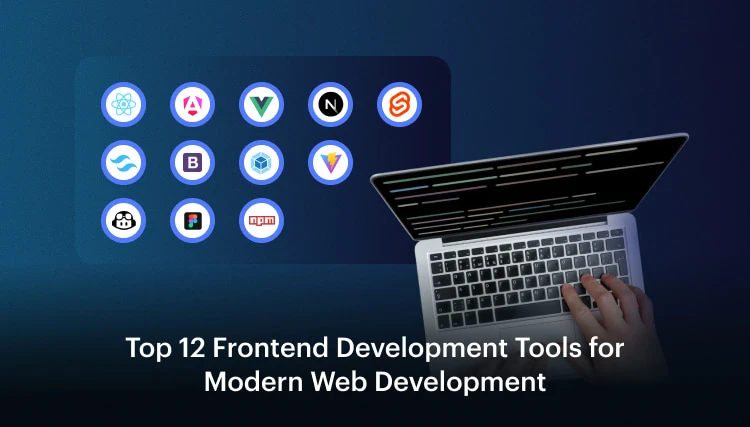
  • Top 12 Frontend Development Tools for Modern Web Development 

    Top 12 Frontend Development Tools for Modern Web Development 

    Top 12 Frontend Development Tools for Modern Web Development
    [ez-toc]

    Frontend development tools are at the centre of the rapid evolution of the web development industry. With the use of these tools, developers may produce interactive, user-friendly websites and applications. 

    Choosing the right tools can make all the difference in producing an outstanding user experience, whether you want to work for a front-end development company, hire a front-end developer, or offer front-end development services. 

    From powerful code editors and JavaScript frameworks to CSS preprocessors and testing tools, the frontend environment is always evolving. This article will cover the top 15 frontend development technologies that will alter web development in 2025 and help developers create faster, smarter, and more compelling digital experiences. 

    Slow, outdated UI tools limit your web app’s potential.

    Empower performance with modern tools.


    Book Your Free App Consultation

    What are Frontend Development Tools?

    Frontend development tools are at the centre of the rapid evolution of the web development industry. These tools allow builders to create interactive, consumer-friendly programs and webpages. Whether you need to paint for a front-end improvement organisation, hire a front-end developer, or provide front-end improvement offerings, deciding on the right tools could make all the difference in growing a wonderful user enjoy. 

    According to current research, over 75% of consumers rely on their perception of a business enterprise’s legitimacy on its website design, and 94% of first impressions are impacted by using a website’s visual appeal and responsiveness. Frontend developers need to apply the newest era if they want to live ahead of the curve. 

    Why are Frontend Tools Important in Modern Web Development?

    Customers want websites and apps to load quickly and perform on all devices. In this case, front-end development tools are useful. Using these tools, developers can design, test, and improve the objects that users see and interact with, such as buttons, animations, forms, and site layouts. Without them, it will take more time and effort to offer a smooth experience. 

    Modern internet apps rely upon HTML, CSS, JavaScript, frameworks, and development tools to carry out nicely. A frontend developer can use Webpack, Vite, or React. Developer Tools to swiftly package content, speed up website load times, and improve group collaboration. These technologies also support automation, which makes it less complicated to control repetitive responsibilities like photo optimisation, CSS prefixing, and code formatting. 

    Adopting the appropriate device set is essential for any frontend development employer. It will increase productivity but also ensure regular, satisfactory results throughout diverse initiatives. Businesses that use expert frontend development services gain a competitive benefit by reducing time to market, improving UI performance, and growing scalability. If you want to hire a frontend developer, you are searching for someone conversant with present-day equipment. 

    In short, frontend development tools make developer duties easier while increasing user experience. They contribute to the translation of creative design concepts into responsive, engaging, and high-performance digital solutions, such as websites and apps that consumers enjoy revisiting. 

    Which are the Most Popular Frontend Tools in 2025?

    The frontend industry is constantly changing, and it has introduced several favourites that developers use daily. Frontend development tools are now the foundation of contemporary web projects as websites grow faster, smarter, and more interactive.  

    These tools have a significant impact on how seamless and effective the finished result feels, regardless of whether someone works for a front-end development business or wants to employ one. 

    1. React.js 

    React JS

    Facebook developed the JavaScript language React.js specifically to create fast and dynamic user interfaces for single-page apps. Large programs use component architecture, which makes them easier to create and maintain. 

    • Speciality: React apps load quickly, scale easily, and maintain stability even as features expand. Virtual DOM allows for faster rendering, reusable components, and substantial community support.
    • Release Date: 2013
    • Key Features: 
    • One-way data binding. 
    • Strong ecosystem (Redux, Next.js, React Router). 
    • Huge library and community support. 
    • Backed by Meta. 
    • Huge Community Support. 
    • Ideal for dynamic, modern web apps.

    2. Angular 

    Angular

    TypeScript is the foundation of Google’s Angular front-end framework. It is ideal for enterprise-level applications that need structured development procedures. Google maintains Angular, a complete front-end framework. Angular guarantees constant performance across huge apps and minimises repetitive coding. 

    • Speciality: Two-way data binding and a full MVC (Model-View-Controller) framework. Strong architecture, type-scripted-based, great for enterprise projects.
    • Release Date: 2016 (Angular 2+)
    • Key Features: 
    • Dependency Injection 
    • Built-in routing 
    • Great for large and complex apps 
    • Built-in routing 
    • Two-way data binding 
    • Suitable for large-scale apps

    3. Vue.js 

    Vue.js

    Vue.js is a progressive JavaScript framework that combines the best aspects of Angular and React and is incredibly adaptable and simple to use. It is best for building flexible and lightweight user interfaces. It’s simple, elegant, and powerful and great for both startups and mid-sized applications. Angular reduces repetitive code and ensures consistent performance across large applications. 

    • Speciality: Lightweight, beginner-friendly, and perfect for fast UI development. Simple learning curve with powerful reactivity. 
    • Release Date: 2014 
    • Key Features: 
    • React data binding 
    • Component-based architecture 
    • Smooth integration with existing projects 
    • Lightweight bundle size 
    • Easy to integrate with existing projects 
    • Ideal for beginners


    4. Svelte 

    Svelte

    The best UI framework for developing quick applications is Svelte, which compiles code at construct time. Even on low-end gadgets, it gives brilliant overall performance. Svelte shifts this workload to the development phase, in comparison to frameworks like React or Vue, which manage the majority of the work inside the browser. 

    • Speciality: No virtual DOM direct compilation for better performance. It compiles your code into highly optimised JavaScript at build time. Svelte apps load faster and have less overhead, making them one of the most effective frontend development tools available today.
    • Release Date: 2016
    • Key Features: 
    • Lightweight bundle sizes 
    • Easy Syntax 
    • Blazing fast runtime 
    • SvelteKit for routing and server-side rendering. 
    • Compiler-based approach  


    5.Next.js 

    Next.js

    Next.js is a React-based framework that enables server-side rendering and static website generation, allowing you to build modern, SEO-friendly web applications. It combines server-side generation (SSR), static site generation (SSG), and client-side rendering (CSR), giving developers full control over how their apps load and perform. It is ideal for production-grade projects that require SEO, performance and scalability. 

    • Speciality: Hybrid rendering (SSR + SSG), making apps faster, more secure, and Google-friendly for improved speed and SEO.
    • Release Date: 2016  
    • Key Features: 
    • API routes 
    • Image Optimization 
    • Built-in routing 
    • File-based routing 
    • Edge and serverless support 

    6.Tailwind CSS 

    Tailwind CSS

    Tailwind is a utility-first CSS framework that facilitates UI design by providing ready-to-use classes. It accelerates UI development without requiring a certain design style. Instead of writing long custom CSS, developers use small utility classes to build clean, responsive interfaces. It’s trendy, lightweight, and perfect for visually polished web apps. Developers can build beautiful UIs quickly without leaving the HTML file. 

    • Speciality: Helps create custom designs without writing traditional CSS. Gives total design freedom through utility classes.
    • Release Date: 2017
    • Key Features: 
    • Highly Customizable 
    • Mobile-first utilities 
    • Fast prototyping 
    • Mobile-first styling 
    • Tremendous design consistency 
    • Popular among modern UI designers

     7.Bootstrap 

    bootstrap

    Bootstrap is one of the oldest and most trusted CSS frameworks for creating responsive and mobile-friendly websites. It is created by Twitter for building mobile-first sites. It is perfect for rapid prototyping and consistent UI design. 

    • Speciality: It has ready-made UI components that include navbars, grids, and modals. It’s pre-built components and ready-made design blocks.
    • Release Date: 2011
    • Key Features: 
    • Large component library 
    • Easy grid layout system 
    • Great documentation 
    • Great for rapid prototyping 
    • Massive community

    8. Webpack 

    Webpack

    Webpack is a mobile bundler that effectively bundles all of your files, CSS, and JavaScript for the browser. Managing numerous files by hand gets challenging as programs get larger. Webpack solves this problem by automating everything in the background.  

    • Speciality: Optimises application speed with bundling and code-splitting. Extensively utilised in enterprise applications and very flexible.
    • Release Date: 2012
    • Key Features: 
    • Loaders and plugins 
    • Tree shaking for smaller bundles 
    • Hot module replacement 
    • Cod splitting 
    • Advanced optimisation options 

    9. Vite 

    Vite

    Vite is a next-gen frontend build tool that offers lightning-fast development using native ES modules. It offers instant server starts and lightning-fast HMR (Hot Module Replacement). Traditional bundlers like Webpack need to compile your entire project before running, but Vite works differently. This makes development extremely fast, especially for large projects. 

    • Speciality: Instant server startup and extremely fast HMR. Blazing fast development environment.
    • Release Date: 2020
    • Key Features: 
    • Modern build pipeline 
    • Optimized production builds 
    • Works with Vue, React, Svelte, etc. 
    • Native ES modules 
    • Faster builds than Webpack 


    10. GitHub Pilot 

    GitHub Pilot

    GitHub Copilot is an AI pair-programmer that speeds up code writing and eliminates tedious work for front-end developers. An AI-assisted coding tool called Copilot helps speed up developers’ code writing. 

    • Speciality: Code completions, suggestions and error detection. Improves productivity by up to 55%, according to GitHub’s 2024 report.
    • Release Date: 2021
    • Key Features: 
    • Supports all major frontend languages 
    • Works in VS Code 
    • Smart code recommendations 
    • Saves time in repetitive tasks 
    • Improves productivity 

    11. Figma 

    Figma

    Figma is a collaborative cloud-based UI/UX design tool used by designers and developers to create website and app interfaces. It removes communication gaps between designers and developers. Unlike older design tools that require heavy software installations, Figma works directly in the browser, making it accessible from any device. 

    • Speciality: Real-time collaboration, cloud-based workflows and easy design handoff.
    • Release Date: 2016
    • Key Features:  
    • Component libraries 
    • Prototyping 
    • Developer mode 
    • Ideal for teams 
    • Easy developer handoff 
    • Used by major design and development companies 

    12.NPM (Node Package Manager) 

    NPM (Node Package Manager)

    NPM is the default package manager for Node.js and the largest software registry in the world. It provides access to millions of open-source JavaScript libraries. Whether you’re installing frameworks or tools, NPM makes managing project dependencies quick, organised, and effortless. 


    • Speciality: Helps install, manage, and update frontend libraries and tools. It lies in its massive ecosystem and strong dependency.  


    • Release Date: 2010 


    • Key Features: 
    • Millions of libraries 
    • Easy dependency management 
    • Excellent package scripts 
    • Built-in script runner for automating tasks 
    • Strong integration with frontend tools 

    Inefficient tools slow your workflow.

    Boost productivity with advanced tools.


    Talk to Our Experts Now

    What Makes a Good Frontend Tool?

    Selecting the programming language or framework is selecting the correct frontend development tool. Developers depend on technology that increases productivity and maintains amazing code as modern-day websites end up quicker and aesthetically pleasing. Instead of making the development technique greater difficult, an amazing frontend tool has to make it less difficult. 

    Here are some key factors that define a high-quality frontend tool today: 

     1. Speed and Performance

    A good tool should help a frontend developer work faster, not slow them down. In fact, according to recent DevTech reports, over 68% of developers prefer tools that reduce build time by at least 30%. Fast bundling, quick updates, and smooth debugging directly impact how efficiently a project grows.

    2.Ease of Use

    Whether you’re a scholar getting to know HTML or an experienced the front-cease developer growing agency-level applications, the tool needs to be easy to use. It is less complicated to use because it has easy documentation, a clean interface, and requires minimal setup. This is also why many companies prefer to hire frontend devs who are familiar with solutions that enable simple onboarding. 

     3. Strong Community and Ecosystem

    The first-rate frontend improvement gear has large, lively groups that keep them up to date and free of bugs. Tools including React, Vue, and Tailwind CSS are great examples; they evolve faster due to the fact that hundreds of builders make contributions, ideas, plugins, and bug fixes. A wholesome atmosphere additionally assures long-term aid, which is something that each front-end development commercial enterprise strives for. 

     4. Scalability and Flexibility

    As websites expand with new features, your tools must handle larger codebases without breaking performance. A scalable tool allows you to manage components, state, routing, and assets easily. This is especially important for companies offering frontend development services that handle enterprise clients. 

    5.Compatibility With Modern Standards

    A good tool should assist with the latest JavaScript functions, responsive design recommendations, and browser compatibility. Tools that engage seamlessly with frameworks, APIs, CI/CD pipelines, and design systems grow developer productivity whilst lowering lengthy-time period maintenance troubles. 

    Which Code Editors are Best for Frontend Developers?

    When it comes to frontend development tools, a good code editor can significantly boost your productivity. It affects how quickly you can write code, how easy it is to detect problems, and how comfortable you are when designing user interfaces. 


    The code editors that front-end developers now use and prefer are shown in this brief comparison chart.

    Code Editor 

    Best For 

    Key Features 

    Why Developers Love It 

    Visual Studio Code (VS Code) 

    Beginners to advanced frontend developers 

    IntelliSense, Extensions Marketplace, Debugger, Git Integration 

    Fast, customizable, and lightweight. It supports almost every frontend framework and is highly recommended by most front-end development companies. 

    Sublime Text 

    Developers who want speed and simplicity 

    Lightning-fast editing, Multiple cursors, Package Control 

    Very fast performance, low memory usage, and perfect for quick edits or large files. 

    Atom 

    Collaborative coding and customisation 

    Built-in GitHub integration, Themes & packages, Smart autocomplete 

    Great for team environments and easy to customise using HTML, CSS, and JavaScript. 

    WebStorm 

    Professional frontend development services & enterprise projects 

    Advanced refactoring, Framework support (React, Vue, Angular), Built-in tools 

    A premium editor with powerful features ideal for companies and teams handling large codebases. 

    Brackets 

    Students, beginners, and designers 

    Live Preview, Inline editing, Preprocessor support 

    Very user-friendly and perfect for front-end developers who work closely with designers. 

    What are the Common Mistakes Developers Make With Front-End Tools?

    Modern frontend development technologies make it easier to create websites, but developers, especially novices, regularly make some common errors that prevent their productivity or have a destructive impact on them personally.

    These errors are effortlessly avoidable with the proper know-how and a little effort. According to the latest surveys performed via several frontend development organisations, incorrect device usage accounts for more than 60% of front-end problems instead of the tools themselves.

    Here are some of the most common mistakes developers make:

    1. Using Too Many Tools at Once

    One of the biggest mistakes is installing multiple tools “just because they are popular.” The project is heavy and complex due to the numerous libraries, frameworks, and extensions. Only tools that genuinely address problems should be used by frontend developers; they shouldn’t add more.

    2. Ignoring Tool Configuration

    Tools like Webpack, Vite, ESLint, and Babel work best when configured correctly. Instead of going through the setup process, many novices rely on default parameters, which can result in performance problems, sluggish builds, or superfluous code in production.

    3. Not Updating Tools Regularly

    The majority of frontend development services use cutting-edge, contemporary tools. Compatibility issues and security vulnerabilities may arise from using out-of-date versions of frameworks, editors, or packages.

    4. Choosing Tools Without Understanding Them

    Developers sometimes pick tools just because a tutorial recommended them. It becomes challenging to resolve problems or scale the project later if you don’t grasp how the technology operates. A front-end developer should review the documentation, use cases, and long-term support of any product before utilising it.

    5. Overlooking Performance & Bundle Size

    Although frontend technologies aid in the creation of attractive user interfaces, improper usage of them can result in enormous bundles that cause a website to lag. Many novices neglect to use features like tree-shaking, optimise pictures, and eliminate unnecessary code.

    How to Choose the Right Frontend Tools For Your Project?

    With new frameworks, libraries, and construction equipment being released every few months, it might be hard to pick the best frontend improvement equipment. The key is to concentrate on what your project genuinely desires, as opposed to deciding on tools simply because they are famous.  


    Therefore, knowing the undertaking’s size, complexity, and long-term goals ought to usually be the first step in making a decision, irrespective of your level of experience as a the front-give up developer. 


    The next thing to consider is the talent stage of your group. If your crew is snug with React, for instance, choosing Angular may also sluggish down development. A precise rule followed by many front-end development groups is: pick tools that enhance productivity, not challenge your learning curve unnecessarily.  


    You also have to consider performance, community support, security updates, and the way scalable the tool is, particularly in case your website or app will grow over the years. 


    Understand project requirements 

    Select libraries and frameworks that are appropriate for the goal of your project: Different toolkits are needed for web apps, dashboards, landing pages, and e-commerce. 


    Check out the community support and documentation 

    Tools with strong communities make debugging and learning much easier. 


    Consider long-term scalability 

    If the project grows, use tools known for stability and flexibility. This is why companies often use front-end developers with experience in scalable frameworks. 


    Evaluate performance requirements 

    Lightweight frameworks and effective build tools are necessary for apps that load quickly. Performance is crucial because even a one-second delay can lower conversions by up to 7%. 


    Look at the skills and experience of the team 

    A tool that your staff can use efficiently is the best. This shortens the development cycle, saves time, and lowers errors, all of which are crucial for businesses that offer front-end development services. 

    Outdated interfaces put you behind competitors.

    Harness innovation for frontend success.


    Start Your Project Today

    Conclusion

    Frontend improvement gear at the moment is the cornerstone of contemporary internet improvement, allowing builders to produce websites which might be quicker, extra fluid, and extra aesthetically stunning. The advent of powerful construct equipment like Webpack and Vite, collectively with frameworks like React, Vue, and Svelte, has made the development process notably more efficient.  

    Particularly for massive groups operating in an expert setting, those technologies foster collaboration, streamline tedious chores, enhance code quality, and increase productivity. The environment gives tools that streamline each step of improvement, from writing code to testing and deployment, whether or not you’re a student analysing frontend development or an agency looking to lease frontend engineers. 

    FAQs


    What are frontend development tools, and why are they important?


    Frontend development tools are software and frameworks that help developers build the visual and interactive parts of a website or app. They speed up development, improve code quality, and ensure faster, more user-friendly experiences for end users. 


    Some of the most widely used frontend tools include React, Vue.js, Angular, Vite, Webpack, Tailwind CSS, Bootstrap, and GitHub. These tools help developers build modern, scalable, and high-performing web applications. 


    For large-scale enterprise apps, React, Angular, and Vue.js are top choices because they offer strong architecture, long-term support, large communities, and excellent performance. They also integrate easily with backend systems and enterprise-grade tools. 

    Found this post insightful? Don’t forget to share it with your network!


    Related Articles

  • 8 Top Single-Page Application Frameworks for Web App Development

    8 Top Single-Page Application Frameworks for Web App Development

    8 Top Single-Page Application Frameworks for Web App Development-1
    [ez-toc]

    A few very big names, like Gmail, Netflix and Twitter, have features that load so quickly and feel almost like using a native mobile app, even though they run entirely in your browser. This is a Single-Page application (SPA) for web apps.  

    SPAs are becoming the preferred method for creating modern web apps since users demand quick interactions and seamless navigation. SPA gives you a speedier experience by dynamically updating only the portion that changes, rather than reloading the full webpage each time you click on something. 

    According to a reputed statistics website, Statista, the global web app development market is projected to exceed $600 billion by 2030. A major share of this growth is driven by single-page application frameworks like React, Angular, and Vue.js.  

    These frameworks are currently being used by businesses and web app development firms to produce apps that are responsive, lightweight, and function well on all devices. 

    We’ll look at 8 of the best single-page application frameworks for creating web apps in this blog. Therefore, this article will help you understand which framework best fits your aims and why SPAs are here to stay if you’re a developer, a tech enthusiast, or a business owner looking to employ a web app development company

    Complex web projects often face slow load times 

    Build smarter with powerful SPA frameworks


    Book Your Free App Consultation

    What is a Single-Page Application (SPAs)?

    When a web application functions as smoothly and quickly as a mobile utility, doesn’t continually refresh, doesn’t require you to wait for new pages to load, and instantaneously changes its content when you click, it’s referred to as a single-page application. 

    An SPA is a type of web software that masses a single HTML page and dynamically alters its content in response to user input.  The SPA makes the experience quicker and smoother with the aid of simply obtaining the applicable information from the server instead of reloading the entire website on every occasion you click on something. 

    Gmail, Google Maps, Netflix, Trello, and Vue.js are some well-known examples of applications constructed with SPA frameworks along with React, Angular, or Vue.js. By permitting net developers to create apps that behave like native mobile apps, those frameworks enhance user enjoy and overall performance. 

    Why Are SPAs So Popular Today?

    Websites that load slowly are undesirable to modern users. A website that takes longer than three seconds to load will be abandoned by 53% of users, according to research. SPAs successfully solve this issue and provide a near-native browser experience by loading content just once and instantly refreshing it. 

    For this reason, top web app development firms and startups are using SPA frameworks to create apps that not only look fantastic but also function flawlessly. 

    The Power Behind SPAs

    A Single-Page Application Framework helps developers build apps that are: 

    • Faster: With each interaction, only the content that is required loads.  
    • Interactive: Users feel more connected when there are dynamic transitions.  
    • Efficient: Enhances performance and lowers server load.  
    • Scalable: Easier to update and maintain as your company expands. 

    How Does a Single-Page Application Work?

    An SPA loads everything as soon as, after which it modifies the data in the heritage the usage of JavaScript and APIs, instead of loading a brand new page each time a person clicks on something. This gives the influence which you are the use of legitimate software, even when you are the usage of an internet browser. 

    A SPA framework is designed to handle all user interactions within a single web page. Here’s the way it works step-by-step: 

    Initial Page Load: 

    A single HTML file, CSS, JavaScript, and other resources are downloaded by the browser when a user first views the application. Everything happens rather quickly after this initial load, which might take a little longer. 

    Dynamic Updates Using JavaScript: 

    The SPA does not retrieve complete pages from the server after it is loaded. Rather, it uses APIs or AJAX queries to interface with the server in order to obtain only the necessary information rather than the entire HTML. 

    Client-Side Rendering: 

    That data is rendered dynamically on the client side by the SPA framework. Client-side rendering is the procedure that gives SPAs their quick and fluid performance. 

    Routing Without Reloading: 

    When you go between regions, the URL could change, but because SPAs use client-side routing, the page does not reload. Frameworks like Angular Router and React Router manage this routing. 

    APIs Keep the Data Fresh: 

    Small amounts of data are continuously sent between SPAs and the backend via GraphQL or RESTful APIs. This enables the app to show updated content instantly, much like when a new remark or tweet appears without requiring a page refresh. 

    A Simple Example: 

    Suppose you start Netflix. The program does not open a new page when you click on a video. Rather, it uses its SPA framework to swiftly alter the view after retrieving the movie’s data (title, description, thumbnail, etc.) from the server. These days, creating web applications is beautiful since everything appears to be swift, smart, and connected. 

    What are the Benefits of Using the SPA Framework?

    Every time they click on a website, nobody wants to have to wait for it to load again. Because of this, SPAs are now the foundation of contemporary online application development. 

    Like mobile apps, an SPA framework such as React, Angular, or Vue.js enables developers to construct online applications that are faster, more interactive, and easier to use. But let’s dissect it and see why SPAs are so well-liked by users and web app development firms these days.

    1. Lightning-Fast Performance

    The rapidity of SPAs is one of its main advantages. Users enjoy quicker navigation and less waiting time because the app just loads once and then simply retrieves fresh data rather than refreshing full pages. 

    Websites that load in less than two seconds have 50% higher engagement rates than slower ones, according to Google’s Web Performance Report. By utilising client-side rendering, where the majority of processing takes place in the browser rather than on the server, SPA frameworks enable developers to do this. 

    Because no one clicks away from a quick and responsive app, businesses will benefit from increased user engagement and conversions.

    2. Seamless User Experience

    Have you ever noticed how Twitter, Trello, and Netflix apps are? This is due to the fact that they employ SPA frameworks to dynamically alter content without necessitating a complete page reload.  

    SPAs provide customers with a smooth experience that is almost exactly like using a native app because of their quick animations, data updates, and transitions. This brings huge benefits for contemporary users who quickly navigate between tabs, displays, and gadgets.

    3. Simplified Development and Maintenance

    Development is made easier and more organised by using an SPA framework. Developers can work on the frontend and backend independently since they are not closely related. Reusable components are commonly used by SPAs, which reduces code problems and saves time. Debugging and updates are easier because the logic and structure stay consistent across the app. 

    This makes SPAs especially beneficial for web app development companies that handle multiple projects simultaneously. Faster development cycles mean faster product launches, something every business wants. 

    4. Better Caching and Offline Functionality

    Modern SPAs hire service personnel to store data locally. This implies that a consumer can still utilise a number of the program’s functionality after downloading it, even in the absence of a live net connection.  

    Think about the use of Gmail or Google Docs offline, then syncing and editing when you’re again online. This is a significant advantage for companies that provide internet app development services because it promotes accessibility and consumer engagement in spite of slow internet connections.

    5. Reduced Server Load and Cost Efficiency

    This suggests that even without an energetic internet connection, a consumer can nevertheless make use of a number of this system’s capabilities after downloading it. Consider the usage of Google Docs or Gmail offline, then synchronising and editing while you’re back online.  

    This is a huge benefit for agencies that offer net app development services because it promotes accessibility and user participation in spite of slow net connections. SPAs manage increasing user traffic more effectively without placing additional strain on the backend.

    6.Mobile-Friendly and Scalable

    By 2025, mobile devices will account for more than 58% of all internet traffic worldwide. Because SPAs are responsive, adaptable, and made to function effectively on all screen sizes, they are perfect for a world that prioritises mobile. Scaling programs as organisations expand is also made simple by SPA frameworks. Without having to completely rebuild the application, developers may simply integrate APIs and add new features.

    7. Easier Integration with Modern Tools

    Popular tools and technologies that are helpful for complex or data-driven applications, such as RESTful APIs, GraphQL, and microservices, are compatible with SPAs. Because of its flexibility, the SPA framework is perfect for web application development frameworks that need data collecting, regular updates, or service integration.

    8.User Engagement and SEO Improvements

    SPAs can rank higher in search results because to server-side rendering provided by modern SPA frameworks like Next.js and Nuxt.js. SPAs are a popular option for companies looking to draw in and retain customers since they integrate performance, engagement, and SEO optimisation. 

    Which are the Top 8 SPA Frameworks in 2025?

    The web app development market has grown significantly in recent years, and 2025 will be no exception. Organisations and developers can find more innovative, scalable, and effective solutions with the aid of SPA frameworks. Everyone uses SPA frameworks to create lightweight, interactive, and high-performing programs from startups to major companies. 

    Let’s examine the top eight frameworks for single-page applications that will influence web development in 2025.

    1.React.js

    React JS

    With proper motivation, Meta’s React.js will continue to dominate the SPA landscape in 2025. It is fast, flexible, and supported by way of a huge community. React makes app experiences fairly fast with the aid of the use of a digital DOM that best updates what is necessary.  

    Because of its issue-based structure, builders might also efficaciously reuse code, which speeds up improvement. Leaders inside the industry like Netflix, Airbnb, and Instagram use it significantly, and it’s excellent for corporations seeking out scalable net app improvement services and dynamic person interfaces. 

    Best for: Large-scale, interactive web apps and startups needing speed and flexibility.

    2. Angular

    Angular

    Google created Angular, one of the most potent Application Frameworks for Web App Development. It is a full framework that consists of everything from shape validation to kingdom control and routing, as compared to React, which is handiest a library. 

    The usage of TypeScript with the aid of Angular is a big gain for company-degree programs as it allows for cleaner, more mistake-free code. Web app development companies that build complicated, information-driven applications like dashboards, CRMs, and e-commerce structures will continue to apply Angular. 

    Best for: Large enterprise applications needing structured architecture and long-term maintenance.

    3.Vue.js

    Vue.js

    Due to its versatility and ease of use, Vue.js has made a strong name for itself in the SPA market. It combines exceptional elements from Angular and React to offer ease of use and overall performance. Its two-way statistical binding and reactive additions are suitable for building lightweight and fast SPAs.  

    Vue’s rapid learning curve and compatibility with current systems are praised by developers. There is a vibrant open-source community, and it is becoming increasingly popular in Asian and European markets.  

    Ideal for: Startups or small to medium-sized projects seeking scalability, speed, and simplicity.

    4. Svelte 

    Svelte

    Svelte is one of the maximum famous frameworks in recent years, typically called the “next generation” SPA framework. Unlike standard frameworks, which run code in the browser, Svelte moves most of the painting to assembly time. Better runtime performance and smaller program sizes are achieved in this manner, leading to lightning-fast speeds and simple interactions. 

    Svelte is one of the best frameworks to consider in 2025, with developer interest growing by more than 25% annually. 

    Ideal for: Developers seeking simpler, faster, lighter, and more effective apps.

    5.Ember.js

    Ember.js

    Even though Ember.js has been around for a while, it’s still a fantastic option for challenging and large-scale web work. Ember is well-known for its “convention over configuration” approach, which includes a robust command-line interface, integrated routing, and ready-to-use mission structures. This ensures consistency across big groups while also cutting down on improvement time. 

    Popular apps like LinkedIn and Apple Music have used Ember for years, proving its reliability in enterprise environments. 

    Best for: Complex, long-term web applications needing strong structure and scalability. 

    6.Backbone.js

    Backbone.js

    Backbone.js supplied the muse for many early SPAs earlier than current frameworks took hold, and it remains relevant these days. It offers developers a light-weight and adaptable shape based on the Model-View-Presenter paradigm.  

    While it does not include as many integrated functionalities as contemporary frameworks, it is easy to modify and combine with other libraries. Backbone continues to be a basic and effective choice for internet app improvement organisations that are seeking complete architectural management. 

    Best for: Simple SPAs or legacy projects needing a lightweight solution.

    7.Next.js

    Next.js

    Nuxt.js symbolises Vue.js if Next.js represents React. Nuxt makes Vue apps more powerful and effective by adding server-side rendering, smart routing, and static site generation. 

    For developers who enjoy Vue but want improved SEO, scalability, and caching support, it’s ideal. With continuous updates through 2025, Nuxt has established itself as a tool for web app development services that value speed and efficiency. 

    Ideal for: Companies seeking the advantages of SPAs with quicker load times and SEO optimisation.

    8. Nuxt.js

    Nuxt.js

    If Next.js symbolises React, Nuxt.js represents Vue.js. Nuxt enhances Vue apps with server-side rendering, automatic routing, and static website online generation, growing their energy and performance. 

    It’s best for developers who experience Vue but need improved SEO, scalability, and caching assistance. With chronic enhancements through 2025, Nuxt has positioned itself as a go-to answer for web app development services that prioritise pace and performance. 

    Best for: Developers using Vue.js who need SEO-friendly and high-performance SPAs. 

    Outdated frameworks limit your app’s reach and responsiveness.

    Empower growth with modern SPA technologies.


    Talk to Our Experts Now

    What are the Common Challenges in the SPA Framework?

    Although creating an SPA with quick performance, fluid navigation, and app-like experiences sounds exciting, it’s not always easy. SPAs, like any other technology, provide unique development obstacles that developers and web app development businesses must solve to provide a pleasant and safe user experience. 

    Let’s take a closer look at the common challenges in SPA development that matter most in 2025, along with practical ways to address them. 

    1. SEO Limitations

    One of the most vital concerns for each unmarried-page utility platform is search engine optimisation. Because SPAs usually load content via JavaScript, conventional seek engine crawlers regularly struggle to index them properly. While frameworks like Next.js and Nuxt.js have protected Server-Side Rendering to enhance search engine optimisation visibility, no longer do all SPAs.  

     2. Performance Optimisation

    SPAs are designed for speed, but their initial load time can sometimes be slow. Because before rendering anything on the screen, the browser must download the full JavaScript package, HTML, and CSS. The beginning of the application may be delayed by a high initial payload, particularly on mobile networks or older devices. 

     3. Security Risks

    SPAs may be susceptible to security risks like Cross-Site Scripting, Cross-Site Request Forgery, or unauthorised API access if they are not adequately secured because of their substantial reliance on APIs for data retrieval. When web app development businesses create apps that handle sensitive data, like banking or healthcare data, data protection becomes even more crucial. 

     4. Browser Compatibility

    Apps may act differently on different platforms because each browser reads JavaScript differently. Users with obsolete systems may experience problems since some JavaScript capabilities and contemporary APIs may not be supported by older browsers. 

     5. State Management

    Managing and coordinating the shared state data between SPA components may be difficult. When several components depend on the same data, inadequate state handling could lead to problems and inconsistent data. To solve this problem and maintain data consistency throughout the application, developers commonly employ state management frameworks like Redux, Pinia, or MobX. 

     6. Memory Leaks and Performance Bottlenecks

    Memory leaks can occur when SPAs remain open for extended periods of time, particularly when developing enterprise web apps. These leaks occur when unnecessary data or event listeners are not cleared from memory, gradually slowing down performance. 

     7. Poor Offline Support

    Most SPAs do not operate offline by default, in contrast to Progressive Web Apps. When the internet connection drops, users could become agitated, particularly in areas where mobile devices are the primary mode of mobility. 

     8. Scalability and Code Maintenance

    As SPAs expand, managing their architecture becomes more difficult. Long-term program maintenance may be difficult if developers working on the same codebase have different coding styles. TypeScript, component-based programming, and modular architecture can all help make code more understandable and scalable. 

    How to Choose the Right SPA Framework For Your Project?

    Selecting the precise SPA framework determines the energy, velocity, and scalability of your online application, just like choosing the suitable basis for your best domestic. As organisations transition to seamless virtual reports in 2025, the need for a framework is critical to performance and fulfilment. 

    So, how do you pick the best one for your project? 

    1. Define Your Project Goals

    Recognise your needs first. A framework is essential for performance and fulfilment as businesses move to seamless virtual reports in 2025. 

    • Startups can benefit greatly from using React.js or Vue.js. 
    • Angular is suitable for large-scale, feature-rich applications.


    2. Consider Ease of Learning

    The skill levels of each team vary. While React provides a versatile environment, Vue.js is easier to utilise for novices. If your workforce is comfortable with JavaScript, Next.js can help speed up development. 

     3. Focus on Speed and Performance

    Users anticipate that apps will load in less than three seconds. With reduced bundle sizes, frameworks like Svelte and React offer improved speed and faster rendering. 

     4. Check Community and Support

    Frameworks like Angular, React, and Vue, which provide additional learning resources, updates, and support, are supported by active communities. 

     5. Think About Scalability and Maintenance

    For rapidly growing apps, choose frameworks like Angular or Next.js that offer modular development and long-term scalability. 

     6. Don’t Ignore SEO and Security

    Server-side rendering is managed by frameworks like Next.js and Nuxt.js, which improve SEO visibility. Angular has strong built-in defences against typical online attacks. 

    Managing multiple pages hinders efficiency.

    Simplify workflows with SPA frameworks.


    Start Your Project Today

    Conclusion

    SPAs are leading the way inside the hastily evolving virtual global. Businesses can not have enough money to apply old websites because customers assume faster, more seamless, and app-like online experiences. The tempo and client interactions of your enterprise can be significantly impacted by using the single-web-page utility framework you choose. 

    At the end of the day, SPAs are more than genuinely a fashion; they represent the future of web app development. Whether you’re a startup developing your first product or an agency enhancing consumer experiences, employing the correct framework will help you continue to be ahead in a trendy, aggressive digital marketplace. 

    If you need to create an excessive-performance single-page utility, paintings with an experienced web app development business enterprise including Chimpare. Our team of workers assists you in choosing the high-quality Application Framework for Web App Development, making sure that your app works quickly, looks incredible, and presents a first-rate user experience. 

    FAQs


    What is a Single-Page Application (SPA)?


    A Single-Page Application (SPA) is a web app that loads a single HTML page and dynamically updates content as users interact, offering faster navigation and a seamless user experience. 


    Businesses choose SPAs because they deliver faster performance, smoother navigation, and better user engagement, making them ideal for modern, interactive web applications.


    The most popular SPA frameworks in 2025 include React.js, Angular, Vue.js, Svelte, Next.js, and Nuxt.js, known for their speed, scalability, and developer-friendly ecosystem. 

    Found this post insightful? Don’t forget to share it with your network!



    Related Articles

  • What Makes .NET Programming Languages Best for Modern Apps?

    What Makes .NET Programming Languages Best for Modern Apps?

    .NET-Programming-Languages
    [ez-toc]

    The demand for valuable applications has by no means decreased. Businesses are under pressure to provide brief, steady, and scalable digital solutions, ranging from banking apps that manage thousands of transactions each day to fitness trackers that sync with devices. The .NET programming languages stand out as one of the strongest selections for builders and organisations alike.

    According to Statista, the worldwide software program development market is expected to reach $1 trillion by 2030, and frameworks that assist cross-platform and cloud-ready packages. For companies making plans to scale, choosing the proper .NET development business or .NET development services partner can make the difference between a good app and an exquisite one.

    Originally developed by Microsoft, the .NET framework programming languages like C#, F#, and Visual Basic have developed into a powerful tool that meets the needs of contemporary app development.

    They provide everything from sturdy security and high overall performance to flexibility across structures, including web, mobile, desktop, IoT, or cloud-native application. For organisations making plans to scale, choosing the proper .NET development services partner can make the difference between a good app and an exquisite one.

    A real-life example of this performance is seen in Stack Overflow, running on .NET platforms and handling more than 100 million visitors each month. The reliability of the .NET framework ensures that high-traffic structures can continue to operate for users without interruption.

    With the rise of AI integration, cloud computing, and cross-platform development, the need for skilled teams in this technology is greater than ever. In the subsequent sections of this blog, we’ll discover why the .NET programming language continues to be the pleasant choice for constructing applications.

    Unlock Web Development Potential for Your Business Today

    From roadmap to execution, we’ll help you implement AI that drives measurable growth.


    Book Your Free App Consultation

    Why are .NET Programming Languages Popular for Modern Apps?

    Modern apps are supposed to be fast, scalable, secure, and go-platform. Businesses are turning to the validated era to meet these needs, consisting of cloud-local banking apps and AI-powered business platforms. Among them, .NET programming languages stand out as a top choice for developers and businesses looking to create future-ready solutions.

    Here’s why .NET continues to gain popularity in the modern app landscape:

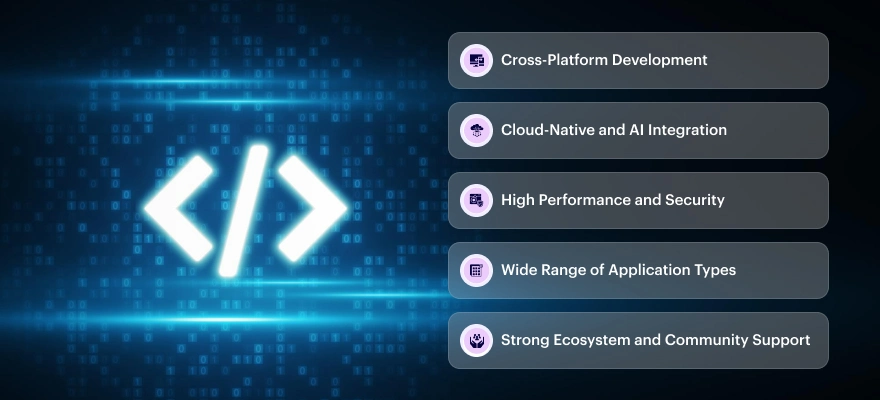
    Why-are-.NET-Programming-Languages-Popular-for-Modern-Apps

    1. Cross-Platform Development

    Since .NET Core has developed into the unified .NET framework, developers may additionally use .NET MAUI to create applications that function perfectly on Windows, Linux or macOS. This lowers the price and time to market for a .NET development business enterprise by making it less complicated to design apps with a single codebase.

    2. Cloud-Native and AI Integration

    As more companies in the UK shift to the cloud, .NET provides great support for serverless functionalities in Azure, microservices, and containerisation (Docker, Kubernetes). Additionally, it connects with .NET frameworks for AI and machine learning, allowing for scalable applications. Businesses can effectively implement these trends with the assistance of a UK’s DOT NET development company.

    3. High Performance and Security

    Modern apps want to deal with heavy visitors and sensitive data. Speed and protection are assured by means of .NET just-in-time compilation, sophisticated garbage collection, and incorporated security libraries. Because of the agency-level dependability that the platform offers, many organisations decide to rent .NET developers.

    4. Wide Range of Application Types

    From web and desktop applications to IoT devices and games, supports. Dot Net supports almost all matters. Why is this flexibility seen in industries from finance to health care?

    5. Strong Ecosystem and Community Support

    Backed by Microsoft and a worldwide developer network, .NET gets common updates, ensuring it stays aligned with current development practices. This guarantees long-term aid for organisations that put money into .NET development services.

    In essence, the cross-platform capabilities, cloud-ready, overall performance, and protection have made .NET development a trusted basis for modern apps.

    Which .NET Languages are Most Widely Used today?

    Though many programming languages are supported via the .NET environment, only a select few are most frequently used to develop current packages. While operating with a .NET development company or .NET developers, organisations can choose which of these programming languages to prioritise. Everything from organisation apps to cloud-based structures is made feasible by way of those languages.

    Here are the most used .NET languages today:

    1. C#

    C#​

    The most popular desire among builders globally is C#. As a result of its security, object-oriented structure, and flexibility. C# is used in the entirety from laptop programs to cloud-native microservices. Cross-platform abilities via .NET 6/7, and reference to Azure, it’s far the language of choice for most projects. C# is often the most famous preference for businesses in search of DOT NET development services or working with a .NET development company due to its scalability.

    2. Visual Basic .NET

    Visual-Basic-.NET

    Although C# is a commercial application, it is popular with companies that require an easy transition from outdated Visual Basic systems to the .NET framework programming language environment. Furthermore, VB.NET is widely recognised for being legible, which makes it simpler for teams with extraordinary skill levels to maintain old applications.

    3. F#

    F#​

    Within the .NET framework, F# is a functional-first language that builders run on problematic statistics technology, analytics, and AI-driven. F# is becoming increasingly more popular in fields that call for overall performance computing due to its capability to manipulate mathematical modelling and asynchronous programming. Businesses that need to apply AI, system monitoring, or financial modelling regularly work with a .NET software development company that specialises in F#.

    4. C++/CLI

    C++/CLI​

    C++/CLI serves as a bridge between traditional C++ and the .NET ecosystem. This language is frequently used while organisations want to integrate existing local C++ applications into modern .NET development environments. For industries wherein performance and legacy compatibility are crucial, running with a specialised .NET development offering ensures efficient transitions without compromising on.

    How Does .NET Support Cross-Platform App Development?

    Windows, Linux, macOS, iOS, and Android apps are all powered by the .NET programming language. Developers can develop and install the .NET Framework due to its ongoing evolution, which has led to its expansion into .NET Core and .NET 6/7/8.

    Here’s how .NET supports cross-platform app development:

    1. Unified Development with .NET Core and .NET 6/7

    Windows is not the best platform for .NET applications. Developers can utilise a single codebase to create apps that run on exclusive working structures with .NET Core and later versions of .NET. This makes it simpler for businesses to work with a .NET development company to create apps that are ready for the worldwide market by development time and expenses.

    2. Xamarin and .NET MAUI for Mobile Apps

    Xamarin, and its successor, .NET MAUI, allow developers to build native mobile apps for iOS and Android. Businesses can reach wider audiences without separate codebases for every platform. For companies partnering with a .NET development company, UK or international providers, this translates into faster delivery and reduced maintenance overhead.

    3. Cloud-Native and Microservices Ready

    Modern applications depend upon cloud-based architectures and microservices. With built-in support for Docker, Kubernetes, and Microsoft Azure, the .NET Framework is right for creating scalable, multi-platform applications. This makes it a top desire for businesses that depend on a .NET software program development.

    4. Consistent Performance Across Devices

    Whether it’s a desktop app, web portal, or mobile solution, .NET guarantees constant performance across systems. It’s just-in-time (JIT) compilation and ahead-of-time (AOT) compilation that assist in optimising apps for every tool. This is valuable for groups investing in .NET development services to deliver dependable applications.

    5. Strong Ecosystem and Tooling

    Developers gain from a strong environment that includes Visual Studio, Visual Studio Code, and GitHub integration. These technologies speed up and grow the efficiency of cross-platform services, allowing groups to hire .NET developers for complicated, multi-platform projects.

    Smarter Decisions. Faster Outcomes.

    Leverage expert web development consulting to cut costs, boost efficiency, and stay ahead of competitors.


    Talk to Our Experts Now

    How is .NET Driving Cloud-Native and AI-Powered Solutions?

    These abilities are being made viable by means of the .NET programming languages, which provide agencies the means to expand shrewd and future-ready apps. More than just clean operation is needed for current applications; they need to leverage the strength of the cloud, which includes AI and system learning.

    Here’s how .NET is driving innovation in cloud-native and AI-powered solutions:

    1. Seamless Cloud Integration

    The .NET Framework integrates natively with cloud platforms, in particular Microsoft Azure, allowing builders to deploy scalable and stable cloud programs. Organisations operating with .NET development business companies in the UK can build microservices, serverless applications, and containerised solutions that run successfully within the cloud.

    2. Support for AI and Machine Learning

    With libraries like ML.NET, .NET affords a sturdy environment for building AI-powered solutions immediately within familiar .NET development environments. This makes it less difficult for groups to enforce predictive analytics, recommendation engines, and intelligent automation without having separate tech stacks.

    3. Microservices and Containerization

    Contemporary .NET development services function microservices, which permit services to be modular and independently deployable. When paired with Docker and Kubernetes, cloud-local scalability, improved overall performance, and reduced downtime can be positive for organisations that intend for excessive reliability.

    4. Real-Time Data Processing

    AI-driven programs regularly require real-time data analysis. .NET programming languages like C# and F# guide asynchronous programming and reactive extensions, supporting builders to create responsive apps that can process huge volumes of data efficiently.

    5. Cross-Platform AI Solutions

    By leveraging .NET framework programming languages, developers can construct AI solutions that run throughout the internet, desktop, and mobile platforms. This guarantees that companies partnering with a .NET software program development employer can deliver regular consumer reviews, no matter the tool or running device.

    What’s the Difference Between .NET Framework and Modern .NET?

    As groups increasingly adopt the present-day era, experiencing the difference between the traditional .NET Framework and the modern-day .NET platform has emerged as crucial. While both enable utility development, they serve slightly different functions and aim at different types of initiatives.

    Feature 

    .NET Framework 

    Modern .NET (.NET 6/7/8) 

    Platform and Compatibility 

    Primarily Windows-based; used for desktop and legacy enterprise apps. 

    Cross-platform; supports Windows, Linux, macOS and cloud applications. Ideal for businesses working with a .NET development company in the UK. 

    Performance and Scalability 

    Stable and reliable but optimised mostly for traditional Windows environments. 

    High performance with just-in-time (JIT) compilation, better memory management, and for high-traffic apps, cloud-native services, and AI solutions. 

    Support and Updates 

    Limited updates; mainly security and maintenance for legacy systems. 

    Actively maintained with regular updates; aligned with the latest development trends. Preferred by enterprises that hire .NET developers for long-term growth. 

    Application Types 

    Desktop apps, internal enterprise solutions, legacy systems. 

    Web applications, mobile apps via .NET MAUI, cloud-native microservices, and AI-powered solutions using ML.NET.  

    Development Tools 

    Visual Studio support; compatible with multiple .NET framework programming languages. 

    Enhanced tooling, debugging, and integration with cloud services, enabling .NET development services to deliver complex applications efficiently. 

    Why Should UK Companies Hire .NET Developers?

    Hiring .NET developers makes strong business sense in 2025 and beyond. Here are key reasons why UK companies benefit from investing in .NET development services:

    1. Strong Demand, Limited Supply = Strategic Advantage

    The UK’s job market continues to show consistently high demand for .NET developer roles, especially at mid-to-senior levels. With many businesses modernising legacy structures, constructing cloud apps, and incorporating AI/ML talents, hiring skilled .NET builders offers companies a competitive benefit in handing over strong and maintainable solutions.

    2. Modern .NET Ecosystem & Frameworks

    The .NET Framework supports cross-platform development, performance optimisations, microservices/field architectures, and cloud-native deployments. A .NET software program development organisation can leverage this to create scalable, high-performance .NET APIs, enterprise applications, in addition to mobile and desktop clients using .NET language equipment like C#.

    3. Cloud Integration & DevOps Native

    UK agencies require programs which can be DOT NET development services that combine well with Microsoft Azure, which includes serverless services, containers, and managed offerings. .NET development teams generally adopt CI/CD pipelines, which reduces deployment hazards and speeds up time to market.

    4. Full-Stack & Cross-Discipline Capabilities

    A peculiar feature of the .NET programmer is their ability to work with an interface with Backend Framework, Front-end Technology, and handle database transactions. This demonstrates how a .NET development company can provide quick .NET development services by reducing code delivery, overhead, and coordinating labour.

    5. Cost-Effectiveness & Long-Term Maintainability

    It can be highly priced to hire .NET builders within the UK. The .NET code has a good architecture, modular design, automated testing, and APIs. Less rework, fewer defects, and simpler scaling over time are the outcomes of this. In the long term, it is more cost-effective for many UK companies to choose a .NET software development company.

    6. Trends: AI, Microservices & Low-Code Architectures

    Microservices, low-code architectures, AI/ML features, and hybrid low-code/no-code connectors are all popular trends in app improvement. Businesses are more geared up to develop scalable packages after they hire .NET developers with these abilities.

    7. Geographical Flexibility & Remote / Hybrid Working Models

    UK businesses, especially those in London, Manchester, Birmingham, Edinburgh, etc., increasingly embody far-off or hybrid working. Many .NET development corporations inside the UK offer remote teams or offshore models that preserve high-quality requirements and time zone collaboration. With the right approaches, hiring far-flung or dispersed .NET developers can help manage fees even as they turn in great work.

    Your AI Transformation Starts Here

    Get a custom plan built around your business goals—without the tech overwhelm.


    Start Your Project Today

    How Do You Choose the Right .NET Development Company UK?

    When it comes to .NET programming languages and modern app development, choosing the right partner makes all the difference. A company like Chimpare stands out as a trusted .NET development company in the UK because of:

    1. Proven Expertise in .NET Framework

    Chimpare ensures current solutions by utilising cross-platform tools like .NET MAUI, ASP.NET Core, and the recently released .NET framework programming languages.

    2. Cloud & Scalable Architecture

    From Azure integration to microservices and containerisation, Chimpare builds applications that scale seamlessly for UK enterprises.

    3. Security & Compliance First

    With GDPR-ready processes and secure coding practices, Chimpare delivers solutions that meet strict UK industry regulations.

    4. End-to-End .NET Development Services

    Whether web, mobile, or enterprise software, Chimpare provides full-cycle .NET development services from strategy to support.

    5. Local Presence with Global Reach

    Based in the UK but with global delivery capacity, Chimpare combines cultural alignment with the flexibility of a modern .NET software development company.

    What are the Future Trends That Shape .NET Development Services?

    As modern apps evolve, .NET programming languages and related .NET development services are also advancing fast. For companies wanting to hire .NET developers or partner with a DOT NET development company UK, these trends are defining what “best practice” looks like:

    1. Blazor + WebAssembly Full-Stack Growth

    Instead of using JavaScript frameworks, C# developers are increasingly embracing Blazor to create rich front-end applications. Blazor is turning into a more mature approach for full-stack .NET development because of upgrades in overall performance, tooling, and developer templates with current releases.

    2. Cross-Platform UI with .NET MAUI & Unified Frameworks

    The drive to reduce time-to-market and maintenance costs is pushing more .NET software development companies to build apps for multiple platforms from one codebase. The .NET MAUI is central here an also, the unified .NET model helps streamline .NET development services.

    3. AI/ML Integration & Intelligent Services

    The .NET growth rapidly increases intelligence through integration of ML.NET, Azure Cognitive Services or Onnx/TorchSharp model. The latest ML.net versions improve the support for deeper learning scenarios, and .NET developers make it easier to hire those who can build smart features.

    4. Cloud-Native, Microservices & Serverless Architecture

    Trends include serverless functions, containerization, microservices, and event-driven architectures. DOT NET development services providers are expected to offer these capabilities. This allows .NET development companies in the UK to deliver apps that scale with demand, perform under load, and are easier to maintain.

    Conclusion

    Modern apps want to be speedy, steady, and scalable to satisfy user wishes in addition to being well-designed. The .NET structure and programming languages really come into their own here.

    .NET has become a viable option for businesses worldwide due to its cross-platform compatibility and ability to interface with contemporary technologies such as cloud computing, AI, and the Internet of Things. The framework affords the needed control over digital demanding situations, including enterprise systems or web apps.

    To make the most of these advantages, working with the right .NET development employer is vital. A professional .NET software program development company in the UK can deliver dependable answers tailored to enterprise needs.

    For companies seeking to hire .NET builders, the generation’s constant enhancements ensure long-term value. Simply positioned, .NET remains one of the high-quality systems for building modern-day, future-prepared applications.

    FAQs


    1. Why do enterprises need custom software development?


    Enterprises need custom software development to address unique business needs, improve efficiency, and gain a competitive edge with solutions tailored specifically to their processes and goals.


    Examples include Enterprise Resource Planning (ERP), Customer Relationship Management (CRM), Supply Chain Management (SCM), Human Resource Management (HRM), and Business Intelligence (BI) tools.


    It offers scalability, automation, enhanced data security, seamless integration with existing systems, and long-term cost savings while supporting digital transformation.


    The timeline varies based on complexity, features, and customisation, but generally, enterprise software development takes between 4 to 12 months for a full-scale application.

    Found this post insightful? Don’t forget to share it with your network!


    Related Articles

  • What Do You Need to Know About Web App Development?

    What Do You Need to Know About Web App Development?

    Web-App-Development
    [ez-toc]

    More than 85% of online customers utilise the internet every day, making it an important aspect of contemporary digital studies. Unlike static websites, which are in the main used to expose records, a web utility is interactive, permitting customers to log in, edit information, behaviour transactions, and participate in real-time sports immediately from their browser. For developers and businesses alike, information in web app development is crucial. The internet app improvement manner goes beyond simply writing code; it involves making plans, selecting the proper frameworks, ensuring scalability, maintaining strong security, and providing a simple user experience. With the decision for fast, reliable, and character-friendly solutions, corporations are investing in expert internet app development services.

    Working with the proper web app development enterprise can streamline this adventure, presenting knowledge in frontend, backend, cloud integration, and testing. To reduce costs, shorten time-to-market, and create apps that can grow with their customer base, many businesses increasingly collaborate with specialized web app development firms.

    Everything you need to know will be covered in this guide, from comprehending the foundations of web applications to investigating the instruments, procedures, and tactics that create effective applications.

    Unlock Web Development Potential for Your Business Today

    From roadmap to execution, we’ll help you implement AI that drives measurable growth.


    Book Your Free App Consultation

    What is Web App Development?

    Web app development is the method of making packages that run in an internet browser and deliver interactive, dynamic functionality to users. Web applications, as opposed to traditional websites that only display static material, let customers to execute real-time tasks such as online purchase, statistics management, teamwork, and voice communication directly through the browser without the need to install software on their devices.

    The net app improvement approach entails a couple of stages, along with making plans, designing, coding, testing, deployment, and ongoing maintenance. Each diploma calls for careful interest in scalability, performance, and protection to make sure that the utility remains reliable and adaptable as business goals evolve.

    When groups accomplice with an expert web app development corporation, they gain access to specialised expertise in frameworks, backend structures, frontend technologies, and cloud integration. Experienced internet app development organisations additionally carry dependent workflows, confirmed methodologies, and best practices that lessen dangers and speed up time-to-market.

    Some key aspects that define modern-day internet app improvement services include:

    • Custom Architecture: Performance and scalability need play a chief function in deciding on the satisfactory frameworks (together with React, Angular, Node.js, and Django).
      The potential of a software program to paintings easily across devices and browsers is referred to as go-platform compatibility.
      The application of authentication, encryption, and authorisation processes is known as data security. 
    • User-Centric Design: Giving UI/UX top priority to create software that is practical and simple to use. 
    • Constant Improvement: Maintaining the app’s capability and ensuring users are properly knowledgeable.

    To put it briefly, internet app improvement isn’t simply about growing software programs; it is about developing flexible, reliable, and person-friendly digital solutions that help companies innovate, engage with clients, and preserve their competitiveness in the rapidly evolving virtual landscape of nowadays.

    What are the Core Components of Web App Development?

    A good web app development consists of several interrelated parts that come together to create a quick, reliable, and visually appealing digital experience. To build scalable and dependable programs, developers need to know about these layers.

    Whether you are running with a web app development company or managing responsibilities independently, you may be coping with the following primary blocks:

    1. Front-End Development

    Technologies Used:

    • HTML: Provides structure and content
    • CSS: Handles styling, colours, and layout
    • JavaScript: Adds interactivity and dynamic functionality
    • Frameworks & libraries: React, Angular, and Vue.js help to streamline the web app development process by offering reusable components and efficient state management.

    Key Focus areas: All-user accessibility, device responsiveness, and smooth interaction.

    2. Back-End Development

    The back-end powers the good judgment and capability of the web app. This is where records are processed, stored, and brought.

    Core tasks: Handling business logic, managing authentication, and processing user requests.

    Language & Frameworks

    • Python (Django, Flask): Great for rapid, scalable apps
    • Node.js (Express): Ideal for real-time, event-driven apps
    • Java (Spring): Enterprise-grade robustness
    • Ruby on Rails: Fast and developer-friendly
    • PHP (Laravel): Flexible for many small to mid-scale projects.

    3. Databases

    Types-of-Databases

    Databases act as the spine of every web utility. They store everything from user profiles to transaction records.

    Types of Databases:

    • SQL (PostgreSQL, MySQL): Structured, relational, great for complex queries.
    • NoSQL (MongoDB, Cassandra): Flexible, schema-less, suited for large-scale or real-time data.

    Best Practices: Use efficient database design, indexing, and caching to provide scalability and quick query responses.

    What are the Technologies and Tools in Web App Development?

    Building a modern-day internet utility involves more than without a doubt writing code; it’s also deciding on the proper equipment, frameworks, and processes to ensure performance, scalability, and maintainability.

    Knowing such technology is vital for net app builders as it without delay impacts how rapid, strong, and user-friendly the software is. Many net app development organisations depend on tested frameworks, languages, and offerings to deliver sturdy solutions to customers.

    1. Front-End Frameworks and Libraries

    The front end of an internet software determines its design and capability. Developers utilise frameworks and libraries to speed up development and bring normal, responsive client interfaces.

    • React: A component-based JavaScript library ideal for dynamic, single-page applications.
    • Angular: A full-fledged framework from Google, ideal for large-scale enterprise apps.
    • Vue.js: Lightweight and flexible, great for projects needing quick integration.

    Key considerations when choosing a tool:

    • Project size and complexity.
    • Developer skills on the team.
    • Community support and ecosystem maturation.

    2. Back-End Frameworks and Languages

    Back-end development handles information processing, server logic, and API introduction. The tools chosen here are used to determine the performance and scalability of the application.

    • Node.js (Express.js): Runs JavaScript on the server, ideal for real-time apps. 
    • Python (Django, Flask): Django is for large, structured projects and Flask is for lightweight apps. 
    • Ruby on Rails: Convention-over-configuration approach for rapid development. 
    • Java (Spring Boot): Enterprise-grade framework for high-performance solutions. 
    • PHP (Laravel): A versatile option used by many web app development companies.

    APIs are central to the process, allowing smooth communication between the patron-facet and server-side. REST and GraphQL are popular strategies for handling these facts in an alternative manner.

    3. Version Control Systems

    Version management is the foundation of collaborative development. It logs every change made to the codebase, allowing groups to collaborate without conflict.

    • Git: Industry standard for version control.
    • GitHub / GitLab: Platforms offering repository hosting, issue tracking, pull requests, and CI/CD integrations.

    Benefits:

    • Safer collaboration among teams.
    • Easier bug tracking and rollback to earlier versions.
    • Better project management and accountability.

    What is the Web App Development Lifecycle?

    The process of making a web utility is a scientific one that entails more than one distinct stage, ranging from theory to ongoing development. In order to guarantee that the software is scalable, strong, and smooth to apply, each step builds upon the one before it.

    Many web app development companies comply with this lifecycle to deliver expert effects through streamlined web app development services.

    1. Planning and Requirement Gathering

    This stage lays the foundation. Developers, stakeholders, and sometimes a web app development company collaborate to:

    • Define the purpose of the software and its enterprise desires.
    • Identify the audience and their needs.
    • List essential features and technical requirements.
    • Conduct market studies and competitor analysis to identify opportunities.
    • Create user testimonies and wireframes for a clear vision of capability.

    A clear plan ensures that the crew knows each the technical and commercial enterprise direction earlier than moving forward.

    2. Design and Prototyping

    Here, ideas transform into interactive visuals. UI/UX designers use tools like Figma, Sketch, or Adobe XD to produce wireframes and clickable prototypes.

    • Focus subjects consist of accessibility, responsive design, and person-pleasant navigation.
    • Benefit of prototyping: Before coding begins, stakeholders can “test” the utility.
    • Early comments reduce costly layout modifications later in the procedure.

    3. Development and Coding

    This is the centre of internet app improvement, where front-end and back-end teams bring the app to life. Agile methodologies like Scrum or Kanban are typically used for iterative development.

    • Developers observe coding first-rate practices for maintainability.
    • Frameworks and gear (React, Angular, Django, Node.js, Laravel) streamline the construct.
    • Code opinions improve the pleasant experience and identify any problems early on.

    4. Testing & Quality Assurance (QA)

    Testing guarantees that the app’s capabilities are as planned and secure. Key practices include:

    • Individual components are validated using unit testing.
    • System testing: Evaluates the entire application under practical conditions.
    • The process of testing functionality with real users is called user acceptance testing, or UAT.
    • Performance and security testing guarantees that the application is secure, scalable, and fast.

    Professional web app development firms can be distinguished from amateur initiatives by having a robust quality assurance approach.

    5. Deployment and Launch

    Following checking out, the software is deployed to production servers, every so often, with the assistance of cloud service carriers, which include AWS, Azure, or Google Cloud. Many groups utilise CI/CD pipelines to automate builds, tests, and deployments to be able to minimise human errors and facilitate faster releases.

    Monitoring after launch is essential. Developers monitor user activity, uptime, and performance. Analytics and logs provide information about the software’s performance in real-world scenarios.

    6. Maintenance and Continuous Improvement

    The lifecycle doesn’t stop at release. Continuous updates, malicious program fixes, safety patches, and characteristic enhancements keep the app aggressive. A dependable web app development company will usually consist of ongoing aid as part of its net app development offerings.

    Smarter Decisions. Faster Outcomes.

    Leverage expert web development consulting to cut costs, boost efficiency, and stay ahead of competitors.


    Talk to Our Experts Now

    What are the Key Considerations for Successful Web App Development?

    Beyond following the net app development manner, a successful software requires an interest in numerous important factors. These considerations ensure not only easy transport but additionally long-term balance, adaptability, and user delight.

    Whether you’re building independently or operating with an internet app development agency, addressing these areas early helps keep away from highly priced pitfalls later.

    1. Scalability and Performance

    A web app must be built with boom in mind. Scalability ensures the app can take care of more users, requests, and records without losing performance. Developers often plan for this by:

    • Choosing scalable architectural styles consisting of microservices.
    • Using caching mechanisms reduces server load.
    • Implementing load balancing to distribute visitors across more than one server.
    • Optimizing code and database queries for faster execution.

    Real-global examples, along with Netflix and Amazon, demonstrate how net app development organizations create programs capable of dealing with tens of millions of concurrent users using smart scaling strategies and advanced CDNs.

    2. Security Best Practices

    Security is one of the maximum crucial aspects of net app development services. Data breaches and vulnerabilities can damage consumers accept as true with and commercial company’s reputation. Developers should:

    • Encrypt important records both at rest and in transit.
    • Implement regular authentication and position-primarily based authorisation (MFA, OAuth2).
    • Follow the OWASP Top 10 tips to reduce common vulnerabilities, which include SQL injection, XSS, and compromised authentication.
    • Conduct normal penetration, trying out and protection audits.

    A secure app not only protects users but also increases the trust of the company behind it.

    3. User Experience and User Interface

    A robust application means little if users find it confusing or difficult to use. A good web app development company prioritises:

    • Navigation is intuitive, with clear, logical paths available via the app.
    • Responsive design: seamless flexibility across laptops, tablets, and mobile devices.
    • Accessibility: Screen reader compatibility and keyboard navigation promote inclusion.

    An interesting and inclusive layout keeps people coming back and increases retention rates.

    4. Maintenance and Updates

    The release of software is most effective at the beginning. Continuous assistance is vital for lengthy-time period fulfilment:

    • Regular malicious program fixes, overall performance improvements, and safety patches.
    • Rolling out new capabilities in line with converting market and commercial enterprise desires.
    • Monitoring with analytics tools (e.g., Google Analytics, New Relic) to track consumer behaviour, become aware of bottlenecks, and provide destination updates.

    Many web app improvement companies offer post-release support as part of their web app improvement services, assisting businesses to stay competitive in evolving markets.

    Your AI Transformation Starts Here

    Get a custom plan built around your business goals—without the tech overwhelm.


    Start Your Project Today

    Conclusion

    Writing code is handiest a small part of expertise in internet app development; it also calls for an organised process, the right gear, and ongoing development. A successful product is formed by way of each step of the web app development process, which incorporates planning, design, coding, testing, deployment, and continuing protection and upgrades.

    A contemporary web utility isn’t just about functionality; it needs to additionally deliver scalability, overall performance, and protection. For builders, this means adopting fine practices along with caching, load balancing, encryption, and stable authentication. For agencies, this highlights the need to partner with the right internet app improvement organisation or explore reliable web app improvement services that ensure long-term fulfilment.

    As technology evolves from cloud-local packages to AI-driven functions, the industry will have to conform. Companies that embody innovation and builders who commit to continuous mastery will thrive in this space. In the quit, effective internet app development is a mix of technical understanding, a considerate approach, and a person-first mindset, the genuine method for constructing destiny-driven digital answers.

    FAQs


    1. How is AI impacting custom software development?


    AI automates coding, testing, and bug detection, reducing errors and boosting efficiency. It also enables smarter, adaptive apps that respond to user needs in real time.


    Machine Learning helps apps learn from data, enabling personalisation, predictions, and anomaly detection. Developers use it to enhance user experience and automate complex processes.


    Yes, By automating repetitive tasks, speeding up testing, and generating code, AI shortens development cycles, saving both time and cost for businesses.


    AI/ML offer efficiency, scalability, personalization, predictive insights, and cost savings making software more intelligent, adaptive, and future-ready.

    Found this post insightful? Don’t forget to share it with your network!



    Related Articles

  • UK’s Top 10 Web Application Development Companies to Consider

    UK’s Top 10 Web Application Development Companies to Consider

    UK's Top 10 Web Application Development Companies to Consider
    [ez-toc]

    Companies looking to get ahead must have a user-friendly web application. You already know that selecting the right development partner can make or break your idea. If you are a UK business willing to go digital, rebuild your online presence, or create a web app from scratch. The UK’s driven approach and expanding technical environment make it home to some of the top web application development companies worldwide.

    Combining technical know-how, imaginative thought, and business sense, these companies assist companies in turning ideas into useful, high-performance digital goods, ranging from custom web applications to corporate-level solutions.

    Having the appropriate web application development partner on your side is essential, whether you are a small firm with a grand vision or a large corporation trying digital transformation. Choose the ideal web development partner to make all the difference, whether you’re starting a new company, expanding an established one, or trying to enhance customer experience.

    The difficulty of creating a web application is well known. It takes the right technology and a development partner to understand your business goals. And if you’re in the UK, you’re in luck because there are some fantastic web app development companies out there.

    But with so many options out there, finding a reliable web development partner can help you make an informed decision. We’ve handpicked 10 of the top web application development companies in the UK that have been making waves in 2025 with their tech skills, client success stories, and solid reputations.

    Looking for a reliable team to build your next web application?

    Get in touch with experts at Chimpare!   


    Book a Free Consultation

    What is Web Application Development?

    Let’s first define web application development so that we can quickly understand what we mean before diving in. To put it simply, it is the process of creating application software that is compatible with web browsers.

    Web apps perform activities and provide interactivity, in contrast to static websites. Examples include booking tools, online banking applications, project management systems, and SaaS platforms such as Slack or Trello.

    Often replacing the necessity for conventional desktop programs, these applications exist online and may be reached via a browser. Normally developed with languages including JavaScript, HTML5, CSS, Python, PHP, or frameworks such as React, Angular, or Vue, web apps often make use of these languages.

    Examples of Web Applications:

    • Online booking systems 
    • eCommerce platforms 
    • Customer portals 
    • HR and payroll management tools 
    • Project management software

    Why Does Your Business Need a Web App in 2025?

    It’s 2025, and whether you realise it or not, your customers and teams expect digital convenience at their fingertips. Here’s why businesses in the UK (and beyond) are investing heavily in web apps:

    • Better user experience as web applications provide a quicker, more personal, and more interactive experience than static websites.
    • Available everywhere without installation, they function on laptops, tablets, and smartphones.
    • Custom web applications assist in automating internal processes, saving time, and minimising errors.
    • Offer services that your consumers can access anytime, anywhere, to stay one step ahead of your rivals.
    • Scalability is there; unlike off-the-shelf software, custom web apps can grow with your business.
    • Data-driven insights with integrated analytics can help you track user behaviour and business performance in real-time.

    In Short: if you’re not already thinking about a web app, you probably should be.

    Need a custom business platform or a smart web app?

    Visit Chimpare and let’s get your project moving!


    Contact us

    Key Things to Look for in a Web Application Development Company

    Choosing a web development partner depends not only on who has coding ability. It concerns who can grasp your company, provide useful counsel, and produce a result suitable for you.

    • Experience & Portfolio: Check the types of projects they’ve handled. Are they similar to what you need?
    • Technology Stack: Make sure they’re skilled in the latest frameworks and tools.
    • Communication: Transparent, regular, and clear communication is non-negotiable.
    • Agile Approach: Can they adapt to changes during the project?
    • Post-launch Support: Do they offer maintenance and future upgrades?
    • Client Testimonials: Real feedback from other businesses speaks volumes.
    • Security Standards: Especially crucial if your app handles sensitive data.

    Top 10 Web Application Development Companies

    1. GoodCore Software

    GoodCore Software

    Headquarters: Croydon, London

    Founded: 2005

    Website: goodcore.co.uk

    Let’s begin with GoodCore, a name that arises for all the right reasons. With almost two decades of experience, GoodCore is an expert in creating bespoke online applications for companies of every size, from financed startups to major corporations.

    GoodCore is remarkable for its client-centric, hands-on approach. They collaborate with you to grasp your requirements and create reasonable, user-friendly, scalable solutions; they are not only coders.

    Though they are as passionate about smaller initiatives, they have worked with the NHS, Pitney Bowes, and other major companies. GoodCore’s team provides quality, on time, whether it be a sophisticated B2B portal, a SaaS service, or an internal company tool.

    Key Services:

    • Custom Web App Development
    • MVP Development for Startups
    • Enterprise Web Solutions
    • UI/UX Design
    • Maintenance and Support


    Why Choose GoodCore Software?

    • Transparent pricing
    • Strong focus on security and scalability
    • UK-based project management
    • Stellar client reviews and long-term relationships

    2. Chimpare

    Chimpare

    Headquarters: Fareham, UK

    Founded: 2012

    Website: chimpare.com

    The UK software development company Chimpare has over 15 years of experience in the field. Based in Fareham, with additional locations in London, New York, Sydney, Toronto, and Dubai, they provide a full spectrum of digital services.

    Its services include web and mobile app development, artificial intelligence solutions, IoT integration, and blockchain applications. Their team of more than 80 experienced developers has provided high-performing digital solutions in many sectors, including healthcare, retail, education, and logistics.

    Their web application development services have notable clients are Haremi, Hexaware Technologies, Jeffcommece, Bay Leaf Digital, Boston Consulting Group, and SuperOffice.

    Key Services:

    • Custom Web Application Development
    • Mobile App Development (iOS, Android, Cross-Platform)
    • AI and Machine Learning Solutions
    • IoT Development and Integration
    • Blockchain Application Development
    • AR/VR Solutions
    • UI/UX Design


    Why Choose Chimpare?

    • Proven track record with over 500 client case studies.
    • Excellent client satisfaction, as evidenced by the 5.0 Clutch rating.
    • Knowledge of modern frameworks and technologies.
    • The agile development approach guarantees on-time delivery.
    • Data security and GDPR compliance are strongly emphasised.
    • Bespoke solutions fit both startups and major corporations.

    3. Lupa

    Lupa

    Headquarters: Mexico City, Mexico (remote across Latin America)

    Founded: 2022

    Website: lupahire.com 

    Lupa is a Latin America focused recruiting partner that helps U.S. and Canadian companies hire top remote talent across the region. The company specializes in senior technical and operational roles and uses a structured evaluation system that screens for skills, culture, communication, and remote-work readiness. Lupa’s recruiter team operates across multiple countries in Latin America, giving clients direct access to a deep, competitive talent pool without the friction of building local hiring operations.

    Its services include direct recruitment, RPO programs, and staffing solutions that cover contracts, onboarding, payroll, and ongoing compliance. Clients rely on Lupa to scale engineering teams, fill challenging technical roles, and hire cost-effective senior talent while maintaining high quality. Lupa has delivered hundreds of successful hires across SaaS, fintech, healthtech, AI, devtools, and other software-driven industries.

    Their clients include companies such as Deel, Remote, Centivo, Rappi alum teams, and multiple venture-backed startups across North America.

    Key Services:

    • Senior Engineering and Technical Recruitment
    • RPO engagements for multi-role hiring
    • Staffing and contractor management across Latin America
    • Employer of Record services for compliant cross-border hiring
    • Payroll, onboarding, and HR administration for remote teams
    • Market mapping and compensation intelligence
    • Comprehensive candidate assessments, including behavioral and technical screening

    Why Choose Lupa?

    • Specialized expertise in the Latin American talent market.
    • Fast and consistent candidate delivery supported by a proven recruiting system.
    • High satisfaction scores and long-term client partnerships with growth-stage startups.
    • Strong screening processes that emphasize communication skills and culture fit.
    • Cost-efficient recruiting for companies hiring senior talent at scale.
    • Full support across contracts, compliance, and remote onboarding.
    • A region-wide network of vetted candidates in engineering, product, design, and operations.

    4. Imaginary Cloud

    Imaginary Cloud

    Headquarters: London, UK

    Founded: 2010

    Website: imaginarycloud.com

    Imaginary Cloud is a name that blends creativity with tech mastery. Renowned for its elegant designs and brilliant solutions, it is perfect if you want a contemporary web application with an excellent user interface.

    In addition to working with global clients like Nokia, Thermo-Fisher, and BNP Paribas, the company is satisfied with assisting startups in rapidly scaling with high-performing web applications. They use a more process-oriented approach, using agile methods and design thinking.

    If you appreciate cooperation and want your project to be as user-centred as possible, they are especially brilliant.

    Key Services:

    • Web & Mobile App Development
    • UI/UX Design
    • AI & Data Science Solutions
    • Product Strategy

    Why Choose Imaginary Cloud?

    • Award-winning design team
    • Agile and transparent workflow
    • Fast delivery times
    • Excellent client communication

    5. DCSL GuideSmiths (Now part of Netcompany)

    DCSL GuideSmiths (Now part of Netcompany)

    Headquarters: London, Manchester

    Founded: 1994

    Website: dcsl.com (redirects to Netcompany)

    With over 25 years of experience, DCSL GuideSmiths is one of the heavyweights in the UK’s web development landscape. Now operating under Netcompany, they’ve grown bigger and better, offering full-service software development from ideation to delivery.

    They build custom web apps, cloud-based platforms, and business systems for industries like healthcare, logistics, government, and education. Known for tackling complex enterprise-grade projects, they’re the go-to for robust, large-scale web applications.

    Key Services:

    • Custom Web and Mobile Apps
    • Legacy Software Modernisation
    • System Integration
    • Cloud-Based Solutions
    • DevOps & QA Services


    Why Choose DCSL GuideSmiths?

    • Highly experienced team
    • Trusted by UK government and enterprise clients
    • Scalable and secure solutions
    • ISO 9001 and ISO 27001 certified

    6. Thoughtbot

    Thoughtbot

    Headquarters: London (UK Office)

    Founded: 2003

    Website: thoughtbot.com

    Thoughtbot brings a Silicon Valley vibe to the UK web development scene. Their team is all about lean, agile development with a strong design-first mindset. They don’t just write code; they help you validate your product idea, build prototypes, and create polished web applications that users actually enjoy.

    With offices in the US and UK, they’ve worked with companies like Iora Health and edX. Their team is ideal for startups and SMEs looking for a high-quality, no-fuss build.

    Key Services:

    • Web App Development 
    • Product Design Sprints 
    • MVPs and Startup Support 
    • Staff Augmentation


    Why Choose Thoughtbot?

    • Strong product strategy support
    • Collaborative team culture
    • Elegant UI/UX design
    • Open-source contributors 

    7. Kyan

    Kyan

    Headquarters: Guildford, Surrey

    Founded: 2002

    Website: kyan.com

    A boutique agency with a big heart, Kyan mixes tech with creativity to craft beautifully engineered web applications. Their design-first attitude and human-friendly UX design set them apart from others.

    Barclays and WWF, among other well-known names, are their customers; they are proud of developing excellent digital experiences for major businesses and forward-looking companies.

    Kyan emphasises partnerships. They aim to be more than just a vendor but rather an extension of your team. Their strength lies in solving real-world problems with elegant and scalable tech. 

    Key Services:

    • Web App Development
    • Design & Branding
    • Agile Product Teams
    • Platform Engineering


    Why Choose Kyan?

    • Great design and branding capabilities
    • Collaborative, agile approach
    • Transparent communication
    • Long-term partnerships

    8. Intellectsoft

    Intellectsoft

    Headquarters: London (Global Presence)

    Founded: 2007

    Website: intellectsoft.net

    Intellectsoft is more of a global tech consultancy than a small studio, but it has a strong presence in the UK and serves clients in healthcare, fintech, construction, and more.

    If you’re looking for an enterprise-level web app with all the bells and whistles, think of blockchain, IoT, or AI integrations. Intellectsoft possesses both the team and the reputation. They’ve worked with brands like Universal, Harley-Davidson, and the NHS.

    Key Services:

    • Enterprise Web Development
    • Blockchain and AI Solutions
    • Cloud App Development
    • IT Consulting


    Why Choose Intellectsoft?

    • Tech innovation leaders
    • Strong focus on scalability and enterprise-grade solutions
    • Rich portfolio across industries
    • Great for long-term digital transformation projects 

    9. Geeks Ltd

    Geeks Ltd

    Headquarters: London, UK

    Founded: 2007

    Website: geeks.ltd.uk

    Geeks Ltd is a major participant in the UK software development scene; don’t let the eccentric name deceive you. Known for providing excellent custom web apps and systems addressing challenging corporate issues, they have won several awards.

    Their customers range from SMEs to Fortune 500 corporations; they are especially adept at assisting firms in digitalising obsolete systems or manual operations.

    Key Services:

    • Custom Web Applications
    • Business Process Automation
    • System Integration
    • Cloud-based Software


    Why Choose Geeks Ltd?

    • Deep technical expertise
    • Strong problem-solving mindset
    • Recognised by Clutch, Deloitte, and Microsoft
    • Agile project delivery 

    10. Digiryte

    Digiryte

    Headquarters: Manchester, UK

    Founded: 2015

    Website: digiryte.com

    Digiryte is a relatively fresh and dynamic web application development company with its headquarters located in Manchester. Its emphasis on startups and SMEs gives it a distinct flavour. It produces MVPs, scalable web applications, and digital platforms that expand with your company.

    Ideal for startups needing rapid turnaround and cheap pricing without sacrificing quality, their team is friendly, quick, and flexible.

    Key Services:

    • MVP & Prototype Development
    • SaaS Product Development
    • Web & Mobile Apps
    • UI/UX Design


    Why Choose Digiryte?

    • Start-up friendly approach
    • Excellent turnaround time
    • Very cost-effective
    • Good blend of design and development

    11. Codal

    Codal

    Headquarters: London (UK Office), Chicago (HQ)

    Founded: 2009

    Website: codal.com

    Codal combines top-notch design with enterprise-level development expertise. Though originally based in the US, their UK presence has been growing steadily thanks to their results-driven approach.

    They’ve worked with clients like Pepsi, United Airlines, and Motorola, but they’re also happy to work with SMEs. Their process is great, from discovery workshops and UX research to testing and scaling.

    Key Services:

    • Web Application Development
    • UX/UI Design
    • eCommerce Platforms
    • Product Strategy & Consulting


    Why Choose Codal?

    • UX-first approach
    • Global delivery model
    • Strong portfolio
    • Fast and efficient project execution

    Benefits of Working with a UK-Based Web App Development Company

    While outsourcing overseas might seem cheaper, working with a local UK-based firm has its perks:

    • No Time Zone Issues: Real-time communication during business hours.
    • Regulatory Compliance: Adherence to GDPR and UK data protection laws.
    • Cultural Alignment: Easier understanding of local market needs.
    • Face-to-Face Meetings: Allows you to meet the team when needed.
    • Dependable Contracts: Under British contract law, solid legal protection is available.

    Pro Tips Before Your Hire: 

    Choosing a web application development company is a significant choice. It’s not just about price or portfolios; it’s about finding a team you can trust, one that understands your vision, communicates openly, and delivers quality work on time.

    • Start with a small discovery phase if you’re unsure.
    • Request to speak with previous clients, a good firm won’t hesitate.
    • Be clear about your business goals, not just features.
    • Get everything in writing: scope, deadlines, costs, and deliverables.
    • Prioritise user experience and security from day one.

    Not sure where to start with your web app idea?

    Drop Chimpare a message for free!


    Book an Appointment

    Conclusion

    Before starting, always get a detailed proposal with milestones and payment terms. Avoid vendors who give vague estimates or fixed quotes without properly understanding your project.

    There you have it, a complete guide to the top 10 web application development companies in the UK, why your business should care about web apps in 2025, what’s trending in the industry, what to budget for, and how to pick the right partner.

    Whether you’re launching a SaaS product, upgrading internal systems, or building a customer portal, these UK firms have the experience and expertise to bring your vision to life. And remember, don’t just pick the biggest name or the cheapest quote.

    FAQs


    1. Which UK company is the best at developing websites?


    Since it depends on the requirements of your project, there is no one-size-fits-all solution. However, firms like Chimpare, Imaginary Cloud, GoodCore, and CodeFirst consistently rank among the top for their quality work, customer satisfaction, and innovative solutions.


    Yes, web developers are highly in demand across the UK in 2025, with businesses of all sizes investing in web apps, eCommerce platforms, and custom software solutions to support digital transformation.


    UK web development companies typically offer services like custom web app development, mobile app development, UI/UX design, AI integrations, eCommerce platforms, cloud solutions, and post-launch support. 

    Found this post insightful? Don’t forget to share it with your network!



    Related Articles

  • Web App Development: Advancing Programming languages 2025

    Web App Development: Advancing Programming languages 2025

    Best Programming Languages for Web App Development 2025

    Best Programming Languages for Web App Development 2025
    [ez-toc heading_levels=”2,3″]

    Do you ever get bewildered by tons of emerging programming languages and which one to choose? Whether to opt for Python Web App Development, Angular, or Ruby on Rails? And the lengthy list continues! 

    In both industry and research, programming languages are also evolving along with systems and applications. We have a great selection of programming languages for Web Application today, all with different syntaxes and features.

    Along with that, there comes a wide variety of reports that the software developers are carrying out. It lets them know whether their particular niche language is currently in demand. Moreover, the developers would find out if there is a requirement to improve their skills.

    Businesses, on the other hand, are not in the loop and are unfamiliar with the web application development languages, which are widely used to create web pages and web applications.

    Our custom web development company experts draw a clear thought on which programming language works the best today.

    Let’s get right in and unfold all of the programming languages for web application in this comprehensive guide!

    Top Programming Languages To Develop A Robust Web Application In 2025

    1. Java-script

    Javascript serves as one of the greatest programming languages for web application with high demand and a substantial following base. Many IT companies like Google, Uber, and Microsoft utilise the JavaScript programming language. 

    If we head on to talk about the uses of this language, it serves the purpose of giving a responsive touch to the web pages along with many other uses.

    Moreover, it is useful for front-end development as well as backend development. It is prevalent among developers because of its compatibility with other widespread frameworks namely Vue, Node, and React.

    With so many sites relying heavily on JavaScript in 2025, it seems reasonable to imagine that JavaScript will continue to dominate the web.

    Java mscript

    2. Python

    Python has always been in the industry and serves a great purpose for web app development. 

    You can easily develop web applications using their simple and optimised environment. In addition, it offers easy database connections and basic scripts. As a result, Python web development is very good at creating neural networks, which are a very trendy concept currently.

    Many developers use python web development because of its extensive library and compatibility with widely used operating systems. Following Python’s discontinuation in 2020, web developers have started using Python 3.

    Python

    3. Java

    Java, because of its high scalability, undoubtedly fits into the list. On the other hand, full stack engineers may make all the tasks easier by eliminating the monotonous codes and optimising the website performance. 

    Because of its cross platform features, it helps in providing custom web development to enterprises. Further, if you are seeking Java-specialising web developers, you will discover that there are many of them since businesses like Java because of its comprehensive security features. This language is incorporated in several other frameworks like Spring and Hibernate.

    java

    4. C#

    C# is more secure than C and C++ and is more widely used for developing web apps. Do you know? C# is said to be the fourth most frequently searched language for educational purposes. 

    C# is one of the programming languages for web application development as well as it has extensive involvement in server application development.

    C

    5. .Net

    In today’s technological era, the rise of Microsoft made the .Net programming language extensively used to create feature-rich web applications. 

    It provides cross platform support, hassle-free web app development, multi-language and multi-device support, ease in deployment and provides the highest level of security.

    .Net

    6. Laravel

    Aside from providing an astonishing developer experience, Laravel web development provides an incredibly fast and secure platform, expressive and cultivated syntax, powerful features, and maximum safety. 

    Laravel web development serves as one of the best programming languages for web application development with features like progressive, scalable, and communitive in nature.

    Laravel

    7. Ruby

    Web applications can also be written in Ruby. Ruby on Rails development can be easily configured as it is somehow based on the Python and PHP languages. 

    Major enterprises like Shopify, Kickstarter, and Airbnb are utilizing the Ruby on Rails framework for their developmental needs. This makes Ruby on Rails development different from other top languages for web applications.

    Ruby

    8. VueJS

    A frontend web programming language that allows you to create structured and engaging web applications, VueJS is one of the most popular. Easily learnable and simple to use, VueJS is a great choice. 

    A range of web elements can be developed using this framework, and it is very flexible. Furthermore, it provides fast and dependable solutions for SMBs due to its affordability, reliability, and popularity among developers.

    VueJS

    9. Angular

    Angular web development is an established framework that is used to develop first-class web applications. It is because angular web development is a cross-functional language that also helps with creating dynamic web apps. 

    Moreover, the developers do not require to depend on third party software to develop a fully-functional web app. Angular web development, thus, will help save their time & resources.

    Angular

    10. Flask

    A small and lightweight python framework that is extensively useful to develop web apps with python. It is flexible to the developers as it helps to develop apps within a single file itself. 

    The Flask framework provides us with 2 major advantages including its built-in server and the fast debugger.

    Flask

    To Sum Up: Programming Languages for Web Application

    Your final decision regarding choosing the right one among the programming languages for web application will clearly have an impact on the business goals you are pursuing as well as the web app requirements. 

    Based on the many criteria you should consider when choosing a language, it’s perfectly fine to take your time analyzing each one. This article aims to help you learn more about the right web app programming language for your project after reading this article.

    Found this post insightful? Don’t forget to share it with your network!


    Related Articles