
In the digital landscape of 2026, the traditional “click” is no longer the definitive metric of user intent. For years, businesses have lived and died by click-through rates (CTR) and conversion funnels, yet these metrics only tell half the story. They tell you what happened, but they rarely explain why. As we move deeper into an era dominated by immersive experiences and lightning-fast AI, understanding the “Attention Economy” has become the ultimate competitive advantage.
Eye tracker software has evolved from a niche laboratory tool into a scalable, cutting-edge necessity for modern enterprises. By leveraging sophisticated AI algorithms and standard hardware, businesses can now peer through the eyes of their customers to identify exactly where attention lingers and where it falters.
Table of Contents
- The Evolution of Gaze Technology in 2026
- Why Clicks Lie: The Case for Gaze Analytics
- The Science Behind the Sight: How it Works
- Stakeholder Benefits: From Developers to CEOs
- Key Features to Look for in Eye Tracking Software
- ROI and Data: The Real Cost of Ignored Content
- Step-by-Step: Implementing Eye Tracking in Your Workflow
- Common Mistakes to Avoid
- Comparative Analysis: Traditional vs. Eye Tracking Analytics
- The Future of Vision-Based Interfaces
- Frequently Asked Questions
1. The Evolution of Gaze Technology in 2026
The year 2026 marks a turning point for biometric software. We have moved past the era of clunky, expensive infrared hardware. Today, seamless eye tracking is achieved through advanced Python-driven machine learning models that can track gaze points with 95% accuracy using nothing more than a standard 4K smartphone camera or a laptop webcam.
At Chimpare, we’ve seen a massive shift toward software-only solutions. These tools utilize foveated analysis to determine not just where a person is looking, but the intensity of their focus. This is no longer just about “looking at a screen”; it’s about measuring cognitive load and emotional resonance in real-time.
2. Why Clicks Lie: The Case for Gaze Analytics
A click is a binary action. It is the result of a process, but it isn’t the process itself. Research shows that users often spend 80% of their time looking at the top half of a page, but their clicks might be concentrated at the bottom due to poor UI/UX design.
The “Ghost” Interaction
Users often “interact” with your content without ever touching their mouse or screen. They read your testimonials, scan your pricing, and evaluate your brand’s visual authority. If they leave without clicking, traditional analytics label them as a “bounce.” Eye tracking software, however, reveals that they spent 45 seconds reading a specific paragraph but were deterred by a confusing graphic. This distinction is the difference between a failing product and a market leader.
3. The Science Behind the Sight: How it Works
Modern eye tracker software operates on three primary pillars of visual data:
- Fixations: These are the moments when the eye remains relatively still, taking in information. Longer fixations usually indicate high interest or, conversely, high cognitive difficulty.
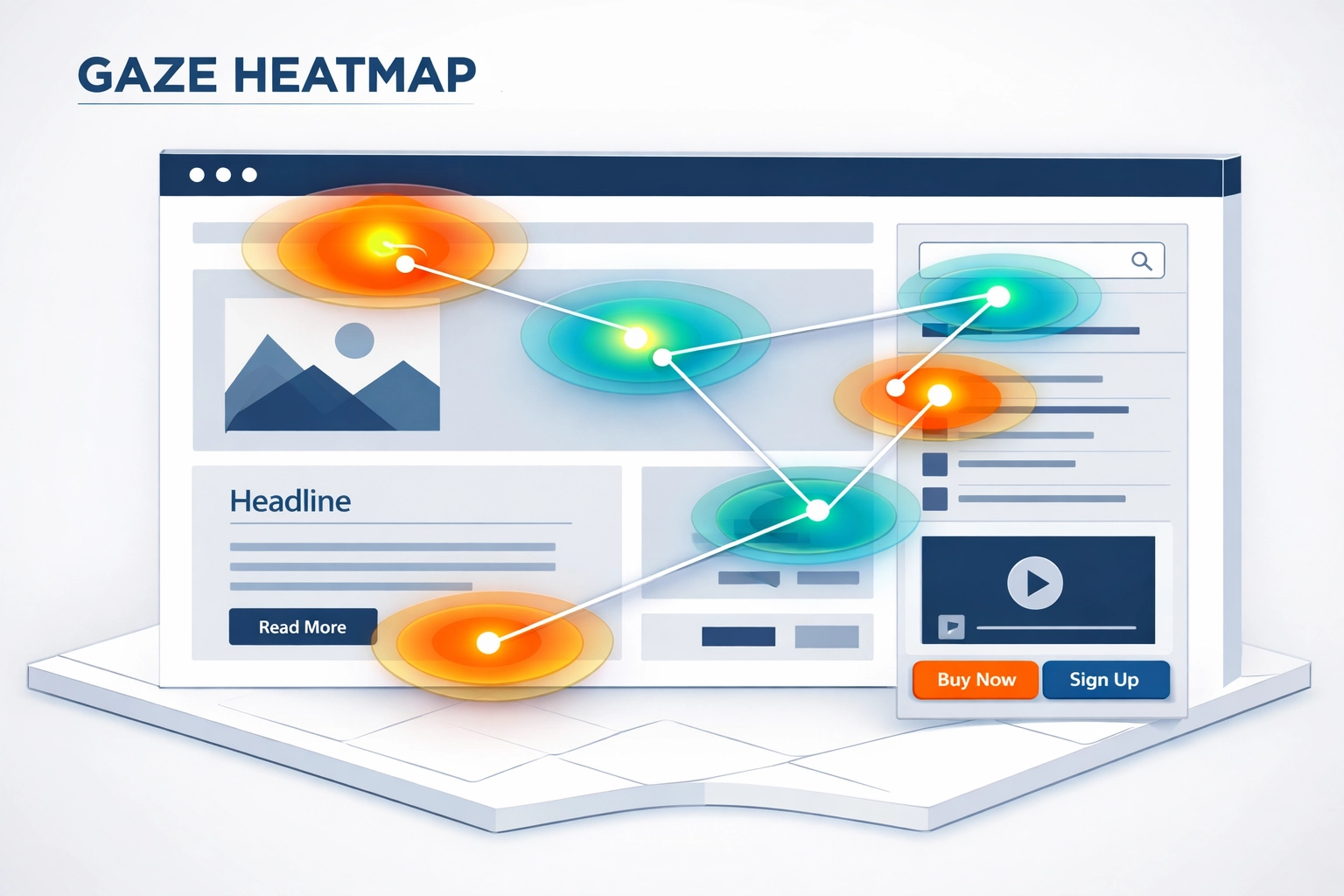
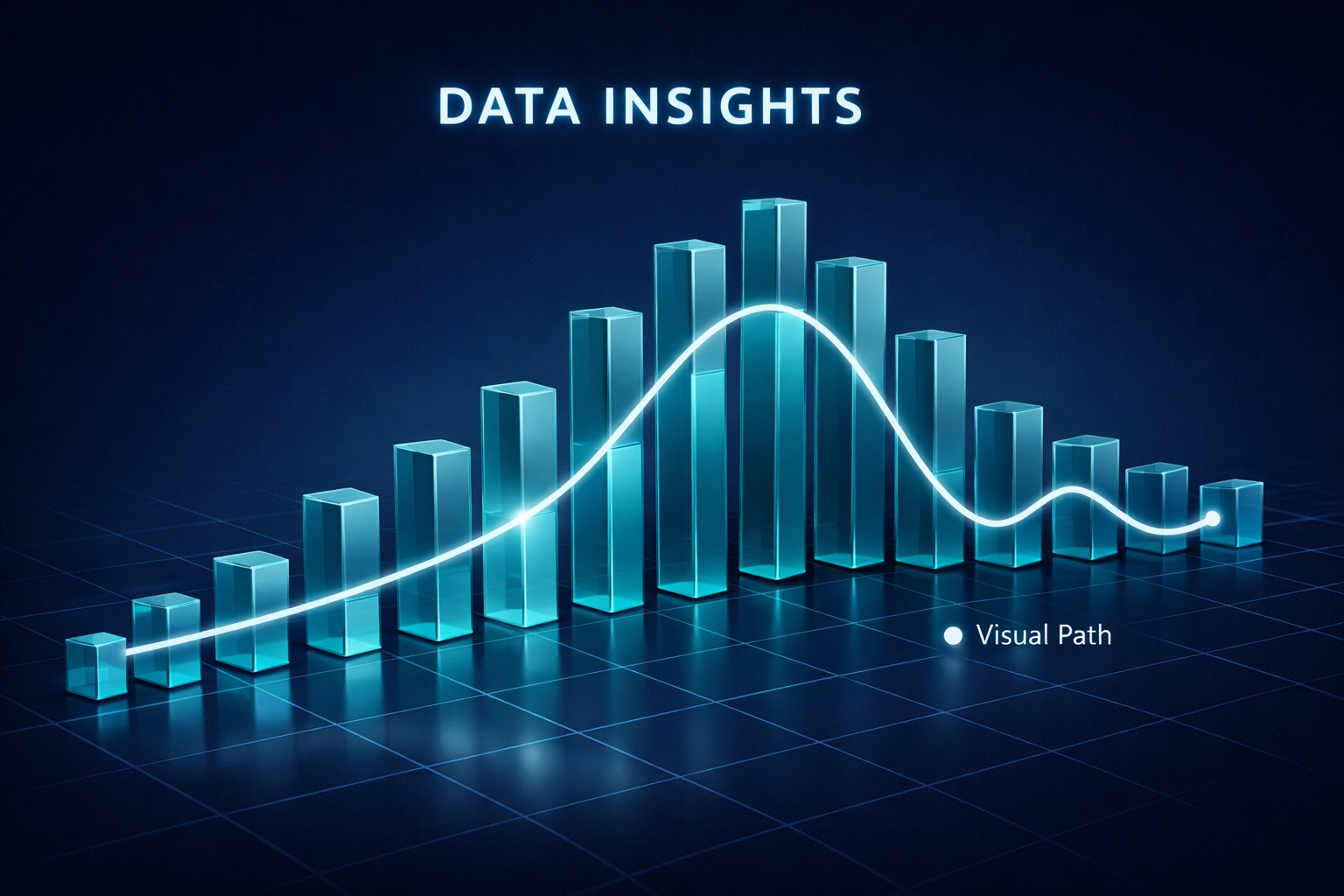
- Saccades: These are the rapid movements between fixations. By mapping saccades, developers can understand the “visual path” a user takes through a mobile app.
- Heatmaps & Opacity Maps: These are the visual representations of the aggregate data, showing “hot zones” where the majority of users focus their attention.
4. Stakeholder Benefits: From Developers to CEOs
Implementing this technology isn’t just a win for the marketing department; it provides scalable value across the entire corporate structure.
- For Business Owners: Gain objective proof of ROI. Stop guessing which marketing assets work and start investing in visual triggers that actually convert.
- For UI/UX Designers: Validate your design choices. Use gaze data to prove that the new Flutter-based interface reduces the time it takes for users to find the search bar.
- For Marketing Heads: Optimize ad spend. Identify “banner blindness” early and pivot your creative strategy before the budget is depleted.
- For Developers: Build more dynamic and accessible interfaces. For instance, using Node.js to handle high-concurrency gaze data streams for real-time interface adjustments.
5. Key Features to Look for in Eye Tracking Software
When selecting a vendor or developing a custom solution, ensure the software includes these modern specifications:
- Webcam-Based Tracking:
- Specialty: Accessibility and Scalability.
- Release Date: Industry standard as of late 2024.
- Key Features: No hardware required, browser-based integration, high-speed AI calibration.
- Real-Time Gaze Visualization:
- Specialty: Live User Testing.
- Key Features: Live gaze overlays, remote session recording, and instant heatmap generation.
- Emotion AI Integration:
- Specialty: Neuromarketing.
- Key Features: Combines gaze tracking with facial expression analysis to measure frustration or delight.
- Cross-Platform Compatibility:
- Specialty: Omnichannel Strategy.
- Key Features: Works seamlessly across iOS, Android, and Web environments.
6. ROI and Data: The Real Cost of Ignored Content
In 2026, the cost of ignored content is higher than ever. With the average human attention span fluctuating, catching the eye in the first 1.5 seconds is critical. Recent industry statistics indicate that:
- Websites optimized via eye tracking see a 30% increase in engagement.
- Users are 85% more likely to notice a Call to Action (CTA) if it is placed within the “F-Pattern” gaze path.
- Eye-tracking-informed redesigns can reduce bounce rates by up to 22% in the first quarter of implementation.
Visual Data: Attention Retention Rates (2026 Index)
| Content Type | Average Fixation (Sec) | Recognition Rate (%) |
|---|---|---|
| Video Hero Headers | 4.2 | 92% |
| Static Text Blocks | 1.8 | 45% |
| Interactive Infographics | 5.5 | 88% |
| Standard Banner Ads | 0.3 | 12% |
The chart above demonstrates that standard banner ads are almost entirely invisible to the modern user, whereas interactive elements capture nearly 5x the attention.
7. Step-by-Step: Implementing Eye Tracking in Your Workflow
To successfully integrate gaze analytics into your software development lifecycle, follow this directive guide:
- Define Your Primary KPI: Don’t just track everything. Decide if you are looking to reduce “Time to First Fixation” on a checkout button or improve the readability of your blog posts.
- Select Your Participant Pool: Use a diverse group of testers. Eye tracking can vary based on age, cultural background, and even the type of device used.
- Calibrate for Ambient Conditions: Ensure your software accounts for different lighting environments, as webcam-based tracking relies on clear facial feature detection.
- Run A/B Attention Tests: Use two versions of a landing page. Compare which version directs the gaze toward the conversion goal more seamlessly.
- Analyze the “Void”: Look specifically at the areas where users don’t look. If your most important feature is in a “visual void,” move it immediately.
8. Common Mistakes to Avoid
Even with the most cutting-edge tools, human error can skew results. Avoid these pitfalls:
- Ignoring the “Halo Effect”: Just because someone looks at an element doesn’t mean they like it. They might be looking at it because it’s confusing or annoying. Combine eye tracking with qualitative interviews for the full picture.
- Over-Calibration: Forcing users to calibrate their eyes too frequently can lead to “tester fatigue,” causing them to behave unnaturally.
- Neglecting Mobile Gaze Patterns: People hold phones differently than they sit at laptops. Ensure your Android development team is testing for thumb-reach and eye-focus synchronization.
- Privacy Negligence: In 2026, data privacy is paramount. Always ensure your software is GDPR/CCPA compliant and that users have explicitly opted-in to biometric tracking.
9. Comparative Analysis: Traditional vs. Eye Tracking Analytics
| Feature | Traditional Analytics (Clicks) | Eye Tracking Software (Gaze) |
|---|---|---|
| Data Type | Behavioral / Final Action | Subconscious / Cognitive |
| User Intent | Inferred | Observed |
| Blind Spots | High (Shows nothing if no click) | Low (Shows everything seen) |
| Setup Speed | Instant | Requires Setup/Calibration |
| Implementation | Node.js / Laravel tags | AI/ML Webcam Integration |
| Actionability | Reactive | Proactive |
10. The Future of Vision-Based Interfaces
Looking forward, eye tracking software is set to merge with IoT development and AR/VR systems. We are already seeing the rise of “Gaze-to-Action” interfaces where a user can select a menu item simply by looking at it for a set duration.
For businesses, this means the “Click” will eventually become a legacy interaction. The future is a dynamic, hands-free environment where software anticipates user needs by observing visual intent. Whether you are building a security app or a complex logistics platform, eye tracking is the key to unlocking the next level of user experience.
Forward-Looking Summary
Adapting to eye tracker software in 2026 is no longer an optional “innovation project”, it is a survival strategy. As consumers become more shielded from traditional advertising, the only way to break through the noise is to master the art of attention. By moving beyond the click, you gain the clarity needed to build software that doesn’t just function but truly resonates. The eyes don’t lie; it’s time your business started looking at what they’re saying.
11. Frequently Asked Questions
Q: Does eye tracking software require special glasses?
A: Not anymore. While high-end hardware exists for clinical research, most modern business applications in 2026 use AI-powered webcam tracking that works on standard laptops and smartphones.
Q: Is gaze data difficult to integrate into existing apps?
A: With the right development partner, no. Utilizing frameworks like React Native or Swift, developers can integrate gaze-tracking SDKs that feed data directly into your existing analytics dashboard.
Q: How accurate is webcam-based eye tracking compared to infrared?
A: In 2026, the gap has closed significantly. While infrared is still the gold standard for medical use, webcam-based software now offers roughly 93-95% accuracy, which is more than sufficient for UX testing and marketing analysis.
Q: How do we handle user privacy?
A: Privacy is handled through anonymization. Modern software processes the visual feed locally on the user’s device and only sends coordinate data (not the video itself) to the server, ensuring total compliance with global privacy standards.