

Table of Contents
- The Digital Dilemma: Native or Hybrid?
- Deep Dive: Native Development (iOS & Android)
- Deep Dive: Hybrid & Cross-Platform Development
- Performance, UX, and Architecture Comparison
- The Business Case: Cost, Time, and Scalability
- Detailed Comparison Table
- Data-Driven Insights: Trends for 2026
- Common Mistakes in App Tech Stack Selection
- Decision Framework: Which Approach Should You Choose?
- Frequently Asked Questions (FAQ)
Problem: Choosing the wrong development path can lead to 2x higher costs, fragmented user experiences, and a codebase that becomes obsolete within two years.
Solution: Selecting a tech stack based on long-term business goals, performance requirements, and hardware integration needs ensures a scalable, future-proof product.
The Digital Dilemma: Native or Hybrid?
In the current landscape of Software Development, the question is no longer just about “making an app.” It is about how that app will scale, how it will feel in the hands of the user, and how much it will cost to maintain over a five-year lifecycle.
Business owners and CTOs are often caught between two powerful forces: the lightning-fast performance of Native development and the modern efficiency of Hybrid frameworks. With over 6.5 billion smartphone users globally, the stakes for your mobile strategy have never been higher. Whether you are building a complex FinTech solution or a sleek E-commerce store, the foundation you choose today determines your market agility tomorrow.
Deep Dive: Native Development (iOS & Android)
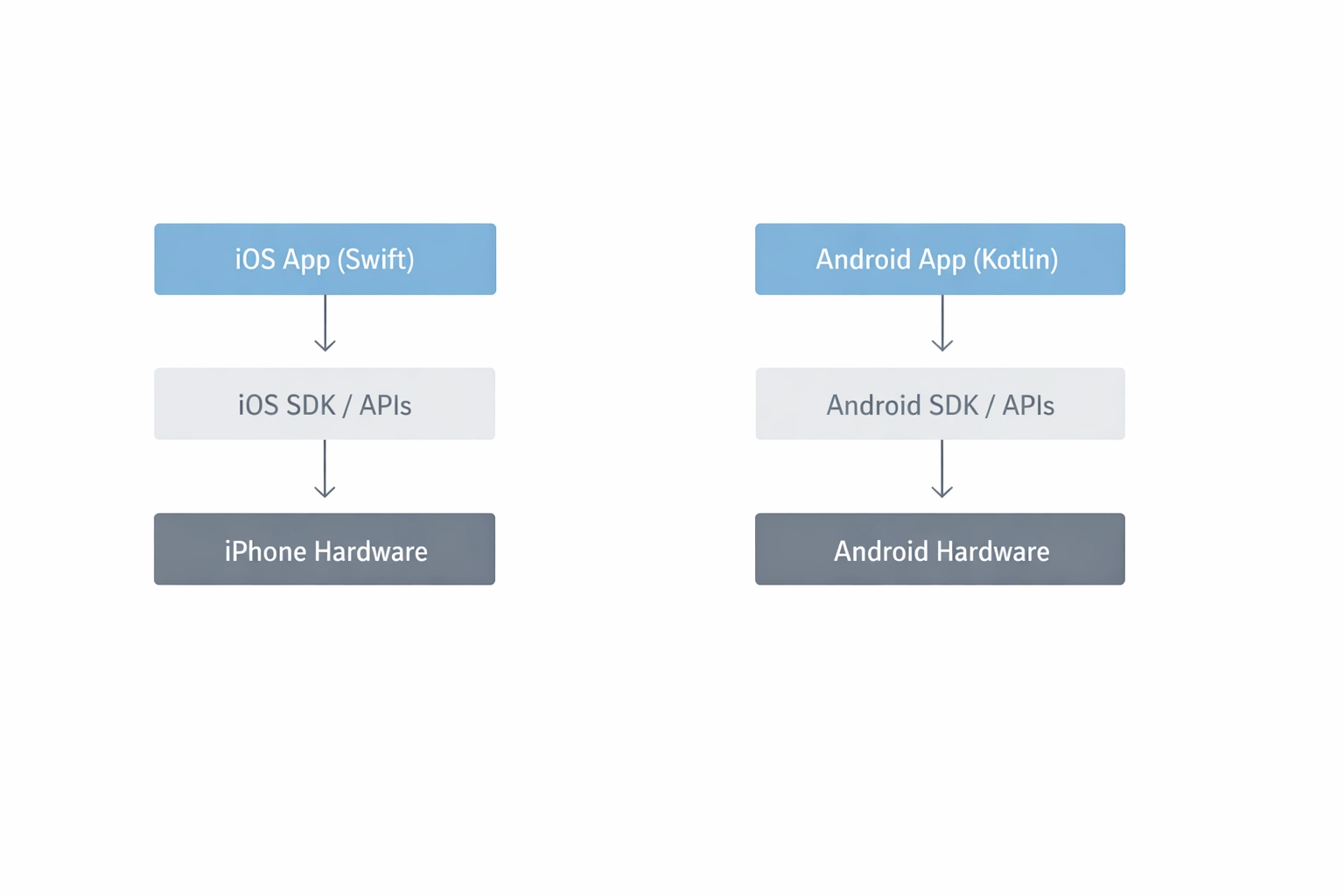
Native development involves building separate applications for each mobile operating system using platform-specific programming languages and tools.
iOS Development: The Premium Standard
- Speciality: High-end consumer apps, secure financial tools, and AR-driven experiences.
- Key Features: Leverages Swift and Objective-C within the Xcode environment.
- User Experience: Provides the most “fluid” feel, adhering strictly to Apple’s Human Interface Guidelines.
Android Development: Global Reach
- Speciality: Large-scale enterprise tools, hardware-integrated apps, and massive global reach.
- Key Features: Utilizes Kotlin or Java with Android Studio.
- Fragmentation: Must account for over 24,000 different device types, which can extend testing phases significantly.
3. Deep Dive: Hybrid & Cross-Platform Development
Hybrid and cross-platform development allows developers to write code once and deploy it across multiple platforms. While “Hybrid” traditionally referred to web-views inside a native container, modern frameworks like Flutter have redefined this category.
The Modern Cross-Platform Suite
- Flutter: Developed by Google, uses the Dart language to provide high-performance UI that looks identical on both iOS and Android.
- React Native: Developed by Meta, allows for a seamless bridge between JavaScript and native components.
- Code Reusability: Developers typically reuse 70-90% of their codebase, drastically reducing the time spent on dual-feature implementation.
Problem: Maintaining two separate codebases for Native iOS and Android doubles the surface area for bugs and security vulnerabilities.
Solution: Adopting a cross-platform approach synchronizes updates, ensuring all users receive the same features and security patches simultaneously.
4. Performance, UX, and Architecture Comparison
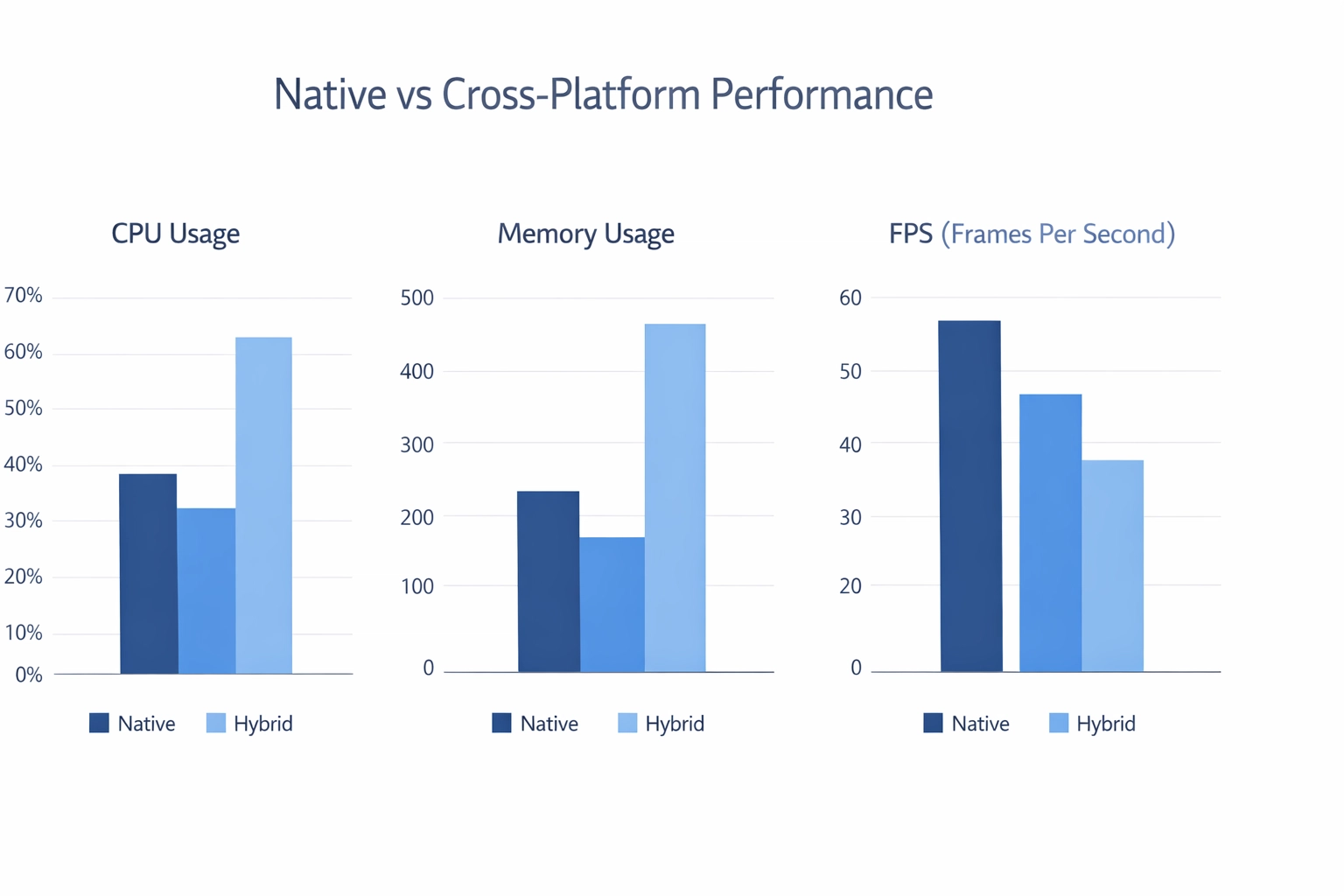
Performance is where the gap between Native and Hybrid is most visible.
- Native Performance: Because the code is compiled specifically for the hardware, native apps have the lowest latency and highest frame rates. This is critical for graphics-heavy applications or real-time RPA development.
- Hybrid Performance: While frameworks like Flutter deliver near-native speeds (60-120 FPS), traditional hybrid apps (web-based) can suffer from laggy scrolling and slower transitions when handling complex data sets.
5. The Business Case: Cost, Time, and Scalability
From a marketing and management perspective, the decision is often driven by the “Iron Triangle”: Fast, Good, or Cheap.
- Time-to-Market: Hybrid development is the clear winner for MVPs. By developing one codebase, you can cut the initial development time by 30-50%.
- Development Cost: Native requires two distinct teams (or developers with vastly different skill sets). Hybrid allows a single team to manage the entire mobile ecosystem.
- Maintenance: Long-term maintenance for Native apps involves two separate update cycles. For Android, this also includes navigating device fragmentation, which can take 2-3 times longer than iOS updates.
6. Detailed Comparison Table
| Feature | Native (iOS/Android) | Hybrid / Cross-Platform |
|---|---|---|
| Languages | Swift, Kotlin, Java | Dart, JavaScript, C# |
| Performance | Maximum / High-End | High (Near-Native) |
| Development Time | Long (Parallel tracks) | Fast (Single codebase) |
| Cost | Higher (2x teams) | Lower (1x team) |
| Hardware Access | Full / Immediate | Very High (via Plugins) |
| UI/UX | Platform-specific fidelity | Unified / Brand-consistent |
| Maintenance | Complex (Two codebases) | Simplified (One codebase) |
| Best For | AR/VR, Gaming, IoT | E-commerce, Social Media, MVPs |
7. Data-Driven Insights: Trends for 2026
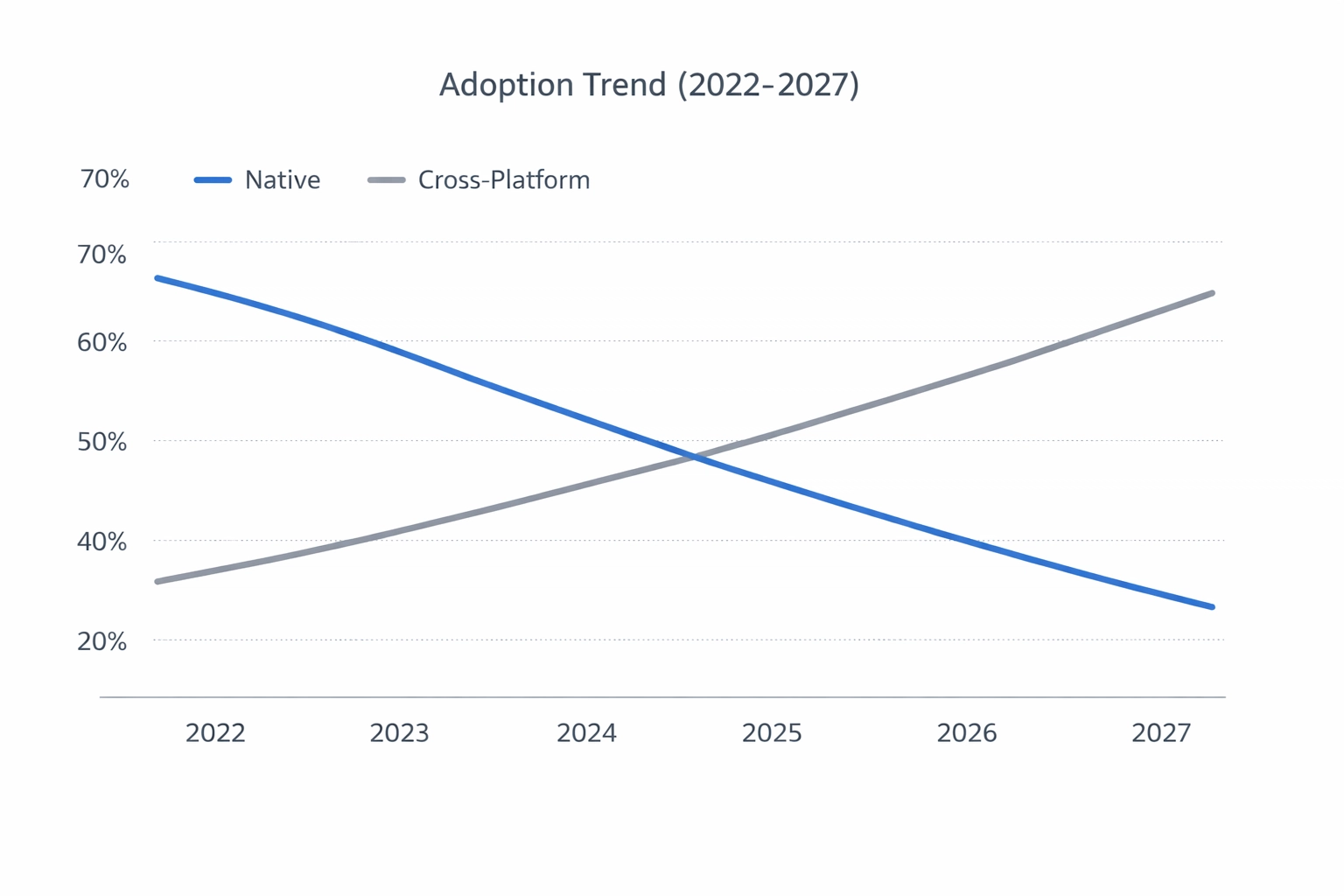
Research into the current software market reveals shifting priorities for 2026. Data suggests that while performance was once the sole driver for Native, the stability of cross-platform tools has shifted the needle.
- Market Share: Approximately 42% of developers now use cross-platform frameworks for their primary projects.
- App Store Approval: On average, iOS app approval takes 24-48 hours, while Google Play averages 1-3 days. Native apps often see fewer rejections related to UI inconsistencies.
- Developer Efficiency: Teams using Modern Frontend Tools alongside cross-platform frameworks report a 40% increase in sprint velocity.
8. Common Mistakes in App Tech Stack Selection
Even experienced product managers fall into these traps:
- Ignoring the “Off-the-Shelf” Hardware: If your app requires complex Bluetooth, biometrics, or sensor integration, forcing a Hybrid solution can lead to “plugin hell.”
- Over-Engineering the MVP: Choosing Native for a simple content-driven app often leads to burned capital that could have been used for user acquisition.
- Neglecting the Backend: A mobile app is only as strong as its architecture. Utilizing Node.js or Python for the backend is vital regardless of the frontend choice.
- Underestimating the Android Ecosystem: Failing to test on the vast array of Android hardware is the #1 reason for “one-star” reviews post-launch.
Problem: Startups often choose Native because they believe it’s “better,” only to run out of funding before the second platform (Android) is even launched.
Solution: Start with a Hybrid approach to validate the market. Use the saved capital to scale once product-market fit is confirmed.
9. Decision Framework: Which Approach Should You Choose?
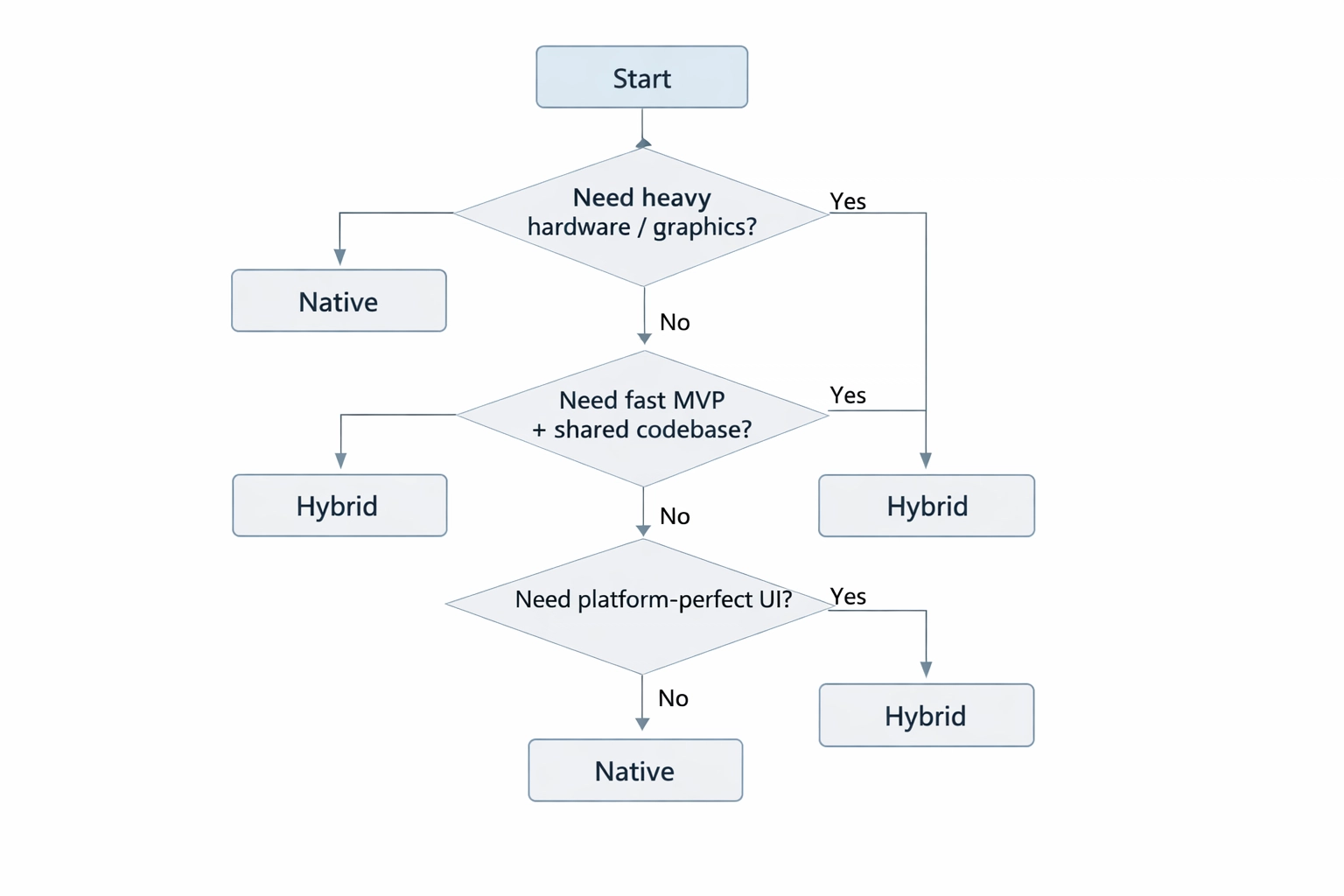
To make the right choice, follow this directive guide based on your project requirements:
- Evaluate Hardware Intensity: Does your project require heavy GPU usage or complex sensor data? Go Native.
- Assess Budget Constraints: Is your budget under £50k for an initial launch? Go Hybrid.
- Determine Deployment Speed: Do you need to be on both stores in under 3 months? Go Hybrid.
- Define UI Fidelity: Does your app need to look like a “system app” on both iOS and Android with distinct navigation patterns? Go Native.
- Long-Term Strategy: Are you building a core product that will exist for 10+ years? Go Native (for stability and direct OS support).
Should I use Flutter or React Native for my Hybrid project?
Flutter is often preferred for highly custom, brand-centric UIs, while React Native is excellent if your team is already proficient in JavaScript and React.
What is the typical timeline for a Native app?
A standard Native app for both platforms usually takes 4-6 months to develop, whereas a Hybrid version might take 3-4 months.
The evolution of mobile technology in 2026 demands adaptation. Whether you choose the unparalleled power of Native development or the dynamic scalability of Hybrid solutions, the key is to align your technology with your business trajectory. Static companies fail; those who embrace the right tools at the right time lead the market. Explore our work to see how we’ve helped businesses navigate these very decisions.
Is Hybrid development cheaper than Native?
Generally, yes. Since you are maintaining one codebase instead of two, you typically save 30% to 50% on development and long-term maintenance costs.
Can Hybrid apps work offline?
Yes. Modern cross-platform frameworks support local data storage and offline functionality, though Native still offers slightly more robust background processing.
Which is better for SEO and Web visibility?
Mobile apps themselves don’t rank in traditional Google search like websites. However, if you are looking for web-parity, Single Page Application frameworks can bridge the gap between your web presence and mobile app.