[ez-toc]
Consider a wonderful app idea you have. You have envisioned every other element that will have clients love it: the elegant design, the straightforward user experience, and every other feature. The following, meanwhile, presents a dilemma: Shall it be designed for both Android and iOS? Moreover, how much money and time are you prepared to spend on several versions? This is where cross-platform program development comes to help.
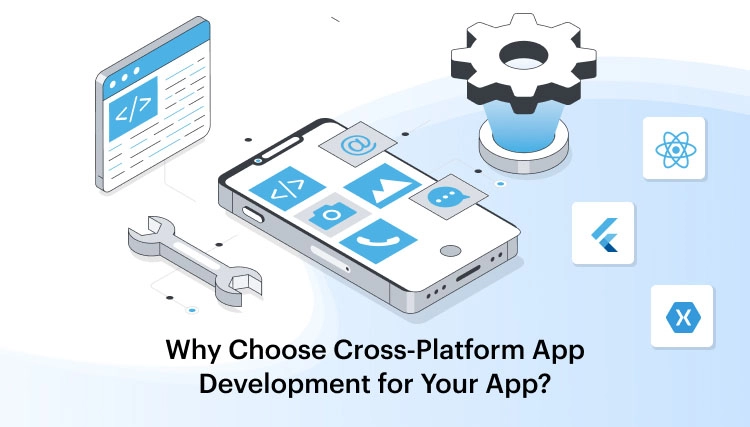
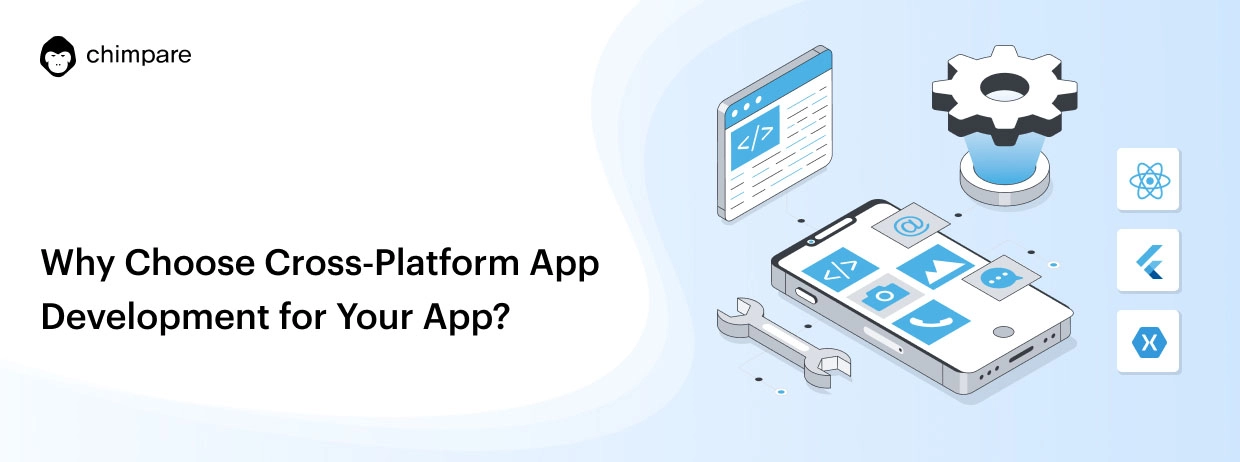
The cross-platform app development is a sensible approach whereby developers produce a single codebase running flawlessly across several platforms. Instead of developing separate iOS and Android apps, you create an app that functions everywhere. Cooking one dinner that every visitor at the party would adore is comparable to that; rather than cooking many meals to fit every guest’s tastes.
Why does this issue matter now?
In 2026, the app market is more cutthroat than ever. Since customers want apps to work effectively across all devices, businesses want to reach their audience without going over budget. More companies are therefore looking for cross-platform mobile app development. It guarantees a consistent experience for all consumers in addition to saving money and time.
Who can profit from this strategy?
Startups searching for a quick MVP, established companies trying to reach a larger audience, or even firms needing a strong solution for devices are all examples of people with an app concept. Turning your vision into reality quickly, a cross-platform mobile app development firm guarantees your app feels and seems native on all platforms.
Furthermore, inclined toward this approach is the future of mobile technology. With frameworks like React Native and Flutter setting the standard, cross-platform application development is quickly becoming the preferred solution for businesses looking to scale well in the UK and throughout the world.
To be clear, the answer to the question “Why is cross-platform app development the future?” lies in its speed, affordability, and ability to reach millions of users without requiring the creation of numerous apps from the start.
In this blog, we’ll dive deep into why cross-platform app development services are the ultimate gamechanger for modern businesses, explore the pros and cons, compare them with native development, and give you real-life examples of successful apps built using this approach. By the end, you’ll know whether a cross-platform app development company is the right choice for your next project.
Tired of platform-specific development costs and delays?
Streamline with cross-platform efficiency.
Book Your Free App Consultation
What is Cross-Platform App Development?
Cross-platform application design is perhaps something you know about, but how effectively do you understand it?
A single codebase essentially enables the creation of apps meant to run on a number of platforms, including iOS, Android app, and even the web. Actually, it resembles developing one potent program that would automatically change to fit any device rather than producing several editions for every platform.
Besides saving you a lot of money and time, the technique also allows your app to maintain the same look and feel on any device. Many companies are now seeking cross-platform mobile app development services so that they may grow swiftly without sacrificing quality.
Here’s the gist in a nutshell:
- Once you create your app, disseminate it everywhere; there is no need to keep many versions. Single Codebase Across Platforms
- Cost-effective development reduces development expenses and speeds time to market by means of fewer coding lines.
- User Experience: Across Android, iOS, and the internet, users find the same basic features and user experience.
- For cross-platform app developers, React Native, Flutter, and Xamarin enable the rapid creation of apps.
- Changes to the codebase quickly show across all platforms, therefore speeding maintenance and updates.
- Flexibility for Businesses: Whether you’re a startup or an enterprise, cross-platform mobile app development company services give you the freedom to innovate and scale.
- Future-Proof Approach: With growing demand for apps across devices, cross-platform app development UK and worldwide is quickly becoming the standard, proving why cross-platform app development is the future.
Cross-platform development combines the finest of both worlds: native-like performance with a single, manageable codebase, unlike native apps, which are built individually for each operating system, or hybrid apps, depending on web views. This makes it the best answer for companies trying to launch quickly, remain consistent, and satisfy consumers.
What are the Major Benefits of Cross-Platform Apps?
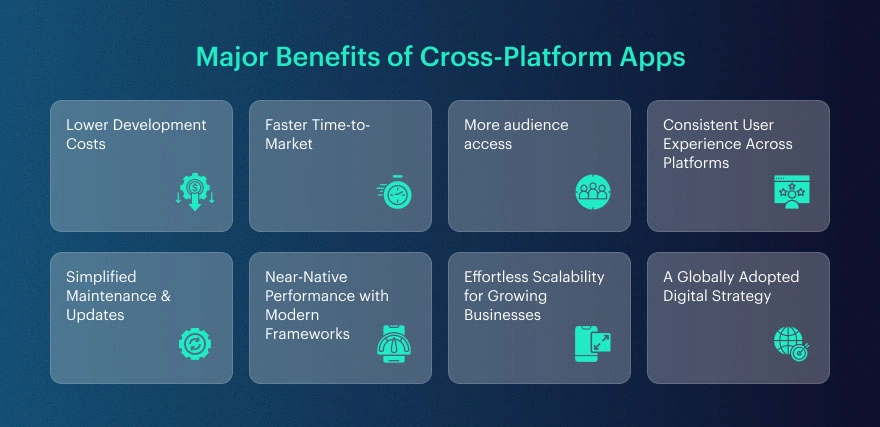
No one has the time (or money) to duplicate a computer program in the rapidly growing digital world of today. That is the main reason why cross-platform app development has become very popular in 2026. Companies want to be the first in the market, make their products available to more people, and at the same time, give a seamless, top-notch experience, and cross-platform is what makes all these things possible.
Cross-platform application development is the way of the future as it lets businesses expand fast, remain competitive, and satisfy consumers with one shared codebase running on many platforms.
- Lower Development Costs: A single app for multiple platforms requires less coding, fewer developers, and thus, brings about huge savings, a great advantage for startups and expanding businesses.
- Cross-platform mobile app development solutions let you release your iOS and Android applications virtually simultaneously, instead of you waiting for separate builds for months, therefore speeding your Time to Market.
- More audience access: From the very first day, your app can be accessed by consumers on several devices. In this manner, companies may expand more quickly and powerfully.
- Cross-platform frameworks guarantee that your application operates the same across platforms and not only seems the same, hence building confidence and familiarity among the users.
- Once the app is updated, the changes will automatically show on all devices; maintenance and updates are made simpler. Releases of corrections and functions are once only.
- High Performance Using Modern Frameworks: Today, frameworks like Flutter and React Native provide performance, speed, and smoothness nearly at a native level.
- The ideal method of scaling companies is: Collaborating with a cross-platform mobile app development firm will enable companies to expand without having to recreate everything from the ground up from MVPs to massive enterprise applications.
- Worldwide Trend: It is now the go-to strategy for digital expansion when it comes to cross-platform app development, not only in the UK but also worldwide, whether it is a startup or a large enterprise that is considering it.
Are Cross-Platform Apps Only Good for Simple Projects?
Cross-platform app development is sometimes misunderstood as being only for simple apps with few features; Actually, modern cross-platform systems are strong enough to manage complicated company logic, real-time data processing, high-performance animations, and even enterprise-level security. Businesses of all sizes depend on cross-platform mobile app development services to create feature-rich, scalable solutions from fintech applications and e-commerce sites to social media networks and on-demand services. You’re just constructing smarter and more quickly with the appropriate cross-platform app development firm; cross-platform app development is the future. You are not sacrificing quality or performance.
Here’s why cross-platform apps go far beyond “simple projects”:
- High performance is now typical: Modern frameworks like Flutter and React Native translate to near-native code, therefore providing excellent performance even for sophisticated apps.
- Cameras, GPS, biometric authentication, push notifications, sensors, and cross-platform programs may use native APIs just like standard ones.
- Designed for scalability: Whether you are debuting an MVP or going global, a good cross-platform mobile app development company may quickly grow your app.
- Effective implementation of encryption, safe authentication, and compliance requirements is achievable.
- Thanks to sophisticated UI/UX features, custom animations, interactive dashboards, and reactive designs are all quite conceivable.
- Cross-platform applications handle everything from real-time chat systems to payment gateways and cloud integrations for advanced corporate demands.
- Relied on by major companies all over, several of the most popular apps in many industries already use cross-platform app development solutions to reach millions of consumers daily.
What are the Challenges and Limitations to Consider?
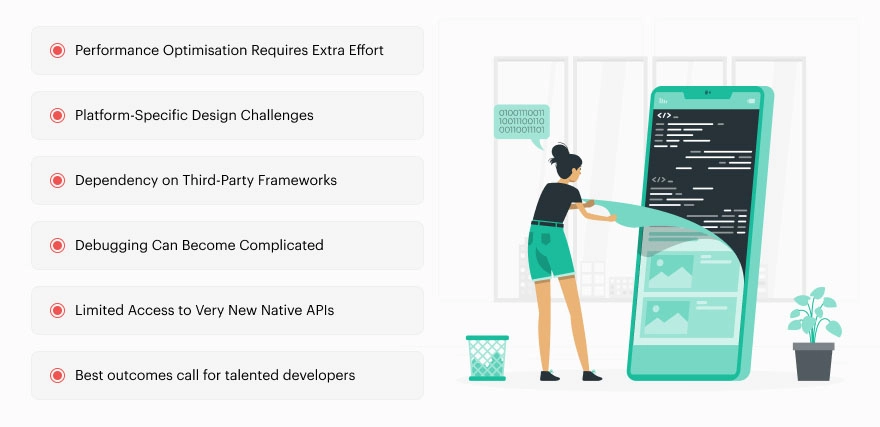
For most companies, cross-platform app development is a good option, but it is not a magical wand that will magically solve everything right away. Like with any technology, you should know of a few obstacles before you adopt it.
Working with a seasoned cross-platform mobile app development company able to maximise performance, create intelligent user experiences, and select the right technologies will enable you to manage or even eliminate most of these restrictions. The direction of the future is cross-platform app development since it enables you to create better apps by anticipating these problems when performed properly.
Here are some common challenges to keep in mind:
- Performance Optimisation Requires Extra Effort: Although some advanced animations or intensive data processing could still need fine-tuning to fit natural performance, contemporary frameworks are really quick.
- Every platform has its own design guidelines (Material Design for Android and Human Interface Guidelines for iOS, among them); therefore, developing a real “native feel” across devices occasionally demands additional design work.
- Cross-platform applications depend on external frameworks like Flutter app or React Native. Delaying a framework update could momentarily reduce access to new operating system functions.
- Debugging Can Become Complicated: Because you’re working with several platforms through one codebase, finding bugs can occasionally take slightly longer than in native development.
- Limited Access to Very New Native APIs: Brand-new device features may not be immediately supported until the framework releases updates.
- Best outcomes call for talented developers: Selecting the proper cross-platform app development services is crucial; bad architecture can cause performance or scalability problems.
What is the Difference Between Cross-Platform Vs. Native Development?
While cross-platform app development is changing how apps are built (and honestly, for the better), it’s still important to know that no technology is completely perfect. Cross-platform solutions focus on speed, cost-efficiency, and scalability, which is exactly why cross-platform app development is the future, but a few technical challenges can pop up if the project isn’t planned properly.
Most of these issues are manageable when you work with a skilled cross-platform mobile app development company that knows how to optimise performance, design platform-friendly interfaces, and choose the right frameworks for your app.
| Challenge | What It Means (In Simple Words) | Why It Matters for Your App |
| Performance Optimization | Some complex features, heavy animations, or real-time data processing may need extra tuning to run as smoothly as native apps | Without proper optimization, your app could feel slower on certain devices |
| UI/UX Customization Issues | iOS and Android follow different design rules, and one design doesn’t always fit both perfectly | Extra effort is sometimes required to keep the app looking “native” on each platform |
| Framework Dependency | Cross-platform apps rely on tools like Flutter or React Native, which need regular updates | Delayed framework updates can slow access to new OS features |
| Complex Debugging | One bug may behave differently across platforms | Testing needs to be more thorough to avoid platform-specific issues |
| Limited Immediate Access to New APIs | Brand-new mobile features may not be supported instantly | Developers might need workarounds until official updates roll out |
| Skill-Based Development | Poor coding structure can reduce performance | Choosing the right cross platform app development services makes a huge difference |
Facing fragmented user experiences across devices?
Unify with seamless cross-platform apps.
What are Successful Cross-Platform App Examples?
These true success stories might persuade you otherwise if cross-platform app development is still thought of as a tool just for little or experimental apps. Cross-platform frameworks power some of the most popular apps in the world, the ones you most likely scan every day, to deliver fast, fluid, and consistent experiences across devices.
Cross-platform mobile app development services are chosen by businesses ranging from startups introducing MVPs to worldwide corporations scaling millions of consumers for the speed it provides without sacrificing performance. One of the main reasons cross-platform app development is seen as the future is this actual application.
Here are some popular and powerful examples:
- Instagram employs React Native for quicker feature development while still providing consistent performance across both iOS and Android.
- One of the creators of React Native, Facebook (Meta), still relies heavily on cross-platform technology for a number of app components.
- Google Ads App – Built using Flutter, allowing Google to manage updates efficiently across platforms
- Alibaba – Uses Flutter to handle millions of users with high performance and fast UI rendering
- BMW App – Built with Flutter to create a premium, consistent digital experience for customers worldwide
- Skype – Shifted to React Native to speed up development and improve performance
- eBay Motors – Uses Flutter for smooth UI and rapid feature releases
These apps prove that what is cross-platform app development today is no longer about compromise; it’s about smart engineering. With the right cross-platform app development company, businesses can build apps that are fast, scalable, secure, and visually impressive. From fintech to social media to e-commerce solutions, cross-platform app development services are powering some of the most successful digital products globally, including across the UK cross-platform app development UK markets.
Struggling with slow time-to-market pressures?
Accelerate using efficient cross-platform development.
Conclusion
Selecting the right development method might make or break your app’s success; hence, cross-platform app development has become the go-to solution for contemporary companies. Brands can introduce quicker, engage more people, and manage expenses all without compromising performance or user experience, thanks to a shared codebase running across iOS, Android, and other systems.
It is easy to see why startups and companies are increasingly adopting this smart, scalable strategy now that you grasp cross-platform app development and how strong current frameworks have become. It is simple to see why both startups and companies alike are turning to this intelligent, scalable strategy now that you know what cross-platform app development is and how strong modern frameworks have become.
Working with a cross-platform mobile app development firm even better offers you access to knowledge that helps you prevent typical problems and maximise efficiency. Cross-platform app development solutions are meant for growth in a mobile-first world, from faster updates to simpler long-term maintenance.
Across global markets, including cross-platform app development, UK businesses are proving every day why cross-platform app development is the future. If your goal is to build an app that’s flexible, future-ready, and built to scale, cross-platform development isn’t just an option anymore; it’s the smart move forward.
FAQs
What is cross-platform app development?
Cross-platform app development is a method of building mobile applications using a single codebase that works across multiple platforms like iOS and Android. Instead of creating separate apps for each operating system, developers use frameworks such as Flutter or React Native to deliver one app that performs smoothly everywhere.
Is cross-platform app development cheaper than native development?
Yes, in most cases, it is more cost-effective. Since only one app is built and maintained instead of two, businesses save on development time, resources, and long-term maintenance costs. That’s why many startups and enterprises choose cross-platform mobile app development services to maximise their budgets.
Do cross-platform apps perform as well as native apps?
The mosModern cross-platform frameworks now offer near-native performance for most use cases. With proper optimisation and skilled developers, cross-platform apps can run smoothly, handle complex features, and deliver great user experiences comparable to native apps. t popular SPA frameworks in 2025 include React.js, Angular, Vue.js, Svelte, Next.js, and Nuxt.js, known for their speed, scalability, and developer-friendly ecosystem.
When should I choose a cross-platform app development company?
You should consider working with a cross-platform app development company if you want to launch faster, reach users on multiple platforms, control development costs, and scale your app efficiently. It’s ideal for startups, growing businesses, and even large enterprises.
Why is cross-platform app development considered the future?
Because it aligns perfectly with today’s digital needs, speed, flexibility, cost-efficiency, and scalability. As frameworks continue to improve and businesses aim to reach wider audiences quickly, cross-platform app development is becoming the standard approach for modern mobile apps.
Found this post insightful? Don’t forget to share it with your network!