[ez-toc]
AI is the main tool of contemporary online interactions, which has been transformed in a way that is much faster than anticipated. These AI features, such as product recommendations while purchasing, the chatbot that welcomes you on a customer service page, or the manner in which a site is automatically adjusting to your usage, make the digital world not only easier but also more user-friendly and personalised.
Multiple industry surveys have reported that 70% of businesses now use AI in web technology to improve their websites. This shows just how quickly this technology has become part of everyday web development.
For web technology teams, the shift is more noticeable. They used to work on tasks that took hours, like testing, bug fixing, or analysing user behaviour. This can now be automated or assisted with AI tools. This allows web development companies to build features faster while keeping user experience at the centre.
Businesses planning an MVP net development project or estimating website redesigning prices are deliberating AI features because they have an instant impact on performance, engagement, and long-time period scalability.
Along with the excitement, AI brings a brand-new set of responsibilities. Developers ought to consider records safety, transparency, and the extent of management delegated to automated tactics. As AI becomes completely integrated into web development services, the ultimate intention will be to locate the proper balance among the usage of AI to better the web at the same time while keeping the human contact that adds fee to virtual interactions.
Slow loading websites and poor user engagement can drive visitors away.
Empower sites with AI optimization.
Book Your Free App Consultation
What Does AI in Web Technology Mean?
AI in the website era includes using intelligent systems to make websites smarter, quicker, and greater useful to customers. Rather than depending without a doubt on manual coding or set guidelines, AI allows websites to analyse from person to person, adapt in real-time, and create more customised experiences.
In practice, this will vary from automated chat assistance to smarter seek bars, predictive analytics, stepped forward security, and even AI-driven design guidelines to assist builders assemble higher interfaces.
To put it simply, AI functions as an extra brain that websites may utilise. It observes patterns, studies how visitors interact with sites, and then allows developers to adjust without starting from scratch. This has become especially important as businesses compare web developer costs, plan MVP web development, or consider the website redesign cost for upcoming projects.
Here’s what AI in web technology really means today:
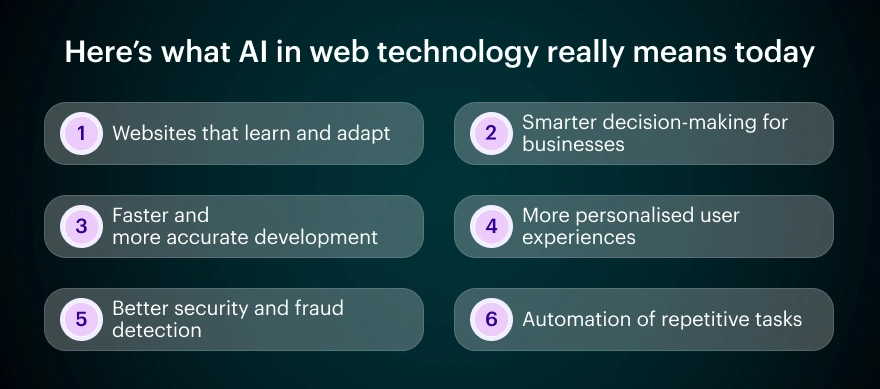
Websites that learn and adapt:
AI looks at the way users navigate, click, search, and engage and customise layouts, content, and points accordingly to meet their individual needs.
Smarter decision-making for businesses:
AI-powered analytics opens the users’ behaviour to view. Firms are implementing AI-powered analytics to direct web-related decisions, thus changing their digital strategy into a data-driven approach.
Faster and more accurate development:
Developers might avail of AI tools to automatically locate their mistakes, give the code a neat look, and test the features. Thus, the time for development is halved, and the reliability of the online applications is enhanced.
More personalised user experiences:
AI is responsible for making websites less generic and more relevant to you through a wide range of ways, starting from product suggestions to personalised landing pages.
Better security and fraud detection:
By far, the AI technology can recognise unusual activities or security issues quickly than conventional methods, thus giving businesses the chance to businesses to better protect their data and customers.
Automation of repetitive tasks:
AI takes away the need for engineers to manually test each feature and analyse every data set, by which teams are given the freedom to concentrate on strategy and innovation.
What Key Web Technologies are Being Influenced by AI?
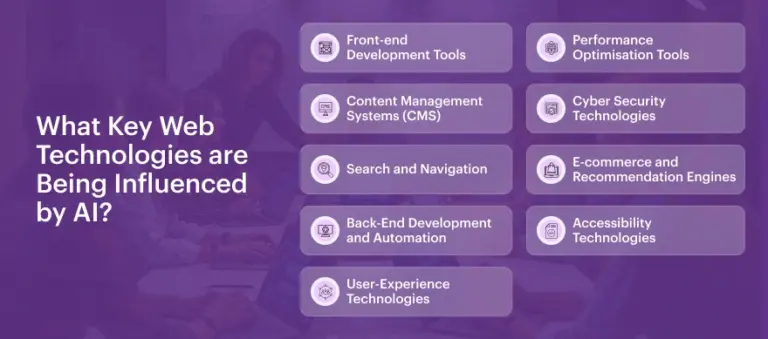
AI is becoming less of a separate thing and more of a core component for almost every aspect of the web. AI-powered solutions are revolutionising basic web technology, such as user interaction and site loading. These are the few industries which are frequently mentioned, as those where AI has a major influence.
1. Front-end Development Tools:
AI is speeding up how developers build interfaces and layouts. This means faster MVP web development and cheaper web developer charges for businesses looking to launch quickly.
- AI-assisted code generation: Development time can be reduced by up to 55% with GitHub Copilot and other alternatives.
- Automated UI creation: AI can convert wireframes, sketches, and written prompts into useful code.
- Smarter debugging: AI techniques quickly identify damaged components, accessibility problems, and inconsistent user interfaces.
2. Content Management Systems (CMS):
Contemporary CMS platforms are employing AI to free by automation of daily tasks. This is very efficient in the situation of a website restructuring when a large volume of content needs to be refreshed.
- Smart content recommendations by user behaviour, and thus engagement rates are getting better by 30-40% on average.
- Automated SEO suggestions that help websites rank better.
- AI content auditing, checking tone, readability, and duplicate content Humanzie ai text before publishing.
3. Search and Navigation:
Search functions are becoming more conversational and accurate. This enhances website usability without dramatically increasing web development service costs.
- AI-powered semantic seek is familiar with consumer intent as opposed to simply terms.
- Voice seek optimisation is vital considering the fact that it’s expected that by means of 2026, speech-based queries will make up half of all searches.
- Personalised navigation that adjusts suggestions and menus based on user options.
4. Back-End Development and Automation:
AI is helping developers build smarter, more stable systems. These improvements help web development companies deliver more reliable and secure platforms.
- Predictive analytics help servers scale automatically during high traffic.
- Regression bugs can be cut by up to 75% using AI-driven testing.
- Vulnerabilities are identified by automated security scanning before they become actual risks.
5. User-Experience Technologies:
AI is enhancing how people experience websites. This kind of personalisation is now expected, not optional.
- Content blocks that are tailored according to browser history, location, or behaviour.
- AI-driven A/B testing that predicts the best version without carrying out extensive testing.
- With round-the-clock support, intelligent chatbots can increase customer satisfaction by up to 60%.
6. Performance Optimisation Tools:
AI plays a major role in keeping websites fast and smooth. This directly reduces bounce rates and improves conversions.
- AI predicts which pages visitors will open next with predictive caching.
- Smart picture optimisation can lower an image’s size by up to 40% while maintaining its quality.
- Dynamic content delivery optimises website load speeds across several devices.
7. Cybersecurity Technologies:
As threats increase, AI is essential for protection. For businesses comparing website redesign cost options, AI-enabled security is now a must-have.
- AI-based anomaly detection spots unusual user activity instantly.
- Automated threat response, blocking attacks in real time.
- Bot management tools protect forms, payment gateways, and logins.
8. E-commerce and Recommendation Engines
AI drives many revenue-boosting features that online stores rely on. E-commerce websites are among the biggest beneficiaries of AI-driven web capabilities.
- Product suggestion systems can boost sales by up to 35%.
- Dynamic pricing technologies alter prices based on demand and competitive trends.
- Smart inventory prediction reduces stockouts and waste.
9. Accessibility Technologies
AI is helping make the web more inclusive. This is especially useful for companies that want to follow global accessibility standards without huge additional development costs.
- Automatic alt-text generation for images.
- AI-powered screen readers that interpret context more precisely.
- Real-time captioning of audio and video information.
Why AI is Important in Front-End & Back-End Development?
AI is the engine behind the drastic change of the internet infrastructure in general. From the very visible to the users and to the barely noticed by them, backend systems, AI is not taking over the role of developers; instead, it is accelerating, enhancing, and deepening their output.
Here’s why AI has become such a big deal in both front-end and back-end development.
Faster Front-End Development Without Compromising Quality
Creating similar components, fixing UI alignment issues, and making sure websites are responsive on all devices are just some of the repetitive activities that front-end developers put a lot of work into.
With AI, this labour is greatly reduced. AI expedites and improves front-give up paintings at a fair price for businesses that want to save money on web development or meet deadlines.
- AI-assisted code pointers make it less complicated to write down clear, bug-free HTML, CSS, and JavaScript.
- MVP web development can be accelerated by converting hand-drawn mockups or text prompts into functional interfaces using layout-generating technology.
- Automated user interface testing expedites the process of testing a page’s behaviour across many browsers and screen sizes, which often takes hours.
Smarter and More Efficient Back-end Systems
On the back end, AI plays an even bigger role because this is where automation and intelligence truly shine. This not only makes websites more reliable, but it also reduces the long-term maintenance and backend troubleshooting expenses for any web construction business.
- Websites can automatically handle traffic increase through predictive server scaling, making sure reliability even in the event of sudden peaks.
- AI-powered tracking systems song performance, discover problems before they get worse, and regularly remedy them robotically.
- Smart security structures use machine gaining knowledge of to locate unusual styles, inclusive of suspicious logins or bot attacks, much quicker than humans.
What Role Does AI Play in Creating Personalised Web Experiences?
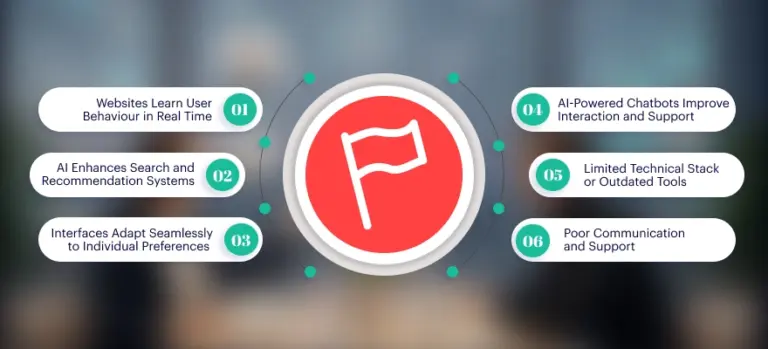
Perhaps the single largest reason why AI has become an indispensable part of the tech stack for the web of the future is its capacity to generate personalise interactions in a very human-like manner, instead of being mechanical or impersonal. Users nowadays demand that websites “comprehend” their requirements, be it by suggesting the right products, delivering the most suitable content, or simply by making the interface intuitive.
1. Websites Learn User Behaviour in Real Time
AI lets websites stumble upon and examine consumer interactions as they occur. It tracks which pages users visit, how long they remain, where they go away from, and which gadgets they use. This behavioural awareness permits you to provide extra applicable content material, make centred product pointers, and customise the layout to fulfil person preferences.
These upgrades not only increase engagement but additionally assist organisations in enhancing their digital presence without requiring a full redevelopment or incurring excessive website redecorate expenses.
2. AI Enhances Search and Recommendation Systems
Search bars and product pointers have evolved well past easy keyword matching. Natural Language Processing strategies allow websites to better understand and reply to conversational queries.
AI-powered advice structures also analyse browser records, purchasing habits, and similar consumer profiles to propose relevant products or articles. These talents are critical in MVP web development, as companies require immediate wins and features that drive user retention.
3. Interfaces Adapt Seamlessly to Individual Preferences
AI personalisation extends beyond content and includes the interface itself. Modern websites can also now mechanically reply to user alternatives, consisting as activating dark mode in low-light conditions or converting to a lightweight layout when the internet connection is poor.
They can also adjust text length and spacing for accessibility, making the enjoy more cushty for human beings with special desires. These adaptive interfaces give compelling motives for corporations to apply clever web development services, since they directly improve usability and pleasure.
4. AI-Powered Chatbots Improve Interaction and Support
AI chatbots outperform traditional textual technology. They use natural language processing and machine learning to assess user requests, conduct discussions and provide accurate answers in real time.
AI assistants help users find suitable products, navigate the website and solve persistent challenges, helping them meet their needs efficiently. Businesses benefit from reduced support workload and better customer experience, all of which are compelling reasons to include chatbot capabilities in any modern web development service.
5. Predictive Insights Help Improve the Website Continuously
AI does more than merely tailor experiences; it also gives you clean insights into why consumers behave in one-of-a-kind ways. Predictive analytics systems identify styles such as where users depart, which pages receive the maximum attention, and which features require development.
These insights empower corporations to make better decisions, optimise client experiences, and boost conversion rates. For any organisation centred on long-term scalability, these AI-driven insights extensively enhance the effectiveness and reliability of destination net improvement offerings planning.
6. AI Brings Personalisation and Performance Together
One of the biggest challenges with heavy personalisation in the past was the impact on performance, slow loading times, heavy scripts, and laggy interactions. AI has changed this completely.
It optimises images, manages caching intelligently, and distributes resources in a very efficient way, which allows personalised content to be loaded quickly and without interruption. Such a combination of speed and relevance is exactly the experience that modern customers expect, thus organisations are assured to get a real return on their digital transformation expenditures.
Visitors abandon slow, generic websites.
Personalize speed with AI tools.
How Do AI Tools Improve Coding, Testing & Deployment?
They decide on pages that take into account their choices, display relevant clothing, and offer trustworthy navigation. According to current industry surveys, more than 70% of online consumers decide upon websites with tailored hints, and corporations that utilise AI-powered customisation experience a 20-25% growth in engagement.
1. AI Helps Developers Write Better Code Faster?
Modern AI coding assistants perceive trends, provide pointers, and generate code snippets to help developers avoid repetitive tasks. They can hit upon unproductive exercises, suggest extra green options, and forecast the next line of code based on context.
This notably reduces improvement time and web developer fees for projects that require a brief turnaround, consisting of MVP web development or touchdown web page building.
2. Automated Testing Spots Bugs Before They Reach Users
Testing was at a point in time considered the slowest part of the web development branch. With the help of AI-powered testing tools, the process is now much quicker as these tools review codebases, simulate user behaviour and locate issues even before the release.
Within a short period of time, they can detect broken links, user interface inconsistencies, performance bottlenecks, and device compatibility concerns. As a result, websites are ensured to be running smoothly across different browsers and platforms, hence there is a decrease in adjustments that take place after the launch and costs relating to website redesign that occur in a longer period.
3. AI Speeds Up Deployment with Predictive Automation
AI-powered deployment systems can analyse past releases and detect patterns in errors, performance drops, or traffic spikes. This enables groups to use predictive deployment, wherein the gadget robotically recommends the most secure time to distribute new updates and shows areas that may require monitoring.
For companies that rely on web development services, this reduces downtime and guarantees that customers enjoy minimal disruptions even throughout huge characteristic rollouts.
4. Smarter Debugging and Real-Time Issue Resolution
Rather than manually going through millions of lines of code, AI debugging tools are the ones that locate the areas where faults occur, and additionally, they give suggestions on how to solve them. These tools can identify situations where the logic is flawed, API calls are incorrect and scripts that consume a lot of memory, thereby causing the website to slow down.
This makes troubleshooting much faster and helps developers maintain high-quality standards without delaying product timelines.
5. Continuous Optimisation for Future Updates
AI doesn’t stop working after deployment. Many modern tools continuously monitor websites to analyse performance indicators, user journeys, and traffic patterns. They provide insight into which areas of the site require modification or where performance can be improved.
Such a feature is extremely valuable for companies which are considering the option of expanding their business in the long run, as it will be less costly and upgrading the web development service features will be easier with time.
What Challenges Should Teams Expect When Integrating AI?
Using AI for web development is certainly fascinating, but there are still many obstacles to be overcome. The most talented teams also face issues; some of these are technical, and others are related to strategy or simply handling people’s expectations. The following are the most typical challenges that businesses and development teams should be prepared for.
Data Quality Issues Slow Down AI Accuracy
AI tools depend closely on exceptionally tagged information. If the statistics are inadequate, old or inconsistent, AI fashions will produce misguided predictions or complex automation. For organisations operating with an internet development provider, this means spending more time cleaning and establishing information before the AI layer can characteristic properly.
Integrating AI With Old Systems Is Harder Than It Looks
Many businesses still operate on legacy systems that don’t “talk” well with modern AI frameworks. Connecting AI APIs, cloud-based models, or automation tools with outdated architectures often requires custom middleware and, therefore, additional development time and higher web developer costs. This compatibility challenge is one of the biggest blockers for organisations adopting AI-powered MVP web development.
Talent Shortage & Skill Gaps Slow Down Implementation
AI is changing rapidly; however, there are only a few developers who have deep knowledge of machine learning, automation workflows, and model optimisation. As a result, companies may face difficulties in locating a suitable team or deciding to take the risk of a technically complex project led by a trusted web development company.
AI Models Require Continuous Maintenance, Not “Launch and Forget”
AI models require regular retraining, software updates, and performance checks. Such a continuous operation increases the expenses of the enterprise, notably in projects that take a long time. The teams are very much inclined to underestimate the time and money that need to be spent on the maintenance of these systems.
Higher Security Risks Due to Sensitive Data Exposure
As AI tools handle a massive amount of user data, a single point of vulnerability can result in significant security breaches. Therefore, departments are obliged to carry out tight data governance, utilise encryption, and ensure privacy compliance to the highest standard if they decide to work with web development services.
What Are Some Strong Examples of AI-Powered Websites?
AI is not a potential future factor that may influence the web. It is the core of the most advanced digital user experiences that we have at our disposal every day.
Customisation and automation being two of the main advantages, big brands (some of which are located in the UK) are using AI to develop websites which are not only quicker but also more intelligent and user-friendly. There is a plethora of impressive cases which demonstrate the extent to which AI is silently taking control behind the curtain.
1. ASOS
ASOS, a major UK online fashion retailer, is dependent on artificial intelligence to figure out consumer browsing habits, popular looks, and last purchases. Using this data, the platform is able to present the products that actually match a customer’s style rather than just throwing a bunch of random things at them.
- ASOS uses computer vision to recommend similar outfits.
- Their AI-driven search engine reportedly improves product discovery by 18–25%, especially on mobile.
- Personalised recommendations contribute significantly to customer retention.
2. Tesco
Tesco’s website and app use AI to suggest weekly essentials before customers even type anything. Their system tracks buying patterns and uses machine learning to predict recurring purchases.
- AI-driven recommendations reduce browsing time by over 30%, according to several e-commerce studies.
- Their website also uses AI for delivery slot optimisation, ensuring faster fulfilment.
3. BBC
The BBC uses AI algorithms to personalise articles, documentaries, and entertainment based on each user’s viewing and reading history. They show how AI can help large content-heavy platforms maintain relevance without hiring massive editorial teams, something extremely valuable for businesses focusing on MVP web development.
- Their AI recommendation engine reportedly boosted user engagement by around 20%.
- Natural language processing (NLP) helps analyse huge volumes of content and tag it automatically.
4. Ocado
Ocado is widely recognised for having one of the most advanced online grocery systems in the UK. This blend of AI in both the website and operations shows how powerful integrated AI-driven web development services can be.
- Their website uses AI to auto-sort items, suggest replacements, and help customers complete their carts faster.
- The backend uses AI + robotics, making Ocado’s fulfilment accuracy one of the best in Europe.
- They claim a 99% order accuracy rate, supported by AI-powered systems.
5. Boots UK
Boots have brought in AI-powered instruments to enhance product search to be more efficient and to provide visitors with easy access to the right health-related content. Their AI-powered search assistants recognise misspellings, user intention, and frequently asked questions to deliver the most relevant results. This is an excellent instance of how AI can be used for UX enhancement without the need for a substantial increase in web developer expenses.
- More than 60% of users rely on search, so AI helps reduce drop-offs.
- Their “advice and guides” sections use AI to cluster related content, making navigatio simpler.
Outdated websites fail modern users.
Automate updates with intelligent AI.
Conclusion
AI is not merely adjusting web technology; it is changing the entire digital world in a very different way. AI-driven websites are performing better and becoming more user friendly with less human intervention through features like advanced recommendations, automated coding, and super-fast testing.
With studies showing that AI-powered experiences can boost user engagement, it’s no surprise that businesses are rethinking how the approach web development services and MVP web development.
As we move forward, the goal isn’t to replace human creativity but to amplify it. So whether you’re teaming up with a web development company or weighing your website redesign cost, AI is becoming the secret ingredient that helps websites stay ahead of the curve, proving that in the future of the web, humans and machines really can go hand in hand.
FAQs
How much time does it take to build a website?
Most websites take anywhere from 4 to 12 weeks, depending on the design, features, and complexity. A basic site is quicker to build, while custom or large-scale projects may take longer due to testing and revisions.
What are the phases of website development?
Website development usually goes through these stages: planning, design, development, testing, and launch. Some teams also include maintenance as an ongoing phase to keep the website secure and up to date.
What are the basic requirements for web development?
The essentials include a domain name, web hosting, and the website’s design and code. You’ll also need clear content, a responsive layout, and the right tech stack (like HTML, CSS, JavaScript, or frameworks), depending on your project.
Found this post insightful? Don’t forget to share it with your network!