
Let’s be honest: most enterprise software feels like that one kitchen drawer everyone has. You know the one. It’s filled with old batteries, a manual for a blender you threw away in 2014, and three different types of tape that are all somehow stuck to each other. In the world of digital transformation services, we call this a “Monolith.”
For years, businesses bought these massive, “all-in-one” software platforms because they promised to do everything. And they did, until you wanted to change one tiny thing. Then, the whole drawer jammed.
Enter composable architecture. It is the tech equivalent of upgrading from a messy drawer to a sleek, modular organized system where every tool has its place and can be swapped out without causing a structural collapse. If you are a business owner or a CTO in the UK looking to stay relevant in 2026, you don’t just want this; you need it. Especially if you want your AI investments to actually pay off.
The Problem: The “Monolithic” Anchor
Problem: Your current legacy system is a giant, interconnected ball of yarn. Changing the “Check Out” button breaks the “Inventory Management” module for reasons no one understands.
Solution: Break the yarn. Move to a modular, API-first architecture where components operate independently but communicate seamlessly.
What Exactly is Composable Architecture?
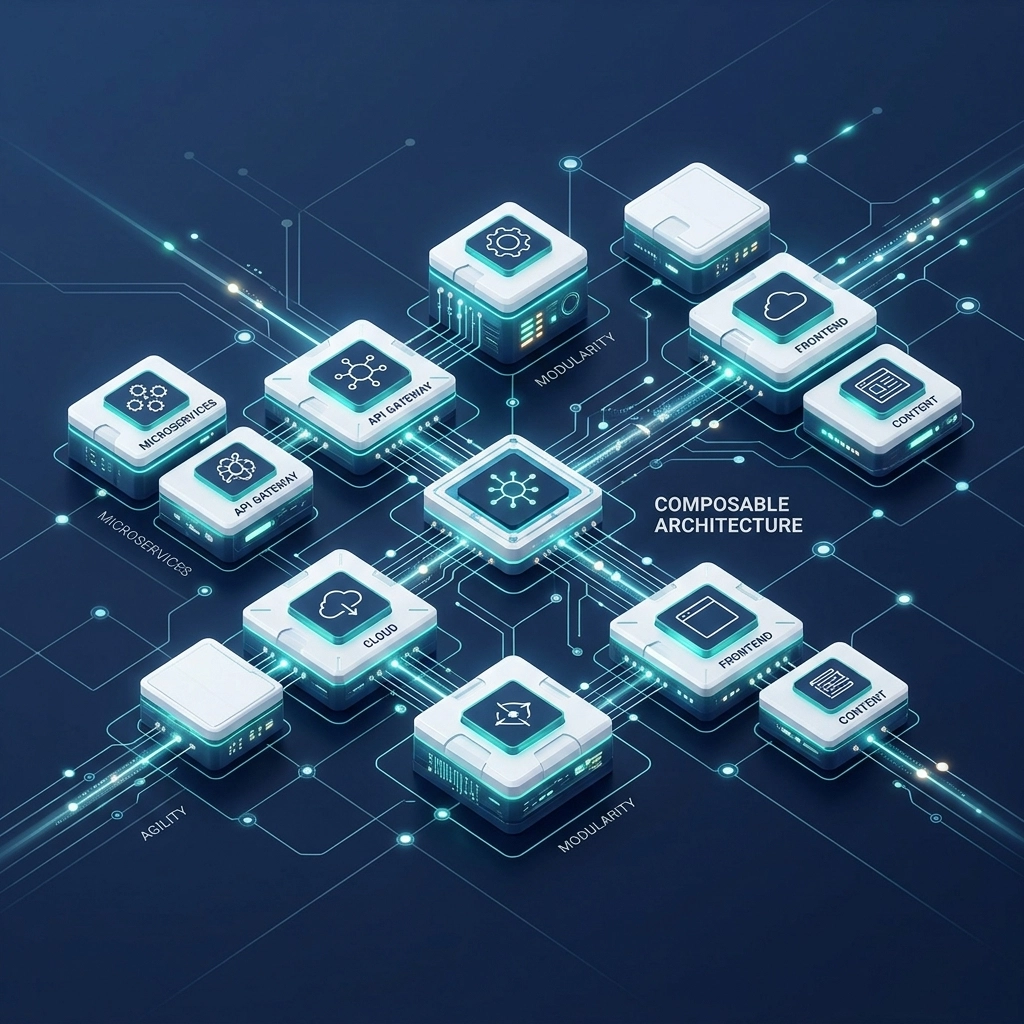
At its heart, composable architecture is a design philosophy where business capabilities are treated as independent “building blocks.” Instead of one giant application, you have a series of specialized services that talk to each other via APIs.
Think of it like LEGO. If you’re building a LEGO castle and decide you want a space laser on the tower, you just snap one on. You don’t have to melt the whole castle down and recast the plastic. In the world of bespoke software development, this means using a mix of best-of-breed tools, one for your CRM, one for your payments, one for your search engine, and tying them together into a high-performing ecosystem.
The 5 Pillars of a Composable Foundation
To understand why this is the gold standard for digital transformation services, we need to look at the architectural DNA:
- Modularity
- Speciality: Breaking complex systems into discrete, manageable components.
- Key Feature: Each module serves one specific business function (e.g., pricing, user authentication).
- Benefit: Developers can update a single module without touching the rest of the codebase.
- Autonomy
- Speciality: Independent operation and scaling of components.
- Key Feature: If the payment gateway goes down, the product catalog still works.
- Benefit: High system resilience and easier debugging.
- Discoverability
- Speciality: Making internal and external services easy to find and use.
- Key Feature: Comprehensive API documentation and service registries.
- Benefit: Reduces “re-inventing the wheel” syndrome across large development teams.
- Orchestration
- Speciality: Managing the interactions between different modules.
- Key Feature: Smart workflow engines that coordinate data flow.
- Benefit: Seamless user experiences across disparate tech stacks.
- Flexibility
- Speciality: The ability to swap or upgrade parts without friction.
- Key Feature: Vendor-agnostic design.
- Benefit: No more being “locked in” to a legacy provider just because it’s too hard to leave.
Why Composable Architecture is the Secret Sauce for AI ROI
Everyone is talking about AI, but here’s the cold, hard truth: AI is only as good as the data it can access. If your data is trapped inside a monolithic “black box,” your expensive AI agents are basically trying to read a book through a keyhole.
Businesses that embrace composable architecture are seeing significantly higher AI ROI. Why? Because a modular system is inherently “API-first.” This means your AI can easily “plug in” to your inventory, your customer data, and your logistics modules simultaneously. It can orchestrate complex tasks because the infrastructure was built for connectivity.
At Chimpare, we’ve seen that companies with a composable foundation can deploy AI features 3x faster than those struggling with legacy migrations. When your data is liquid and your services are modular, AI isn’t just a gimmick; it’s a force multiplier.

Comparing the Old Guard vs. The New Wave
| Feature | Monolithic Architecture | Composable Architecture |
|---|---|---|
| Speed of Change | Slow (Weeks/Months for updates) | Fast (Hours/Days for updates) |
| Scalability | All or nothing | Scale individual components as needed |
| Vendor Lock-in | High (Hard to leave one platform) | Low (Swap vendors easily) |
| Risk of Failure | High (System-wide crashes) | Low (Failures are isolated) |
| Cost | High upfront, high maintenance | Pay-as-you-go, optimized ROI |
| Developer Happiness | Low (Working in “spaghetti code”) | High (Using modern, clean APIs) |
The Tech Behind the Transformation: Choosing Your Tools
Building a composable ecosystem requires the right tools. You can’t build a modular skyscraper with toothpicks. Here are the core technologies we leverage at Chimpare to deliver world-class bespoke software development.
1. Node.js: The King of Scalable APIs
- Speciality: Fast, non-blocking I/O for real-time applications.
- Release Date: 2009 (Matured into an enterprise staple).
- Key Features: Huge package ecosystem (NPM), excellent for microservices.
- Why it fits: Node.js development allows for lightning-fast communication between modules, making it perfect for the “Orchestration” layer of a composable setup.
2. Python: The AI and Data Powerhouse
- Speciality: Data science, machine learning, and rapid prototyping.
- Release Date: 1991 (With modern iterations like 3.12).
- Key Features: Clean syntax, vast libraries for AI (TensorFlow, PyTorch).
- Why it fits: If you’re looking for a Python development company, you’re likely looking to build the “brain” of your modular system. Python handles the heavy lifting of data processing while staying modular.
3. Kotlin & Swift: Modular Mobile Experiences
- Speciality: High-performance native mobile apps.
- Key Features: Strong typing, memory safety, and modern syntax.
- Why it fits: Your mobile app shouldn’t be a separate silo. Using Kotlin and Swift allows you to build mobile interfaces that pull from the same composable APIs as your web platform.
4. .NET & Laravel: The Reliable Backbones
- Speciality: Enterprise-grade stability and rapid web development.
- Key Features: .NET offers massive corporate support, while Laravel provides elegant PHP syntax for rapid modular builds.
- Why it fits: These are perfect for building the core “Business Capability” modules that require 100% uptime and rigorous security standards.
The Reality of Costs: Is Composable More Expensive?
Problem: Management is worried that building “many small things” will cost more than buying “one big thing.”
Solution: Focus on Total Cost of Ownership (TCO). Monoliths have hidden costs in technical debt and “workarounds.” Composable systems offer lower long-term costs through efficiency and the ability to scale only what is needed.
Upfront Investment vs. Long-term Agility
While the initial design phase of a composable architecture requires a strategic investment in “Digital Transformation Services,” the long-term savings are massive.
- No Over-Provisioning: You don’t pay for 1,000 features if you only use 10.
- Reduced Maintenance: It’s easier and cheaper to fix a small module than to debug a million lines of interconnected code.
- Market Speed: Being first to market with a new feature (thanks to modularity) often pays for the entire architecture in a single quarter.
Common Mistakes to Avoid in Your Digital Transformation
Even with the best intentions, it’s easy to trip up. Here’s what we see most often:
- Over-Engineering the Modules: Don’t break things down so much that you end up with 5,000 micro-services that are impossible to manage. Aim for “Packaged Business Capabilities” (PBCs).
- Ignoring Governance: If every team picks their own language and database for every small module, you’ll end up with a “tech zoo.” Set some standards!
- Neglecting the API Layer: Your APIs are the glue. If the glue is cheap and brittle, the whole thing falls apart. Invest in scaling microservices properly.
- The “Big Bang” Migration: Don’t try to switch everything overnight. Start with one high-impact area, like your checkout process or your customer portal, and move it to a composable model first.

How to Select Your Digital Transformation Partner
Choosing the right partner for bespoke software development is like choosing a co-founder. You need someone who understands your business goals, not just someone who can write code.
- Look for API Expertise: Ask them how they handle data integration and third-party services.
- Check Their Track Record: Have they actually delivered modular systems before? Look at their previous work to see if they build for scale.
- Assess Their Tech Breadth: Do they only know one tool? A composable partner needs to be comfortable with everything from React Native to RPA development.
The Chimpare Approach: Building for the Future
At Chimpare, we don’t just build apps; we build ecosystems. Whether we’re helping a client with Flutter app development or implementing complex RPA solutions, our philosophy remains the same: Stay Modular. Stay Fast. Stay Future-Proof.
We’ve helped UK businesses transform from sluggish legacy giants into agile, composable leaders. We focus on the “why” before the “how,” ensuring that every module we build adds direct value to your bottom line.
FAQ: Digital Transformation & Composable Architecture
Q: Is composable architecture only for large enterprises?
A: Absolutely not. In fact, startups and SMEs benefit even more because it allows them to scale without the “re-platforming” pains that usually hit at the 2-year mark.
Q: How does this affect my existing legacy systems?
A: You don’t have to delete your old system. We can use APIs to “strangle” the monolith, gradually moving features out of the old system and into new, composable modules until the old system is no longer needed.
Q: What is the first step in a digital transformation journey?
A: An audit. You need to understand where your “bottlenecks” are. Is it your data flow? Your slow release cycles? Once we find the pain point, we build the first module to fix it.
Q: Can we use off-the-shelf tools in a composable setup?
A: Yes! That’s the whole point. You can use a bespoke module for your “secret sauce” functionality and an off-the-shelf tool (via API) for standard things like email or payments.
Final Thoughts: Adapt or Get Left Behind
The world isn’t slowing down. By 2026, the companies that are still trying to update their monolithic systems will be the ones wondering why their competitors are launching AI features in days while they take months.
Composable architecture isn’t just a buzzword; it’s a survival strategy. It’s about building a business that can change its mind without breaking its bones. It’s about making your digital transformation services actually work for you, rather than you working for your software.
Ready to stop fighting your software and start winning with it? Let’s build something modular. Contact Chimpare today and let’s get your digital transformation moving.