
Author: Samuel Meleder

  • What Do You Need to Know About Web App Development?

    What Do You Need to Know About Web App Development?

    Web-App-Development
    [ez-toc]

    More than 85% of online customers utilise the internet every day, making it an important aspect of contemporary digital studies. Unlike static websites, which are in the main used to expose records, a web utility is interactive, permitting customers to log in, edit information, behaviour transactions, and participate in real-time sports immediately from their browser. For developers and businesses alike, information in web app development is crucial. The internet app improvement manner goes beyond simply writing code; it involves making plans, selecting the proper frameworks, ensuring scalability, maintaining strong security, and providing a simple user experience. With the decision for fast, reliable, and character-friendly solutions, corporations are investing in expert internet app development services.

    Working with the proper web app development enterprise can streamline this adventure, presenting knowledge in frontend, backend, cloud integration, and testing. To reduce costs, shorten time-to-market, and create apps that can grow with their customer base, many businesses increasingly collaborate with specialized web app development firms.

    Everything you need to know will be covered in this guide, from comprehending the foundations of web applications to investigating the instruments, procedures, and tactics that create effective applications.

    Unlock Web Development Potential for Your Business Today

    From roadmap to execution, we’ll help you implement AI that drives measurable growth.


    Book Your Free App Consultation

    What is Web App Development?

    Web app development is the method of making packages that run in an internet browser and deliver interactive, dynamic functionality to users. Web applications, as opposed to traditional websites that only display static material, let customers to execute real-time tasks such as online purchase, statistics management, teamwork, and voice communication directly through the browser without the need to install software on their devices.

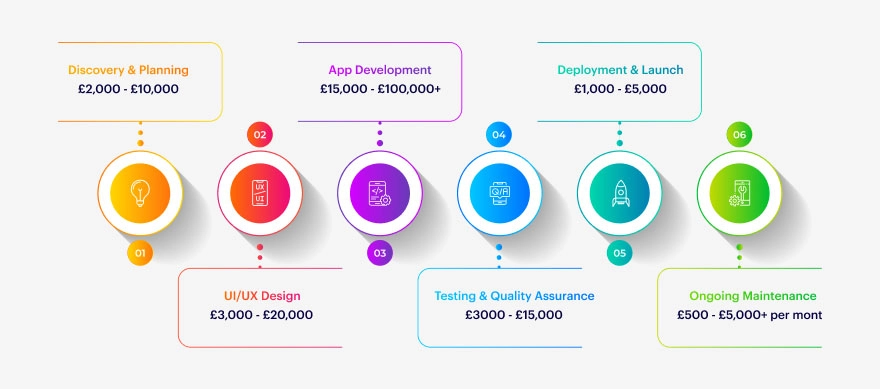
    The net app improvement approach entails a couple of stages, along with making plans, designing, coding, testing, deployment, and ongoing maintenance. Each diploma calls for careful interest in scalability, performance, and protection to make sure that the utility remains reliable and adaptable as business goals evolve.

    When groups accomplice with an expert web app development corporation, they gain access to specialised expertise in frameworks, backend structures, frontend technologies, and cloud integration. Experienced internet app development organisations additionally carry dependent workflows, confirmed methodologies, and best practices that lessen dangers and speed up time-to-market.

    Some key aspects that define modern-day internet app improvement services include:

    • Custom Architecture: Performance and scalability need play a chief function in deciding on the satisfactory frameworks (together with React, Angular, Node.js, and Django).
      The potential of a software program to paintings easily across devices and browsers is referred to as go-platform compatibility.
      The application of authentication, encryption, and authorisation processes is known as data security. 
    • User-Centric Design: Giving UI/UX top priority to create software that is practical and simple to use. 
    • Constant Improvement: Maintaining the app’s capability and ensuring users are properly knowledgeable.

    To put it briefly, internet app improvement isn’t simply about growing software programs; it is about developing flexible, reliable, and person-friendly digital solutions that help companies innovate, engage with clients, and preserve their competitiveness in the rapidly evolving virtual landscape of nowadays.

    What are the Core Components of Web App Development?

    A good web app development consists of several interrelated parts that come together to create a quick, reliable, and visually appealing digital experience. To build scalable and dependable programs, developers need to know about these layers.

    Whether you are running with a web app development company or managing responsibilities independently, you may be coping with the following primary blocks:

    1. Front-End Development
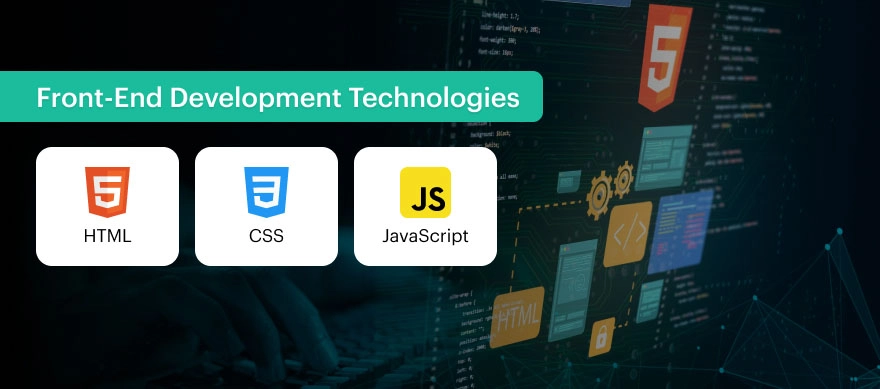
    Technologies Used:

    • HTML: Provides structure and content
    • CSS: Handles styling, colours, and layout
    • JavaScript: Adds interactivity and dynamic functionality
    • Frameworks & libraries: React, Angular, and Vue.js help to streamline the web app development process by offering reusable components and efficient state management.

    Key Focus areas: All-user accessibility, device responsiveness, and smooth interaction.

    2. Back-End Development
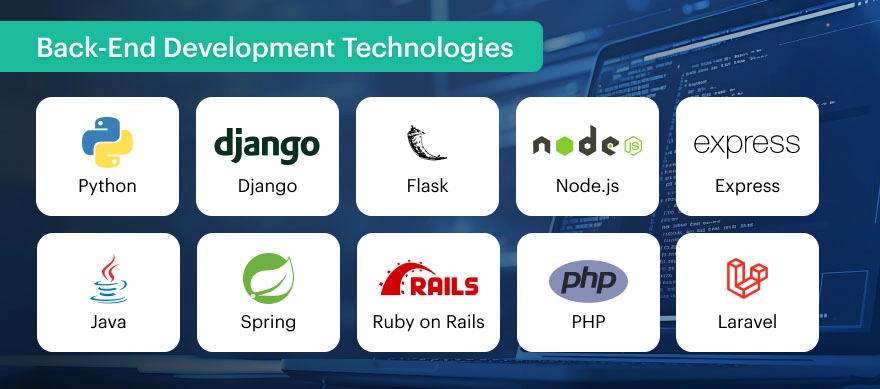
    The back-end powers the good judgment and capability of the web app. This is where records are processed, stored, and brought.

    Core tasks: Handling business logic, managing authentication, and processing user requests.

    Language & Frameworks

    • Python (Django, Flask): Great for rapid, scalable apps
    • Node.js (Express): Ideal for real-time, event-driven apps
    • Java (Spring): Enterprise-grade robustness
    • Ruby on Rails: Fast and developer-friendly
    • PHP (Laravel): Flexible for many small to mid-scale projects.

    3. Databases
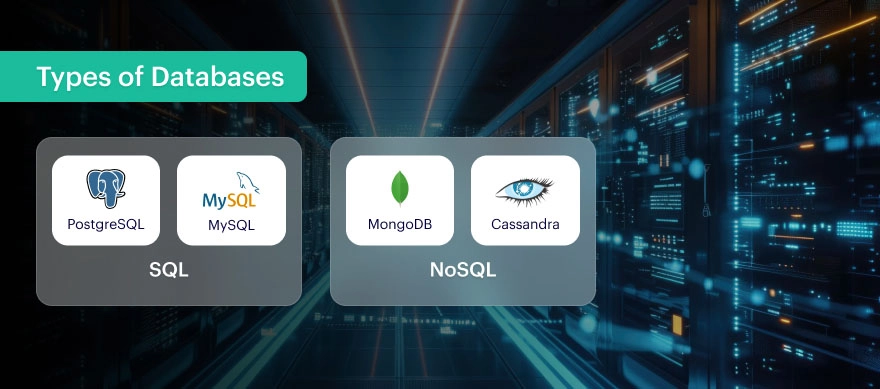
    Types-of-Databases

    Databases act as the spine of every web utility. They store everything from user profiles to transaction records.

    Types of Databases:

    • SQL (PostgreSQL, MySQL): Structured, relational, great for complex queries.
    • NoSQL (MongoDB, Cassandra): Flexible, schema-less, suited for large-scale or real-time data.

    Best Practices: Use efficient database design, indexing, and caching to provide scalability and quick query responses.

    What are the Technologies and Tools in Web App Development?

    Building a modern-day internet utility involves more than without a doubt writing code; it’s also deciding on the proper equipment, frameworks, and processes to ensure performance, scalability, and maintainability.

    Knowing such technology is vital for net app builders as it without delay impacts how rapid, strong, and user-friendly the software is. Many net app development organisations depend on tested frameworks, languages, and offerings to deliver sturdy solutions to customers.

    1. Front-End Frameworks and Libraries

    The front end of an internet software determines its design and capability. Developers utilise frameworks and libraries to speed up development and bring normal, responsive client interfaces.

    • React: A component-based JavaScript library ideal for dynamic, single-page applications.
    • Angular: A full-fledged framework from Google, ideal for large-scale enterprise apps.
    • Vue.js: Lightweight and flexible, great for projects needing quick integration.

    Key considerations when choosing a tool:

    • Project size and complexity.
    • Developer skills on the team.
    • Community support and ecosystem maturation.

    2. Back-End Frameworks and Languages

    Back-end development handles information processing, server logic, and API introduction. The tools chosen here are used to determine the performance and scalability of the application.

    • Node.js (Express.js): Runs JavaScript on the server, ideal for real-time apps. 
    • Python (Django, Flask): Django is for large, structured projects and Flask is for lightweight apps. 
    • Ruby on Rails: Convention-over-configuration approach for rapid development. 
    • Java (Spring Boot): Enterprise-grade framework for high-performance solutions. 
    • PHP (Laravel): A versatile option used by many web app development companies.

    APIs are central to the process, allowing smooth communication between the patron-facet and server-side. REST and GraphQL are popular strategies for handling these facts in an alternative manner.

    3. Version Control Systems

    Version management is the foundation of collaborative development. It logs every change made to the codebase, allowing groups to collaborate without conflict.

    • Git: Industry standard for version control.
    • GitHub / GitLab: Platforms offering repository hosting, issue tracking, pull requests, and CI/CD integrations.

    Benefits:

    • Safer collaboration among teams.
    • Easier bug tracking and rollback to earlier versions.
    • Better project management and accountability.

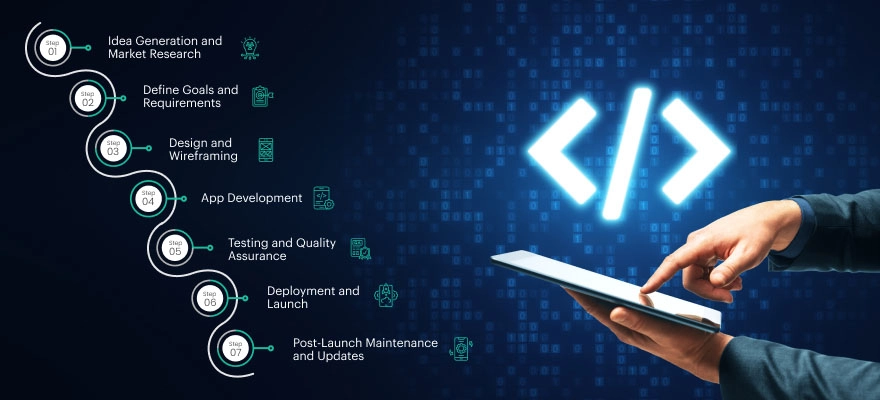
    What is the Web App Development Lifecycle?

    The process of making a web utility is a scientific one that entails more than one distinct stage, ranging from theory to ongoing development. In order to guarantee that the software is scalable, strong, and smooth to apply, each step builds upon the one before it.

    Many web app development companies comply with this lifecycle to deliver expert effects through streamlined web app development services.

    1. Planning and Requirement Gathering

    This stage lays the foundation. Developers, stakeholders, and sometimes a web app development company collaborate to:

    • Define the purpose of the software and its enterprise desires.
    • Identify the audience and their needs.
    • List essential features and technical requirements.
    • Conduct market studies and competitor analysis to identify opportunities.
    • Create user testimonies and wireframes for a clear vision of capability.

    A clear plan ensures that the crew knows each the technical and commercial enterprise direction earlier than moving forward.

    2. Design and Prototyping

    Here, ideas transform into interactive visuals. UI/UX designers use tools like Figma, Sketch, or Adobe XD to produce wireframes and clickable prototypes.

    • Focus subjects consist of accessibility, responsive design, and person-pleasant navigation.
    • Benefit of prototyping: Before coding begins, stakeholders can “test” the utility.
    • Early comments reduce costly layout modifications later in the procedure.

    3. Development and Coding

    This is the centre of internet app improvement, where front-end and back-end teams bring the app to life. Agile methodologies like Scrum or Kanban are typically used for iterative development.

    • Developers observe coding first-rate practices for maintainability.
    • Frameworks and gear (React, Angular, Django, Node.js, Laravel) streamline the construct.
    • Code opinions improve the pleasant experience and identify any problems early on.

    4. Testing & Quality Assurance (QA)

    Testing guarantees that the app’s capabilities are as planned and secure. Key practices include:

    • Individual components are validated using unit testing.
    • System testing: Evaluates the entire application under practical conditions.
    • The process of testing functionality with real users is called user acceptance testing, or UAT.
    • Performance and security testing guarantees that the application is secure, scalable, and fast.

    Professional web app development firms can be distinguished from amateur initiatives by having a robust quality assurance approach.

    5. Deployment and Launch

    Following checking out, the software is deployed to production servers, every so often, with the assistance of cloud service carriers, which include AWS, Azure, or Google Cloud. Many groups utilise CI/CD pipelines to automate builds, tests, and deployments to be able to minimise human errors and facilitate faster releases.

    Monitoring after launch is essential. Developers monitor user activity, uptime, and performance. Analytics and logs provide information about the software’s performance in real-world scenarios.

    6. Maintenance and Continuous Improvement

    The lifecycle doesn’t stop at release. Continuous updates, malicious program fixes, safety patches, and characteristic enhancements keep the app aggressive. A dependable web app development company will usually consist of ongoing aid as part of its net app development offerings.

    Smarter Decisions. Faster Outcomes.

    Leverage expert web development consulting to cut costs, boost efficiency, and stay ahead of competitors.


    Talk to Our Experts Now

    What are the Key Considerations for Successful Web App Development?

    Beyond following the net app development manner, a successful software requires an interest in numerous important factors. These considerations ensure not only easy transport but additionally long-term balance, adaptability, and user delight.

    Whether you’re building independently or operating with an internet app development agency, addressing these areas early helps keep away from highly priced pitfalls later.

    1. Scalability and Performance

    A web app must be built with boom in mind. Scalability ensures the app can take care of more users, requests, and records without losing performance. Developers often plan for this by:

    • Choosing scalable architectural styles consisting of microservices.
    • Using caching mechanisms reduces server load.
    • Implementing load balancing to distribute visitors across more than one server.
    • Optimizing code and database queries for faster execution.

    Real-global examples, along with Netflix and Amazon, demonstrate how net app development organizations create programs capable of dealing with tens of millions of concurrent users using smart scaling strategies and advanced CDNs.

    2. Security Best Practices

    Security is one of the maximum crucial aspects of net app development services. Data breaches and vulnerabilities can damage consumers accept as true with and commercial company’s reputation. Developers should:

    • Encrypt important records both at rest and in transit.
    • Implement regular authentication and position-primarily based authorisation (MFA, OAuth2).
    • Follow the OWASP Top 10 tips to reduce common vulnerabilities, which include SQL injection, XSS, and compromised authentication.
    • Conduct normal penetration, trying out and protection audits.

    A secure app not only protects users but also increases the trust of the company behind it.

    3. User Experience and User Interface

    A robust application means little if users find it confusing or difficult to use. A good web app development company prioritises:

    • Navigation is intuitive, with clear, logical paths available via the app.
    • Responsive design: seamless flexibility across laptops, tablets, and mobile devices.
    • Accessibility: Screen reader compatibility and keyboard navigation promote inclusion.

    An interesting and inclusive layout keeps people coming back and increases retention rates.

    4. Maintenance and Updates

    The release of software is most effective at the beginning. Continuous assistance is vital for lengthy-time period fulfilment:

    • Regular malicious program fixes, overall performance improvements, and safety patches.
    • Rolling out new capabilities in line with converting market and commercial enterprise desires.
    • Monitoring with analytics tools (e.g., Google Analytics, New Relic) to track consumer behaviour, become aware of bottlenecks, and provide destination updates.

    Many web app improvement companies offer post-release support as part of their web app improvement services, assisting businesses to stay competitive in evolving markets.

    Your AI Transformation Starts Here

    Get a custom plan built around your business goals—without the tech overwhelm.


    Start Your Project Today

    Conclusion

    Writing code is handiest a small part of expertise in internet app development; it also calls for an organised process, the right gear, and ongoing development. A successful product is formed by way of each step of the web app development process, which incorporates planning, design, coding, testing, deployment, and continuing protection and upgrades.

    A contemporary web utility isn’t just about functionality; it needs to additionally deliver scalability, overall performance, and protection. For builders, this means adopting fine practices along with caching, load balancing, encryption, and stable authentication. For agencies, this highlights the need to partner with the right internet app improvement organisation or explore reliable web app improvement services that ensure long-term fulfilment.

    As technology evolves from cloud-local packages to AI-driven functions, the industry will have to conform. Companies that embody innovation and builders who commit to continuous mastery will thrive in this space. In the quit, effective internet app development is a mix of technical understanding, a considerate approach, and a person-first mindset, the genuine method for constructing destiny-driven digital answers.

    FAQs


    1. How is AI impacting custom software development?


    AI automates coding, testing, and bug detection, reducing errors and boosting efficiency. It also enables smarter, adaptive apps that respond to user needs in real time.


    Machine Learning helps apps learn from data, enabling personalisation, predictions, and anomaly detection. Developers use it to enhance user experience and automate complex processes.


    Yes, By automating repetitive tasks, speeding up testing, and generating code, AI shortens development cycles, saving both time and cost for businesses.


    AI/ML offer efficiency, scalability, personalization, predictive insights, and cost savings making software more intelligent, adaptive, and future-ready.

    Found this post insightful? Don’t forget to share it with your network!



    Related Articles

  • How To Build An MVP and Why It’s Essential For Your Success?

    How To Build An MVP and Why It’s Essential For Your Success?

    MVP-Development
    [ez-toc]

    Launching a brand-new product in today’s fast-shifting digital global environment can feel like stepping onto a Formula 1 track, fast, competitive, and volatile. That’s what MVP development is available in.

    Before you’re making a massive funding in large-scale development, you ought to study your concept with actual consumers using an MVP, which is the initial version of your product that quality includes the maximum critical elements.

    In easy terms, MVP app improvement allows you to bring your concept to life fast, validate it within the marketplace, and research from actual consumer feedback. Instead of spending months or even years building a “perfect” product, agencies can save time, cash, and resources via that specialize in centre price. This technique not handiest reduces dangers but also increases the probabilities of building something people simply want.

    It makes sense for entrepreneurs to use MVP software development services or collaborate with an MVP app development company. With a working prototype, they can attract investors, move quickly, and acquire early users. MVP development services guarantee that your idea is sound before it is expanded into a final product, whether you are creating a mobile app, SaaS platform, or digital tool.

    What is an MVP Development?

    What-is-an-MVP-Development

    MVP development might be compared to testing a novel recipe before launching a full-scale eatery. Rather than investing months in developing each feature, you start with the “core dish”, the most crucial element to gauge user interest. An MVP, or minimum viable product, is the initial iteration of a software or program that provides consumers with just enough value while controlling costs and risks.

    Businesses only concentrate on the essential elements that address the primary issue for users when developing MVP apps. Before going large, this enables startups to test their product on actual consumers, gather feedback, and make necessary improvements. By testing concepts early in the market, an MVP app development business helps owners avoid squandering money on features that no one needs.

    Whether it’s a mobile app, SaaS tool, or digital platform, MVP software development services provide a structured way to experiment, learn, and improve. By using MVP development services, companies can gain investor confidence, build a loyal user base, and reduce the risk of product failure, all while moving faster in today’s competitive digital space.

    What are the Key Benefits of MVP Development?

    Key-Benefits-of-MVP-Development

    The real electricity of MVP development lies in its capacity to turn a big concept into a sensible, testable product without draining all of your resources. Instead of building the whole thing at once, an MVP makes a speciality of the most precious factors as a way to have the very best impact. Here are the key features that make MVP app improvement so effective:

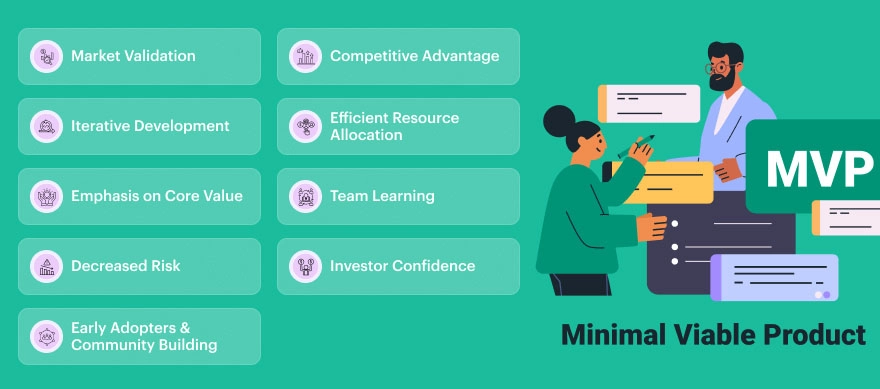
    • Market Validation – Before pouring money into full-scale development, an MVP allows startups to test their idea with real users and understand if there’s genuine demand.
    • Iterative Development – With MVP software development, feedback loops guide continuous improvements. Each update is based on real user behaviour, not just assumptions.
    • Emphasis on Core Value: By doing away with unnecessary capabilities and highlighting the product’s number of answers, an MVP improves clarity and value.
    • Decreased Risk: By starting small, you could decrease your financial risks and avoid extreme setbacks. Many founders depend upon an MVP app development enterprise to ensure a safe, gradual release.
    • Early Adopters & Community Building: MVP users usually develop into committed supporters who share information about your product and offer feedback.
    • Competitive Advantage – Getting to market quickly with MVP software improvement services offers startups a head start, frequently before the competition reacts.
    • Efficient Resource Allocation – By prioritising what matters, MVP development offerings help teams spend wisely on time, talent, and effort.
    • Team Learning – Building an MVP teaches the team about workflows, tech stacks, and patron behaviour, all of which shape the future product roadmap.
    • Investor Confidence – Investors decide on seeing a running prototype in place of just a concept. A strong MVP demonstrates capacity and boosts investment opportunities. 

    What are the Step-by-Step Guide to Building Your MVP?

    A successful product requires not infinite code but intellect and rapid learning. As a end result, growing an MVP is a systematic and organised method. Here’s how businesses and startups should go about creating MVP apps:

    Step-by-Step-Guide-to-Building-Your-MVP

    Step 1: Conduct Market Research

    Every robust MVP starts with studies. Use surveys, interviews, competitor evaluation, and keyword research to apprehend your target market. This guarantees your product solves a real hassle earlier than making an investment in money and time.

    Step 2: Define Your MVP Scope

    Identify the core trouble your product solves. Brainstorm features, then filter out everything needless. The goal of MVP software program software development is to attention most effective on the features that count number maximum.

    Step 3: Choose a Business Model

    Decide how your MVP will generate revenue from subscription, freemium, advertising and marketing, transaction expenses, or e-commerce. A dependable MVP app improvement organisation will assist you in choosing a version that aligns with your market.

    Step 4: Wireframing and Prototyping

    Before writing a single line of code, plan out the prototype. Create wireframes and prototypes, then test them with real users. This reduces both costs and development time.

    Step 5: Choose the Right Tech Stack

    Select technology that assists scalability, protection, and speedy deployment. In MVP software program development services, the right stack could make or spoil your assignment.

    Step 6: Build the MVP

    Decide whether or not to broaden in-house, hire outstaffed talent, or outsource. Many startups depend upon MVP improvement offerings to speed up shipping while retaining prices under control.

    Step 7: Testing and QA

    Your MVP need to be characteristic smoothly. Test for usability, performance, safety, and functionality. Use each manual and automatic exam with proper documentation.

    Step 8: Launch, Monitor, and Improve

    Deploy your MVP and monitor its performance. Collect person comments, tune records, and execute launch plans (smooth, hard, or dark). Iteration is crucial in MVP app development. 

    Step 9: Scaling Beyond the MVP

    Once your MVP gains traction, growth plan. Expand your feature roadmap, scale infrastructure, strengthen your team, and refine monetisation. This is where MVP software development programs evolve into full-scale product development.

    Smarter Decisions. Faster Outcomes.

    Leverage expert AI consulting to cut costs, boost efficiency, and stay ahead of competitors.


    Talk to Our Experts Now

    What are the Best Practices for MVP Development?

    Building an MVP isn’t always just about writing code fast; it’s about building smarter and lowering dangers. To make the maximum of MVP development, startups and businesses want to observe validated fine practices that ensure fulfilment.

    1. Stick to Lean Principles

    The aim of MVP app development is to conserve resources even as growing fee. Concentrate totally on the capabilities that solve the number one problem and keep away from superfluous complications. A competent MVP app development company will always propose starting small and scaling later.

    2. Validate Ideas Early

    Before investing in full-scale MVP software development, check your concept with actual customers. Create clickable prototypes, perform small polls, and launch beta variations. Early validation guarantees that you are fixing the appropriate trouble.

    3. Prioritise User Feedback

    Listening to your first users is one of the biggest advantages of MVP software development services. Their feedback helps refine features, fix usability issues, and shape the future product roadmap.

    4. Adopt Iterative Development

    MVPs are not final products. They evolve with every version. Continuous iterations allow you to improve the product in smaller, faster cycles instead of risky big releases.

    5. Balance Speed with Quality

    Rushing can hurt your MVP’s credibility. While speed is crucial, high-quality subjects are more. Partnering with the proper MVP improvement offerings guarantees your product is rapid, purposeful, and dependable.

    6. Keep the Business Model in Mind

    From day one, align your MVP with a sustainable sales model, whether it’s subscription, freemium, or transaction-based, totally. MVP software program improvement isn’t just about code; it’s about long-term strategy.

    Smarter Decisions. Faster Outcomes.

    Leverage expert AI consulting to cut costs, boost efficiency, and stay ahead of competitors.


    Talk to Our Experts Now

    What are the Common Pitfalls to Avoid During MVP Development?

    While MVP development gives startups a quicker and smarter direction to the marketplace, many groups stumble through making commonplace mistakes. Avoiding these pitfalls can save both money and time while increasing your product’s probabilities of success.

    1. Overbuilding Features Instead of Focusing on Core Value

    One of the mistakes in MVP app development is attempting to construct an excessive number of features, too fast. Adding extraneous functions dilutes the number one value of your product. The reason for an MVP is clarity, not complexity.

    2. Skipping Market Validation

    Without validating your idea, even the maximum polished MVP can fail. Successful MVP software program improvement usually starts with market studies, user interviews, and trying out assumptions earlier than coding.

    3. Ignoring User Feedback Loops

    User remarks are the lifeline of MVP software development offerings. Ignoring it method misses out on treasured insights which can guide improvements and shape your roadmap. Always concentrate on early adopters; they’re your quality critics and supporters.

    4. Rushing Development Without Planning or Testing

    Speed is essential; however, rushing ends in bugs, negative design, and usability issues. A reliable MVP app development business enterprise guarantees right planning, testing, and documentation, so the product is dependable from day one.

    By steering clear of these pitfalls, startups can completely leverage MVP improvement offerings, validating quicker, gaining knowledge of smarter, and scaling more potent. Remember: an MVP isn’t approximately constructing the “perfect” product; it’s approximately building the right product.

    Why Partnering with Chimpare Makes MVP Development Effective?

    Building an MVP isn’t pretty much writing code; it’s approximately strategy, timing, and execution. That’s wherein Chimpare stands out as a dependable companion in MVP development. With years of enjoy in assisting startups and establishments, Chimpare follows an established method that guarantees your product idea transforms into a marketplace-equipped MVP.

    As an MVP development company, Chimpare combines technical expertise with strategic thinking. Our team employs agile methods, which means that your MVP is created in rapid iterations with regular feedback loops to accelerate changes. This method not only saves money but also assures that your product evolves in the appropriate direction.

    With MVP software development services from Chimpare, you get more than just coding support; you gain a partner who understands market trends, user behaviour, and business models. From validating your idea to scaling it into a full product, Chimpare’s MVP development services cover every stage.

    A startup presents us with an app concept, however a restricted budget. Instead of manufacturing the whole thing immediately, we assist them in figuring out the key features, creating a functioning prototype, and launching it to early adopters. Within weeks, they acquire precious remarks, attract investors, and scale speedier all without wasting resources.

    In short, Chimpare makes MVP software development powerful through focusing on cost-performance, agility, and method, helping you build smarter, not just faster.

    Your AI Transformation Starts Here

    Get a custom plan built around your business goals—without the tech overwhelm.


    Start Your Project Today

    Conclusion

    In today’s competitive virtual market, velocity and precision determine whether an idea succeeds or fails. That is exactly why MVP development has become the preferred technique for startups and businesses. MVPs create a clear path to product market readiness by emphasising important functionality, testing concepts early on, and gathering consumer feedback.

    Whether you’re running with a trusted MVP app development agency or leveraging MVP software improvement services, the aim remains the same: construct lean, check speedy, and scale smart. With MVP app improvement, corporations can entice early adopters, benefit investor self-assurance, and use assets accurately even as maintaining risks under control.

    At Chimpare, we assist thoughts into a hit product through our proven MVP development offerings. From idea validation to complete-scale release, our agile process ensures your product grows within the proper course.

    If you’re equipped to deliver your imaginative and prescient to existence and need a partner who blends technical knowledge with strategic steerage, hook up with Chimpare these days permit’s build your MVP for tomorrow’s fulfilment.

    FAQs


    1. What is an MVP in product development?


    An MVP (Minimum Viable Product) is the primary model of a product with the simplest middle features. It’s built to test ideas, validate the call for, and collect actual user comments earlier than full-scale development.


    The key steps are looking into the market, setting the core area, picking a business model, making a first model, choosing the right tech setup, making it better, checking, starting, and growing based on what people say.


    Some common mistakes are overbuilding capabilities, skipping market validation, ignoring user remarks, and speeding up improvement without making plans or trying out.


    Making an MVP can take 3 to 6 months, based on how hard it is, what it can do, and how big the team is. Working with a skilled company that makes MVP apps can make things faster.

    Found this post insightful? Don’t forget to share it with your network!



    Related Articles

  • How to Choose the Right AI Models for Your Project?

    How to Choose the Right AI Models for Your Project?

    AI-Models
    [ez-toc]

    Choosing the best AI models for a project is like picking the right device for a process. If you pick appropriately, your venture can run smoothly, shop time, and yield first-rate effects. However, if finished incorrectly, you hazard losing belongings, experiencing horrific standard overall performance, and having to continuously debug. Today, AI solutions are used anywhere, from predicting patron behaviour and detecting fraud to powering chatbots and automating jobs. But no longer AI models built for every sort of problem.

    Some are higher with pictures, some with text, and others with numbers or real-time decisions. The mission is to understand which one fits your assignment desires.

    In this guide, we’ll walk through a step-by-step process to select the right AI models. We’ll cover the whole lot from understanding your dreams and statistics to testing, expenses, deployment, and even real international examples. By the cease, you’ll have a clear direction to make the right decision for your AI models.

    Step 1: Define Your Project Objectives

    Define-Your-Project-Objectives

    Before you consider an AI model to utilise, you must first define your goals. Your AI venture has to serve a reason which is directly tied to your business enterprise’s objectives. If you do not understand the “why,” you’re more likely to be seeking the wrong solution.

    Ask Yourself:

    • What problem am I trying to solve?
    • How will solving it help my business?
    • What results do I expect from this AI system?

    Once you have that clarity, the next step is identifying the type of problem. AI models are designed for different purposes:

    • Classification is the process of categorising data (for example, spam vs non-spam).
    • Regression is the process of predicting more than a few (inclusive of a sales estimate).
    • Natural language processing is the process of comprehending and producing text (for example, chatbots).
    • Computer vision is the analysis of images or movies (for example, facial recognition).

    Getting this stage properly sets the tone for the entire project and makes model selection much easier later.

    Step 2: Understand Your Data

    Understand-Your-Data

    Your AI model is only as accurate as the information you provide it. If the information is poor, even the neatest model will provide bad consequences. That’s why in AI Modelling, it’s vital to begin by checking both high-quality and quantity. You want enough records for the model to research styles, and it must be accurate, whole, and free from too many mistakes.

    • Structured Data: Examples of dependent data which can be organized nicely in tables are sales figures and consumer records.
    • Unstructured Data: Text, audio, video, and picture formats are examples of unstructured data.

    Each kind has its own management. Before education, records frequently require preprocessing, cleaning, removing duplicates, filling in missing values, or changing formats.

    If your AI mission desires labelled facts (like tagging cats in photographs), you need to make sure of proper annotation. Incorrect labels can mislead the model. Taking time to apprehend and prepare your data nicely will make version education smoother and some distance more accurate.

    Step 3: Know the Types of AI Models

    Know-the-Types-of-AI-Models

    Before you pick an AI model, you should know the main types out there. Each is built for different kinds of problems.

    1. Classical Machine Learning Models  

    These are the older but reliable methods like decision trees, random forests, and linear regression. They work well when your data is smaller and more structured.

    2. Deep Learning Models 

    These are superior and deal with huge, complicated datasets.

    • Convolutional Neural Networks – Best for images and visual records.
    • Recurrent Neural Networks – These are superior and deal with huge, complicated datasets.
    • Transformers – Powerful for understanding language and long-range data patterns.

    3. Large Language Models

    Models like GPT, which could recognise and generate human-like text.

    4. Computer Vision Models

    Specifically for processing and interpreting pictures or videos.

    5. Reinforcement Learning Models

    Learn by using trial and error, terrific for decision-making responsibilities.

    You can also select among pre-skilled fashions (equipped to apply) or custom models (built from scratch). The desire relies upon your statistics, budget, and time.

    Unlock AI’s Potential for Your Business Today

    From roadmap to execution, we’ll help you implement AI that drives measurable growth.


    Book Your Free App Consultation

    Step 4: Evaluate Model Performance Metrics

    After you’ve got a best AI models in mind, you should test their performance. This is where performance metrics come in. They help you measure if the AI model is doing its job right.

    In AI Modelling, the model’s accuracy shows how often it’s correct. While recall gauges how many actual positives the model was able to identify, precision indicates how many of the positive predictions were accurate. The F1-score provides a single score for comparison by balancing recall and precision.

    Other metrics depend on the task. Perplexity gauges a model’s capability to expect textual content, BLEU prices the first-rate of language translation, Log Loss verifies prediction self-self belief, and ROC-AUC assesses how nicely a version divides lessons.

    The model’s accuracy shows how often the AI Agent is correct. While recall gauges how many actual positives the AI Agent was able to identify, precision indicates how many of the positive predictions were accurate. The F1-score provides a single score for comparison by balancing recall and precision.

    Step 5: Consider Computational & Cost Constraints

    Consider-Computational-Cost-Constraints

    Even the best AI models will fail in case you do no longer have the proper configuration in vicinity. Some models are lightweight and might function on a general computer, whilst others require specialised hardware, along with GPUs or TPUs, to address records greater correctly. CPUs paintings well for lesser duties, but GPUs and TPUs are frequently required for huge AI workloads.

    You should also think about costs. There are two main expenses:

    • Training costs – the time and resources needed to teach the model.
    • Inference costs – the cost of running the model once it’s trained.

    Finally, decide where your model or AI Agent will run. Cloud deployment offers flexibility and scalability without shopping for hardware, while on-premises deployment offers you complete management and protection but requires greater prematurely investment. Balancing overall performance with price is fundamental to creating your sustainable AI models.

    Step 6: Deployment & Integration Factors

    Once your AI version is skilled, the subsequent step is getting it to work inside the real international. This is where deployment and integration come in.

    First, consider how the model will technique facts. Do you want real-time processing, where effects come immediately (like chatbots or fraud detection)? Or will batch processing work, in which facts are gathered and processed at set periods (like producing weekly reviews)?

    Next, bear in mind API integration. APIs allow your AI models to connect with other software, apps, or systems. This makes it less difficult to ship information in and get outcomes out without rebuilding your present gear.

    Finally, take a look at compatibility with your cutting-edge tech stack. The model must work smoothly with your existing databases, servers, and platforms. Choosing a version that suits well collectively along with your gadget properly will prevent time, coins, and infinite technical complications.

    Step 7: Compliance, Privacy & Ethics

    AI can be powerful; however, it also comes with huge responsibilities. If your AI Agent includes sensitive data, along with personal statistics, medical statistics, or economic facts, you should follow rigorous privacy guidelines such as GDPR in Europe and HIPAA inside the United States. Establish smooth suggestions for the manner this information needs to be gathered, saved, and used.

    Another key difficulty is bias. If the training facts are biased, the AI version should make unfair or discriminatory choice. This can harm humans and damage your brand’s popularity. It’s critical to regularly check your model for bias and take steps to make it honest.

    Finally, some sectors require explainable AI, which implies you must be able to explain how the model or AI Agent was selected. This increases openness, promotes user trust, and satisfies regulatory requirements. Responsible AI model isn’t just about accuracy; it’s about consideration and fairness too.

    Smarter Decisions. Faster Outcomes.

    Leverage expert AI consulting to cut costs, boost efficiency, and stay ahead of competitors.


    Talk to Our Experts Now

    Step 8: Testing And Validation

    Building an AI version is most efficient half of the time; the actual project is demonstrating that it performs as expected. Testing and validation let you check if your model is correct, reliable, and prepared for real-world use.

    One of the most common methods is using a train/test split. You divide your dataset into  elements, one for education the version and one for trying out it. This shows how the model performs on completely new data.

    To get even better accuracy checks, many teams use cross-validation, where the dataset is split into multiple chunks, and the model is trained and tested on different combinations. This reduces the risk of the results being just a “lucky” outcome.

    When the model moves into production, you can apply A/B testing. Here, you run two versions of the model at the same time, the current one and a new one, and compare which performs better with actual users or real data.

    But testing doesn’t end after deployment. Over time, data changes customer behaviour shifts, market trends evolve, and new patterns appear. This can cause a model to “flow” and lose accuracy. That’s why non-stop tracking is important.

    By monitoring performance in real time and scheduling retraining sessions with clean information, you ensure your AI models stays sharp and promises consistent results. A nicely-examined and regularly demonstrated model isn’t just greater correct, it’s also more honest, scalable, and secure for long-term use.

    Step 9: Making The Final Decision

    After testing and validating unique AI fashions, it’s time to pick out the only that fine suits your mission. This stage is complete; you’ve weighed all of the effects and determined that it balances overall performance, cost, and practicality.

    Begin by comparing models side by side. Look past accuracy, recall speed, scalability, ease of integration, and preservation wishes. A version with barely lower accuracy but faster reaction time or a price decrease is probably the smarter choice in the end.

    To make the method more goal-oriented, you could use a selection matrix or scoring framework. List all of the crucial elements like accuracy, training time, hardware wishes, and explainability and rate every model on these points. This enables you to notice truly which one performs first-class, usual.

    Finally, contain the stakeholders. Business leaders, technical teams, and even cease-users ought to have input, as they will be the ones using or relying on the AI device. A decision backed by absolutely everyone guarantees smoother adoption and higher outcomes while the version is going live.

    Step 10: Post-Selection Best Practices

    Post-Selection-Best-Practices

    Choosing your AI version isn’t the end of the adventure; it’s the start of making sure it works nicely ultimately. These are which post-choice nice practices that are available.

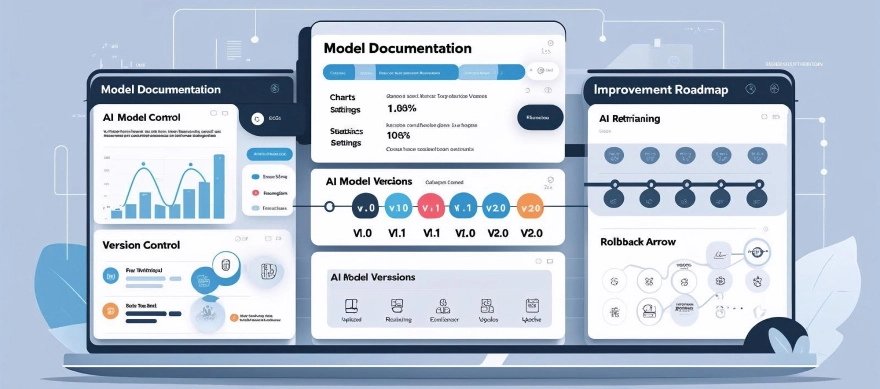
    First, create proper model documentation. Write down details like the information used for education, the parameters chosen, the metrics performed, and any special preprocessing steps. This makes it less complicated for others (or even your future self) to recognise and preserve the model.

    Next, set up version control for models. Just like software code, AI fashions change through the years. Keeping track of different variations ensures you can roll back to a preceding one if the state-of-the-art replaces the reasons for problems.

    Finally, build a model improvement roadmap. AI models can wane as statistics change, so plan for regular overall performance evaluations, retraining schedules, and improvements. In this manner, your model stays accurate, relevant, and aligned with your business dreams.

    Case Studies With Real World Examples

    Understanding AI model selection and AI Use Cases becomes easier when you see how it works in real industries. Here are a few examples:

    1. Healthcare

    Hospitals utilise artificial intelligence to identify diseases in medical scans. Convolutional Neural Networks are the ideal choice for photo-based applications like X-rays and MRIs since they can detect patterns in images. Choosing the wrong model could mean missing critical signs of illness.

    2. Finance

    Banks frequently utilise classification techniques such as Random Forest or Gradient Boosting to detect fraud. These models can quickly detect anomalous expenditure patterns and flag them for evaluation, so reducing financial losses.

    3. Retail & E-commerce

    Online stores use recommendation models and Natural Language Processing to suggest products and improve search results. The right model can increase revenue and enhance the client shopping experience.

    4. Manufacturing

    Factory operators use predictive renovation algorithms to forecast equipment faults. Time-collection forecasting models can help agenda maintenance before issues arise, resulting in fewer financial savings and much less production delays.

    These examples demonstrate that selecting the proper model is heavily encouraged by the sort of records, the corporation’s needs, and the rate at which selections must be made.

    Quick AI Model Selection Checklist

    Here’s a short, practical tick list to utilise on every occasion you start a brand new AI challenge or explore AI use cases. Keep it reachable to make certain you cover all of the essential points, and consider seeking AI consultation for expert guidance.

    • Define Your Goal – Be clear about the business problem and what fulfilment seems like.
    • Understand Your Data – Check the kind, high-quality, and quantity of facts available.
    • Pick the Problem Type – Classification, regression, NLP, imaginative and prescient, or something else.
    • List Possible Models – Include classical ML, deep learning, and pre-trained options.
    • Set Evaluation Metrics – Accuracy, precision, don’t forget, F1-rating, or domain-specific metrics.
    • Check Hardware Needs – CPU, GPU, or TPU necessities.
    • Estimate Costs – Training and inference charges, plus ongoing upkeep.
    • Plan Deployment – Real-time or batch processing, cloud or on-premises.
    • Review Compliance – Privacy laws, bias checks, and explainability.
    • Test and Compare: Before making any final conclusions, conduct cross-validation and A/B testing.

    Completing these degrees lets in you to make confident, informed AI version decisions.

    Your AI Transformation Starts Here

    Get a custom plan built around your business goals—without the tech overwhelm.


    Start Your Project Today

    Conclusion

    Choosing the right AI models isn’t just a technical choice; it’s a mix of understanding about your organization’s goals, understanding your data, and balancing standard performance with fee and practicality. An AI model that works perfectly in principle can fail in the real international if it doesn’t align with your desires or combine properly with your structures.

    The process turns into an awful lot simpler when you observe a clean, step-by-step method: outline your targets, examine your statistics, explore one-of-a-kind model sorts, compare their overall performance, and don’t forget deployment and compliance needs. Real-global trying out, stakeholder involvement, and an improvement plan ensure your AI models stays effective through the years.

    Your next step is to take this framework and use it on your challenge. Start with small experiments, study from the results, and scale up as you benefit self self-belief. With the proper model in place, AI can emerge as one of the maximum treasured tools for your enterprise toolkit.

    FAQs


    1. How can I know which AI version is quality for my mission?


    Begin by organising your targets, assessing record types and fine, and evaluating fashions based on accuracy, velocity, price, and simplicity of integration.


    Examine performance metrics, records wishes, hardware necessities, budget, deployment method, and compliance with privacy or industry regulations.


    You can look into structures like Hugging Face, TensorFlow Hub, PyTorch Hub, and OpenAI’s APIs for pre-trained models, both free and paid.

    Found this post insightful? Don’t forget to share it with your network!



    Related Articles

  • A Comprehensive Guide to IoT Development Services in 2025

    A Comprehensive Guide to IoT Development Services in 2025

    IoT-Development-Services
    [ez-toc]

    When will smart devices become necessary, and not just for entertainment? Your refrigerator sets its temperature, your car communicates with your home, and your watch detects your pulse rate. IoT is no longer sci-fi; it is transforming how we move, live, and create technology, and IoT development services are making this possible.

    But behind every “smart” device is an entire ecosystem of hardware, cloud infrastructure, embedded software, APIs, data pipelines, real-time dashboards, and sometimes even AI at the edge. That’s where IoT development services step in. They don’t just build devices; they engineer connected solutions that talk, sense, process, and act, often in milliseconds.

    This guide is your one-stop map to that complex landscape. Whether you’re planning to launch an industrial IoT system, automate agriculture, or build the next-gen smart city platform, this blog dives deep into the how’s, why’s, and what’s of IoT software development straight from the tech trenches of 2025.

    What are the Key Industries Powering IoT Adoption?

    The IoT has expanded beyond smartwatches and talking toasters. Real-time logistics, related farms, smart manufacturing, and sensible hospitals are all made feasible by way of this invisible era. In 2025, IoT can be the centre of attention in numerous industries in the following ways:

    1. Smart Cities & Urban Infrastructure

    Smart-Cities-Urban-Infrastructure

    Cities are going digital with clever traffic structures, related streetlights, and real-time pollution video display units. Internet of Things software development facilitates lessening congestion, cutting waste, and making public services greener through the use of sensors, edge computing, and cloud systems.

    Example: Visitors’ signals that alter based on live vehicle information, and dustbins that send signals while full.

    2. Healthcare & Remote Patient Monitoring

    Healthcare-Remote-Patient-Monitoring

    Smart implants and wearable IoT gadgets are now used by hospitals to display essential symptoms constantly, even from a patient’s home. IoT-enabled telehealth platforms accumulate real-time health facts and ship them without delay to healthcare carriers. Devices utilise steady cloud APIs, 5G, and Bluetooth Low Energy to make certain that the affected individual’s facts are transmitted quickly and securely.

    3. Manufacturing & Industrial IoT

    Manufacturing-Industrial-IoT

    Real-time asset tracking, predictive preservation, and robot automation are reworking manufacturing unit flooring. By domestically processing machine facts, Edge AI can identify issues earlier than they stand up, saving time and a enormous amount of cash on upkeep. Sensors communicate with ERP software program and MES to automate processes like great inspections and stock control.

    4. Agriculture & Smart Farming

    Agriculture-Smart-Farming

    Farmers are the usage of IoT soil sensors, weather trackers, and drone mapping to get smarter yields with much less waste. Connected irrigation systems simply water while the soil is dry. Data from fields is going into a dashboard, often powered by using LoRaWAN or NB-IoT networks. Less guesswork. More facts-pushed farming.

    5. Retail, Logistics & Supply Chain

    Retail-Logistics-Supply-Chain

    Real-time asset monitoring, predictive protection, and robotic automation are making manufacturing unit flooring smarter. IoT shall we manufacturers reveal stock in real time, reduce spoilage (specifically in cold chains), or even personalise in-store reports the usage of motion sensors.

    6. Consumer IoT & Connected Homes

    Consumer-IoT-Connected-Homes

    Houses are becoming smart ecosystems with AI-powered safety cameras and smart thermostats. Devices communicate with one another via Wi-Fi, Zigbee, or Z-Wave, and answer with voice assistants or applications. In 2025, it is no longer just much convenience, it’s approximately energy optimisation, domestic automation, and private protection all rolled into one.

    What are the Core Components of an IoT System?

    IoT development might look like “just a smart device” on the outside, but under the hood, it’s a whole tech orchestra. Many systems are wired to communicate, think, and act in unison, which is why every “smart” action occurs. This is the idea of an atmosphere for the IoT improvement offerings.

    1. Smart Devices & Sensors

    The actual MVPs are sensors, actuators, and embedded systems that can sense, detect, and respond. They collect unprocessed environmental data and implement measures. Microcontrollers like Arduino, ESP32, and STM32 are commonly used to power them.

    Examples: temperature sensors, motion detectors, heart rate monitors, soil moisture sensors.

    2. Connectivity Layer

    This is how devices ship facts to the cloud, different gadgets, or manipulate apps. Popular protocols encompass Wi-Fi, Bluetooth, Zigbee, Z-Wave, LoRaWAN, NB-IoT, and 5G. Choosing the right one is decided via variety, energy intake, record length, and latency requirements.

    3. Edge Devices & Gateways

    These act as links between sensors and the cloud. Edge computing deals with data right on the spot before sending it off, which saves time and space. Tools like Raspberry Pi, Jetson Nano, or big gateways work on early filtering, making data safe, and making fast choices. Great for fast actions like stopping a valve or locking a door at once.

    4. Cloud Infrastructure

    This is where all of the device statistics are saved, processed, and visualised. Cloud services such as AWS IoT Core, Microsoft Azure IoT Hub, and Google Cloud IoT are widely used. It manages data pipelines, event triggers, devices, and security policies. Additionally, Cloud allows you to scale from one device to a million.

    5. IoT Platforms & Middleware

    These platforms glue the system together: from device onboarding to data routing, dashboard creation, and remote updates. Middleware handles conversation between hardware, cloud, and person apps. They take away the headache of building everything from scratch. The popular platforms include ThingSpeak, Kaa, ThingsBoard, and Bosch IoT Suite.

    6. Data Analytics & Machine Learning

    Raw data is useless if you can’t make sense of it. IoT systems often use ML models to detect patterns, run predictive maintenance, or automate decisions. Tools like Azure ML, AWS SageMaker, and Edge AI models do real-time crunching of numbers. This is how your smart fridge learns what snacks you like and your car predicts when the battery’s gonna die.

    7. User Interfaces

    These are the dashboards, apps, and manipulation panels that allow customers to interact with their IoT systems. Developed with frameworks like as Flutter, React Native, or Angular, and related through REST or MQTT APIs. These UIs permit you to screen information in real time, set triggers, acquire warnings, or even automate schedules. Here, good UX means more adoption and smarter decisions.

    An IoT system is never “just one thing.” It’s sensors + connectivity + logic + cloud + UX working together like a digital ecosystem. Get any part wrong, and the whole thing crumbles.

    Unlock AI’s Potential for Your Business Today

    From roadmap to execution, we’ll help you implement AI that drives measurable growth.


    Book Your Free App Consultation

    What is the IoT Development Process in 2025?

    Building a connected product in 2025 isn’t easy a sensor to something and calling it clever. There’s a full-on technique at the back of every IoT device, from sketching the concept to coping with real-world facts inside the cloud. Let’s stroll through the essential degrees step-by-step.

    1. Define the Problem & Use Case

    Each good IoT software services plan starts by asking: What issue are we fixing? You point out the use case, name your users, and note down what data you need to gather or make automatic. Whether it’s smart agriculture or energy monitoring, this phase sets the tone. Use-case clarity is no last-minute tech chaos later.

    2. Choose the Right Hardware Stack

    This is where the physical stuff comes in. You pick the microcontroller, add your sensors/actuators, and create a rough prototype using breadboards or dev kits. It’s all about validating your idea with real components before writing any heavy code.

    3. Develop Embedded Software (Firmware)

    You need to do something with the hardware now that you have it. You broaden the firmware, that is the low-level code that teaches your tool a way to read sensors, cause actuators, and control energy. The key thing right here is to optimise for speed, energy, and memory. The languages used can be C, C++, MicroPython, etc.

    4. Set Up Network Connectivity

    Your tool wants to interact with the external environment. Therefore, choose the appropriate protocol: 5G for commercial enterprise-scale pace, Bluetooth Low Energy for wearables, LoRaWAN/NB-IoT for lengthy-variety devices, and Wi-Fi for domestic electronics. HTTP, CoAP, or MQTT can all be used to move records.

    5. Build the Backend & Cloud Infrastructure

    When data goes from your device, it needs a home. You pick a cloud service like AWS IoT, Azure IoT Hub, or Google Cloud IoT Core, and create the support to handle, keep, and look at your data. Use NoSQL DBs, serverless tasks, and APIs to make it easy to change. Build for scale, even if you’re starting small.

    6. Create User Interfaces

    Users must be able to communicate with the system. You may use voice interfaces, online dashboards, or mobile apps to visualise records, issue commands, and receive alerts. Use frameworks like as React, Flutter, or Vue.js to make connections across WebSockets or RESTful APIs. Because it encourages adoption, UX is required.

    7. Test Everything

    You run unit tests, integration tests, and simulate edge cases like network drops, dead batteries, or sensor glitches. Also test OTA updates, latency, and security vulnerabilities. Don’t skip hardware + software stress testing in real conditions.

    8. Deploy, Monitor & Maintain

    The system keeps working even after it has been launched. Configure far-flung tracking, send OTA firmware enhancements, and use equipment like Grafana, Prometheus, or CloudWatch to collect logs and facts. Maintain safety patches, repair insects, and scale as your personnel base grows.

    How to Choose the Right IoT Development Framework?

    Picking the wrong IoT development framework can spoil your whole vibe before your device even boots up. There are tons of frameworks out there, some open-source, some mega-enterprise, but choosing the right IoT development framework for your use case is where the magic happens.

    Let’s break it down so you don’t just Google and guess:

    1. Use Case Match

    Pick a framework that suits your domain’s smart home needs, Blynk or Home Assistant, while industrial setups vibe better with AWS IoT or Azure.

    2. Protocol Support

    Your framework should talk your tool’s language: MQTT, CoAP, HTTP, BLE, or LoRaWAN, whichever fits your facts first-rate.

    3. Cloud Integration

    Make sure it connects easily with AWS, Google Cloud, Azure, or private servers. Bonus if it supports serverless and real-time data processing.

    4. Built-in Security

    It should come with TLS/SSL, device authentication, OTA update support, and access control. No excuses, security is non-negotiable.

    5. Scalability

    You might start small, but your framework should handle thousands of devices later. Look for async messaging, load balancing, and multi-device control.

    6. Community & Dev Support

    Good docs, active GitHub, and a responsive dev team are life-saving. Strong community = faster fixes and cooler tricks.

    Framework 

    Type 

    Best For 

    AWS IoT Core 

    Commercial 

    Scalable cloud-based projects 

    ThingsBoard 

    Open-source 

    Custom dashboards & device control 

    Node-RED 

    Open-source 

    Visual flow programming for IoT 

    Google Cloud IoT 

    Commercial 

    AI/ML-powered IoT with real-time insights 

    Kaa IoT 

    Open-source 

    End-to-end device management 

    Blynk 

    Freemium 

    Fast mobile dashboard setup 

    Azure IoT Hub 

    Commercial 

    Enterprise-grade IoT infrastructure 

    Particle 

    Commercial + Dev Kits 

    IoT prototyping + device cloud 

    Smarter Decisions. Faster Outcomes.

    Leverage expert AI consulting to cut costs, boost efficiency, and stay ahead of competitors.


    Talk to Our Experts Now

    What are IoT Development Best Practices?

    IoT software development in 2025 isn’t pretty much making a device “smart”; it’s approximately making it dependable, stable, scalable, and clean to use. Whether you’re launching a clever wearable or automating a complete manufacturing facility floor, there are some golden regulations you just don’t bypass.

    Let’s drop the fluff and talk real IoT software development wisdom.

    1. Build a Modular Architecture

    Don’t make a spaghetti system. Break your answer into easy layers: hardware, firmware, cloud backend, and frontend UI. Easier to test, scale, and debug.

    2. Use Agile & Iterate Fast

    Use the Agile technique to build small, check regularly, and launch brief updates. The quicker you check within the real global, the better your product gets.

    3. Prioritise Reliable Connectivity

    Test your network setup under real conditions. Whether it’s MQTT over Wi-Fi, LoRaWAN, or NB-IoT, constantly plan for drops, retries, and offline modes.

    4. Lock Down Your Security Early

    Add TLS/SSL, encrypt device data, secure your OTA updates, and use device-level authentication. Don’t leave security for “later” IoT breaches are messy.

    5. Optimise for Power Consumption

    Most devices run on a confined battery. Use sleep modes, low-energy protocols like BLE, and green firmware common sense to increase battery lifestyles.

    6. Collect Only the Data You Need

    Don’t just hoard data. Set your main goals, cut what’s not needed, and send the top topics to the cloud. It saves space, makes it fast, and keeps privacy safe.

    7. Enable OTA Updates from Day One

    Your firmware will need fixing. Build your system to support Over-The-Air updates right from the start, so you’re not chasing physical devices later.

    8. Monitor Everything in Real Time

    Use IoT monitoring gear (Grafana, Datadog, AWS CloudWatch) to keep tabs on devices, overall performance, and failures. Visibility = control.

    9. Test in Real-World Conditions

    Simulators can’t replace actual-lifestyle chaos. Test gadgets in noisy, low-signal, outdoor, dusty, cold, or humid environments in which users will use them.

    10. Don’t Skip the MVP Phase

    Before scaling, build a Minimum Viable Product. Test one device, one dashboard, and one workflow. Fix the core before going big.

    Case Studies and Real-World Examples

    You want to know if IoT is just hype or happening in the real world? Companies are building wild things using sensors, cloud, edge, and smart devices, and it’s changing how industries move.

    Here are some unfiltered, real-deal IoT case studies that are straight up levelling up life and business:

    1. Smart Agriculture – John Deere

    Overview: John Deere was groundbreaking for accurate agriculture with IoT-operated tractors and technology.

    Technology Used: 

    • Soil moisture and temperature sensors
    • NB-IoT connectivity
    • Edge computing and cloud data dashboards

    Result: Real-time monitoring provided more informed irrigation decisions, less water waste, and higher crop yields with less manual work.

    2. Smart City Transformation – Barcelona

    Overview: Barcelona’s city government integrated IoT across public infrastructure to enhance urban living.

    Technology Used:

    • LoRaWAN sensors for traffic, lighting, and waste bins
    • Azure IoT Hub for real-time data management
    • AI for traffic optimisation

    Result: 30% energy savings on lighting, cleaner streets, better public transport flow, and improved city services.

    3. Connected Vehicles – Tesla

    Overview: Tesla cars act as Mobile IoT hubs, which have OTA updates and self-driving abilities.

    Technology Used:

    • Embedded sensors and cameras
    • Wi-Fi, cellular, and GPS modules
    • Secure cloud platforms for OTA updates

    Result: Vehicles get smarter over time with software updates, real-time diagnostics, and user-specific driving insights.

    4. Remote Healthcare Monitoring – Philips

    Overview: Philips started portable health technology for constant, remote patient monitoring.

    Technology Used:

    • IoT-enabled wearables (heart rate, oxygen, BP sensors)
    • BLE and 5G for data transfer
    • HIPAA-compliant cloud integration with EHRs

    Result: Improve the hospital trip, initial diagnostic element, and patient results through frequent monitoring.

    5. Industrial IoT (IIoT) – GE Digital

    Overview: To increase operating efficiency, GE smart sensors and analytics are implemented in all the production plants.

    Technology Used:

    • Equipment sensors for predictive maintenance
    • Edge analytics and real-time monitoring
    • Predix platform for industrial data analytics

    Result: Downtime reduced significantly, predictive maintenance saved costs, and production timelines became more reliable.

    6. Smart Homes – Google Nest

    Overview: Google Nest’s most recent model is an excellent example of consumer support for IoT.

    Technology Used:

    • AI-based smart thermostat with humidity + motion sensors
    • Cloud sync and mobile control
    • Real-time energy monitoring

    Result: Personalised climate control, lower utility bills, and energy-efficient homes.

    How to Choose an IoT Development Services Company?

    Picking the right IoT development company is like selecting a teammate for a heist. You need someone who gets the assignment, knows the equipment, and doesn’t bail while things get messy.

    Here’s your tech-smart guide to lock in the right IoT app development company:

    1. Check Their Technical Stack

    Don’t get dazzled by way of fancy phrases. Ask them straight, do they work with MQTT, CoAP, Zigbee, NB-IoT, or Bluetooth Low Energy? What’s their go-to for cloud AWS IoT Core, Azure IoT Hub, or Google Cloud IoT?

    2. Ask for Real Case Studies

    Have they built connected devices before? Can they show live examples of sensor integrations, edge computing, or mobile+cloud sync? Real work speaks louder than pitch decks.

    3. Security Must Be in Their DNA

    IoT devices = hacker magnets. Make sure the company is solid with firmware-level encryption, secure boot, SSL/TLS protocols, and OTA patching strategies.

    4. See How They Handle Testing

    IoT testing isn’t just unit tests; it’s field testing, connectivity failures, firmware bugs, and stress loads. They should talk about hardware-in-the-loop (HIL) or real-world simulation setups.

    5. Check If They Build End-to-End

    Can they handle the hardware, firmware, app, cloud backend, and data dashboards? Or do they outsource half the stuff? One squad > five vendors.

    6. Ask about Maintenance & Scaling

    IoT is not a one-time drop. Your tool will want over-the-air (OTA) updates, cloud performance tuning, and new characteristic rollouts. Ask if they offer a submit-launch guide or leave you ghosted.

    7. Communication Game Should Be Strong

    Can they vibe with your vision? Are their project managers available? Weekly updates, quick bug fixes, no ghosting, that’s how a real partnership works.

    Your AI Transformation Starts Here

    Get a custom plan built around your business goals—without the tech overwhelm.


    Start Your Project Today

    Conclusion

    These real international case research sincerely display that IoT software development is already transforming how industries function, not just in principle, but in practice. Whether you’re building clever devices for consumers or optimising business enterprise operations, deciding on the proper IoT development service partner is key to reaching outcomes like these.

    If you are making plans to construct your IoT-enabled answer, it’s the proper time to learn from these fulfilment stories and take the next step.

    FAQs


    1. What is ChatGPT's latest shopping feature?


    ChatGPT now includes a integrated purchasing assistant that recognises when you’re asking to shop for something and mechanically gives product tips inside the chat. It shows wealthy carousels with images, critiques, expenses, and hyperlinks all seamlessly integrated into the communication. No separate app or search tool needed.


    Recommendations are generated based on the user’s query context and preferences, using structured metadata and review data from trusted sources like Reddit and editorial sites. It predicts what you want, not through ads, but through smart AI-curated relevancy.


    Not right now. All shopping results in ChatGPT are organic and not driven by paid placements or sponsorships; there’s no evidence of ads or commercial bias in the interface currently.

    Found this post insightful? Don’t forget to share it with your network!


    Related Articles

  • Your Guide to AI Consulting Services: Selection, Implementation, and Results

    Your Guide to AI Consulting Services: Selection, Implementation, and Results

    ai-consulting
    [ez-toc]

    Imagine if your enterprise could identify patterns your team misses, except for what customers want next week, and automate the repetitive tasks. It occurs with AI whilst strategy, statistics, tech and people line up. But, no longer is each agency aware of the way to put it into force successfully or where to even start. That’s wherein AI consulting services step in.

    AI consulting companies are your enterprise’s non-public AI manual, the professionals who help you navigate the world of gadget gaining knowledge of, facts analytics, natural language processing, and automation. They help you determine what type of AI tools you need, construct the proper strategies, and make certain you’re getting real results rather than just fancy dashboards and empty guarantees.

    The demand for AI consulting companies has skyrocketed due to the fact that agencies have realised that off-the-shelf AI tools frequently don’t paintings first-rate. Every commercial enterprise has unique challenges, and an experienced AI representative guarantees that the answer isn’t simply clever but also designed to meet your goals.

    In this blog, we’ll take a deep dive into everything you need to know about AI consulting services and AI consulting companies, from the different types of services available and how to pick the right partner, to real-world use cases and what results to expect.

    We’ll also talk about how startups can leverage AI without breaking the bank, and the future trends you should keep an eye on if you want to stay ahead in the AI race. By the end of this guide, you’ll know exactly how to approach AI implementation in your business and achieve measurable, long-term success.

    Unlock AI’s Potential for Your Business Today

    From roadmap to execution, we’ll help you implement AI that drives measurable growth.


    Book Your Free App Consultation

    What are AI Consulting Services?

    What-are-AI-Consulting-Services

    AI consulting services are like bringing in a group of professional problem-solvers who know how to use AI tools to level up your commercial enterprise. These specialists don’t simply throw around tech jargon; they dive deep into your employer’s statistics, processes and demanding situations to figure out how AI can assist.

    Whether it’s automating repetitive tasks, making smarter choices with the usage of information, or constructing custom AI models that anticipate client behaviour, AI consultants bridge the distance between tech ability and actual international execution.

    On a greater technical note, AI consulting services typically cover the entirety from AI strategy consulting development, records readiness assessments, and machine learning model design, to natural language processing, computer vision, and predictive analytics.

    They compare your modern infrastructure, suggest the exceptional tools and technologies (example: TensorFlow, AWS SageMaker, or Azure AI), and create tailored answers that simply work for your unique enterprise desires. In short, AI specialists help corporations flow from “We need to use AI” to “Here’s how we’re the use of AI and how it’s operating.

    Types of AI Consulting Services

    Types-of-AI-Consulting-Services

    AI consulting isn’t a one-size-fits-all kind of service. It’s a flexible blend of expertise designed to assist businesses in solving unique types of troubles throughout the use of AI tools. Depending on your business requirements, budget, and enterprise, AI experts offer a variety of offerings that go way beyond simply constructing fancy algorithms.

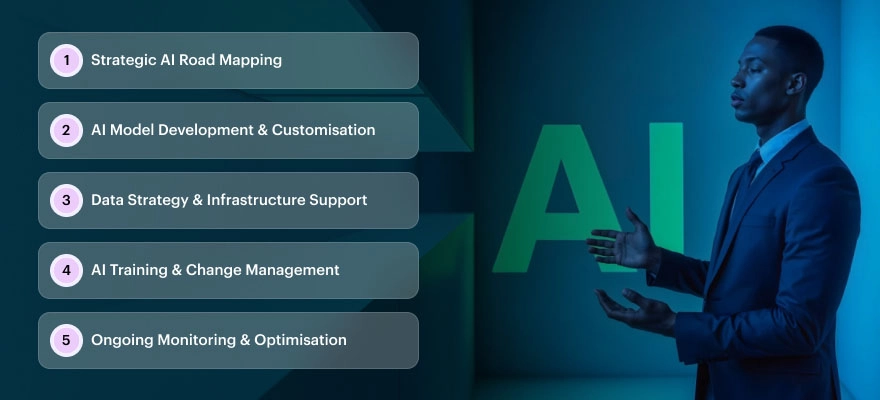
    1. Strategic AI Road Mapping

    Before jumping into any coding or tool-building, consultants start by helping you build a strategic AI roadmap. This is where they figure out what’s realistically achievable for your business using AI integration services.

    They align your goals with the right AI capabilities, be it automation, forecasting, recommendation engines, or smarter workflows and set a plan that ensures long-term success, not just short-term hype.

    2. AI Model Development & Customisation

    Based on your facts and use case, consultants assist in designing, educating, and fine-tuning system mastering models that can perform tasks such as detecting fraud, personalising user experiences, or even forecasting demand.

    And in place of using regularly occurring tools, they often build custom AI answers that combine seamlessly with your systems and resolve the hassle you’re going through.

    3. Data Strategy & Infrastructure Support

    AI integration is nothing without smooth, organised, and reachable statistics. AI specialists assist corporations in auditing their present data, identifying gaps, and creating a scalable records architecture.

    They additionally suggest the right cloud systems (like AWS, Azure, or Google Cloud AI) and installation facts pipelines to ensure the entirety flows smoothly into your AI system.

    4. AI Training & Change Management

    Even the pleasant AI tool is useless in case your team doesn’t recognise the way to use it. That’s why many AI consultants additionally offer schooling workshops, onboarding applications, and documentation to assist groups recognise how the brand-new gadget works.

    They also guide groups through trade control, making sure AI adoption isn’t only a technology improvement but a way of life shift.

    5. Ongoing Monitoring & Optimisation

    AI integration for any business isn’t a “set it and forget it” answer. Once models cross-stay, specialists keep monitoring overall performance, tweak algorithms, and adapt structures based on new facts or converting dreams.

    This guarantees your AI remains relevant, correct, and continuously enhancing over time.

    Industries Benefiting from AI Consulting

    AI consulting isn’t just for tech giants or futuristic startups. From healthcare to fashion retail, businesses throughout almost every industry are leveraging AI to live aggressively, enhance efficiency, and create extra personalised reviews. Let’s have a look at how exceptional sectors are benefiting from professional AI steering:

    Industries-Benefiting-from-AI-Consulting

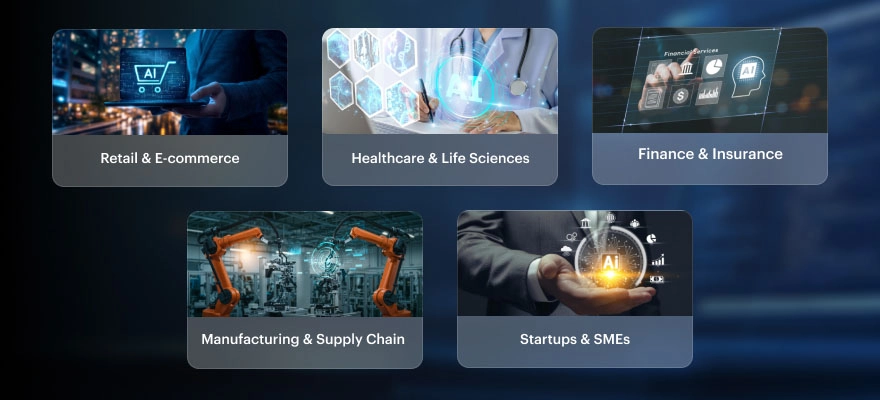
    1. Retail & E-commerce

    Have you ever wondered how your selected internet retailer constantly seems to expect what you would possibly need next?

    With the assistance of AI consultants, shops are the usage of gadget learning to construct recommendation engines, optimise inventory, and personalise client experiences at scale. They’re also the usage of computer imaginative and prescient in physical stores for smart shelves, real-time analytics, and even computerised checkouts.

    2. Healthcare & Life Sciences

    AI consultants are revolutionising everything in the healthcare industry, from medication research to diagnostics. Predictive analytics is being used by hospitals to detect possible problems early and avoid readmissions.

    AI-powered imaging tools, developed with aid from consultants, are being used for faster and more accurate diagnostics, especially in radiology and pathology.

    3. Finance & Insurance

    AI in finance isn’t just about chatbots anymore. Consulting services assist banks and other financial organisations with automating loan underwriting, putting fraud detection systems into place, and even using natural language processing (NLP) to assess sentiment in customer enquiries or financial news.

    On the other hand, insurance companies are using AI for risk modelling, claim automation, and customised policy recommendations.

    4. Manufacturing & Supply Chain

    From predictive protection of machinery to call for forecasting, producers are the usage of AI to lessen downtime, decrease expenses, and enhance operational management. AI consultants help with the aid of implementing clever sensors, IoT data integrations, and models that are expecting, whilst machines need servicing or when supply shortages may hit.

    5. Startups & SMEs

    Consulting services assist banks and other financial organisations with automating loan underwriting, putting fraud detection systems into place, and even using natural language processing (NLP) to assess sentiment in customer enquiries or financial news.

    On the other hand, insurance companies are using AI integration for risk modelling, claim automation, and customised policy recommendations.

    Smarter Decisions. Faster Outcomes.

    Leverage expert AI consulting to cut costs, boost efficiency, and stay ahead of competitors.


    Talk to Our Experts Now

    How to Know Your Business is Ready for AI?

    AI sounds interesting, but not every commercial enterprise is ready to dive in headfirst. It does now not comply with that you have to use AI honestly due to the fact your competition is. Implementing AI correctly calls for greater than simply economic assets or records; it also requires timing, approach, and internal preparedness.

    So, how will you tell if your corporation is prepared for AI?

    Key Signs Your Business is AI-Ready?

    • You Have Clean and Usable Data
      AI runs on information in the same manner as vehicles run on gas. If your business has been continuously collecting dependent (suppose spreadsheets, databases) or unstructured facts (like emails, purchaser chats, snapshots), you already have a massive piece of the puzzle. Even better if your statistics are labelled, organised, and on hand.


    • You Have Clear Business Goals
      AI can’t restore issues you haven’t defined. Whether it’s decreasing customer churn, enhancing product suggestions, or automating assistance, your desires ought to be clear. AI consultants help with this too, but some direction from your side speeds things up.


    • There’s Leadership Buy-In
      AI projects frequently require changes in tactics, equipment, and team culture. If decision-makers in your business enterprise understand the ability of AI and are inclined to make investments in time and budget into it, you’re on the right path.


    • You’re Ready to Experiment
      AI grows in environments wherein companies are open to innovation. If your company is ready to test, fail rapidly, learn, and iterate, that’s exactly the mindset AI consulting needs to be successful.

    Common Challenges to Beware Of

    • Messy or Limited Data
      If your facts are scattered throughout structures or poorly maintained, it can slow down or derail AI projects. This is what AI specialists frequently start cleaning and structuring your statistics before any models are built.
    • Overexpectations
      Some organisations assume overnight transformation, which hardly ever takes place. Real consequences take time, trying out, and staying power.
    • Internal Resistance to Change
      AI frequently introduces automation and shifts in workflow, which could make teams uneasy. Without right trade control, even satisfactory AI solutions can fail due to loss of adoption.

    What is the Step-by-Step AI Consulting Process?

    If you are jumping into AI without a plan, you’ll emerge as wasting time, cash, and energy. That’s why AI consulting follows a based technique. Whether you’re launching your first AI challenge or scaling up existing efforts, right here’s how AI experts commonly assist agencies flow from idea to implementation:

    1. Initial Assessment & Goal Alignment

    This is the “let’s get to know your business” phase. AI consultants start by understanding your industry, your current tech stack, your challenges, and most importantly, your business goals. They ask questions like: 

    • What problems are you trying to solve?
    • What’s your data situation?
    • What kind of ROI are you expecting?

    Based on this, they assist in outlining practical and measurable desires for the AI venture. Think of it as placing the GPS before the journey.

    2. Data Discovery & Preparation

    Once the goals are clear, the focus shifts to data, the fuel behind every AI system. Consultants dive into your data sources (CRM, website, customer chats, sales records, etc.) and start data cleaning, labelling, and structuring it.

    This stage may involve:

    • Building data pipelines
    • Fixing inconsistencies
    • Handling missing values
    • Ensuring compliance with privacy legal guidelines (like GDPR or HIPAA)

    If information is missing, consultants may additionally assist installation structures to accumulate it moving forward.

    3. Model Design, Testing & Deployment

    Now comes the cool stuff: designing and training AI or ML models. Based on your use case (say, patron churn prediction or visual product tagging), specialists:

    • Select the best-fit algorithm (e.g., decision trees, deep learning, NLP models)
    • Train the model on the usage of your statistics
    • Run simulations to test accuracy, bias, and performance

    Once it performs properly in testing, the version is deployed both in your current systems and in a custom-constructed application.

    4. Monitoring, Feedback & Optimisation

    AI isn’t a one-time setup. After deployment, experts strive to display overall performance, collect feedback, and improve the version.

    Maybe consumer behaviour adjustments, or new facts begin coming in, anything, it’s far. Your AI wishes to conform. This stage ensures the system stays smart, relevant, and accurate over time.

    How to Choose the Right AI Consulting Partner?

    Let’s face it, a lot of businesses claim to be specialists in artificial intelligence. But it’s no longer approximately who uses the most buzzwords whilst selecting an AI consulting company. Finding a crew that could provide fees, now not just flashy shows, that knows your goals and speaks the language of your industry is essential.

    1. Expertise That Matches Your Needs

    AI is a broad field of machine learning, computer vision, NLP, and data engineering. The list goes on. Make sure your consulting partner specialises in what you need. If you’re in healthcare, do they understand compliance like HIPAA?

    If you’re in retail, have they built recommendation engines or demand forecasting tools before? The right partner should speak your business language, not just code.

    2. A Portfolio That Shows Real Work

    Look beyond the website copy. Ask for case research, fulfilment tales, or live demos. A suitable AI consultant ought to have the ability to walk you through actual initiatives they’ve carried out, what the trouble was, how they solved it, and what the effects appeared like. If everything sounds theoretical, take it as a red flag.

    3. Ask the Right Questions

    Don’t hesitate to interview your AI consultant like you would a potential hire. Ask things like:

    • What tech stacks do you work with?
    • How do you measure AI project success?
    • How do you address ethical and data privacy issues?
    • What happens if the model underperforms?

    Their answers will tell you if they know their stuff or if they’re winging it.

    4. Red Flags to Watch Out For

    Be cautious if you notice these signs:

    • Overpromising results
    • Vague pricing or scope of work
    • Lack of a clear project timeline
    • Poor communique or slow follow-ups

    An AI consulting company is a partnership, now not a one-time carrier, so accept as true with, transparency, and collaboration are key.

    What is the difference between In-House vs. External AI Consultants?

    One of the maximum critical issues that agencies have after they start their AI journey is whether to increase an AI team internally or lease outside experts. Both alternatives offer benefits and disadvantages, and the optimum route of motion will rely upon your desires, financial fame, and internal fortitude.

    Let’s dissect it so that even in case you’re sparkling to this place, you may get experience.

    1. In-House AI Teams

    Going in-house method hiring facts scientists, ML engineers, AI architects, and probably some DevOps professionals to aid the whole thing. It gives you complete manipulate over your AI improvement and enables higher long-term ownership of the solution. If AI is central to your business model, this route might make sense.

    Pros-and-Cons-of-In-House-AI-Teams

    Pros: 

    • Deep understanding of internal data and systems. 
    • Full control over workflows and priorities. 
    • Long-term scalability and custom innovation.

    Cons: 

    • Expensive and time-consuming hiring process.
    • Hard to find and retain skilled AI talent.
    • Slower execution for early-stage projects.

    2. External AI Consultants: Speed & Specialisation

    Hiring outside AI specialists is like bringing in a SWAT crew; they have already got the skills, tools, and system to hit the floor walking. They’re splendid for groups that need velocity, knowledge, or need to check ideas earlier than scaling.

    Pros-and-Cons-of-External-AI-Consultants_-Speed-Specialisation

    Pros: 

    • Fast execution with proven frameworks. 
    • Access to multi-enterprise enjoy and niche knowledge. 
    • No need to fear about hiring, schooling, or upskilling. 
    • Cost-powerful for short- to mid-term initiatives.

    Cons:

    • Less day-to-day control.
    • Risk of knowledge gaps if documentation isn’t properly handed over.
    • Might not fully align with internal culture or processes.

    Which One Should You Choose?

    If you’re nonetheless experimenting with AI or simply starting, outside experts are the smart flow. They create clarity, validate thoughts quickly, and assist in avoiding steeply priced mistakes. Once you’ve nailed down your approach and recognise AI could be a long-term part of your commercial enterprise, you can steadily build an in-house team with guidance from the consultants.

    Some companies even pick out a hybrid version, begin with experts to construct the muse, and slowly transition the knowledge to inner hires over time.

    What is AI Strategy for Startups?

    Startups need to move quick, have super ideas, and function on a constrained finance. Therefore, even though AI may appear like something that best huge businesses can come up with the money for, startups can include AI at an early degree. Possessing the appropriate approach that is lean, targeted, and in line with your expansion objectives.

    AI consultants play a huge role here by helping startups prioritise what matters and avoid the trap of building cool-but-useless features.

    Let’s look at how startups can make AI strategy consulting work without breaking the bank.

    1. Start Small with MVPs

    You don’t want a complete-blown AI machine right out of the gate. AI consultants frequently advocate constructing a small, testable AI-powered feature like a chatbot, an advice engine, or a smart dashboard as a part of your MVP. This gives you real person information, rapid feedback, and proof that your AI is solving a real problem.

    Example:

    A food delivery startup might test a simple AI model that predicts peak order hours to optimise staffing before investing in a full automation suite.

    2. Focus on Quick Wins & Cost Efficiency

    Startups should go for low-hanging fruit areas where AI can make a big difference with minimal complexity. Think:

    • Automating repetitive customer support
    • Using sentiment analysis for product feedback
    • Personalised emails and push notifications

    AI consultants help identify these quick wins and suggest open-source tools or low-code platforms that reduce development costs.

    3. Scalable AI from Day One

    Even if you’re building lean, it’s smart to think about scale. Consultants assist set up facts pipelines and version architectures that grow together with your commercial enterprise. So whilst you go from 1,000 users to 100,000, your AI won’t crash or become inappropriate.

    4. Experiment, Measure, Repeat

    Agility is fundamental for startups, and AI isn’t any exception. You can look at new AI features in short sprints with a consulting team, analyse the real impact, and regulate your approach in reaction to the results.

    5. Access to Skills You Don’t Have In-House

    Most startups don’t have a full-time AI engineer sitting around. Consultants fill that gap, bringing in high-level skills on-demand so your team can focus on product, growth, and users.

    Real-World Use Cases of AI Consulting

    AI consulting is about creating practical solutions that address actual issues, enhance user experiences, and increase revenue. It’s not just about strategy and seminars. Businesses from a variety of sectors are using AI consultants to create effective intelligent systems.

    1. Predictive Analytics for Sales Forecasting

    Imagine knowing what your customers need earlier than they do. That’s what predictive analytics can do. AI consultants assist businesses construct models that examine past shopping behaviour, seasonal trends, and marketplace alerts to predict destiny income, supporting companies stock smarter, manage assets, and maximise income.

    Example:

    A fashion retailer used AI to predict the most in-demand styles for the upcoming season, reducing overstock and boosting revenue by 20%.

    2. NLP in Customer Support Automation

    Nobody likes waiting on keep or dealing with robotic replies. AI consultants implement natural language processing to energy-wise chatbots and digital retailers that recognise human language and resolve client queries right away. These bots learn over the years, becoming faster and smarter. Companies looking to implement conversational AI often research specialized vendors and AI call center providers before starting deployment.

    Example:

    A SaaS organisation computerised 60% of its assist tickets using an AI chatbot that could handle purposeful and complex queries to human dealers.

    3. Personalised Marketing & Customer Segmentation

    AI doesn’t simply acquire consumer records; it knows what to do with them. Consultants help build fashions that section clients based on behaviour, options, and lifecycle stage, allowing hyper-personalised advertising. Think Netflix-fashion hints, only to your brand.

    Example:

    An e-commerce platform expanded its click-through rates by 35% the use of AI-pushed email personalisation based on browsing records and purchase behaviour.

    4. Computer Vision in Retail & Manufacturing

    Computer vision is being used to monitor store shelves, detect product defects, and even track customer movement patterns in physical spaces. AI consultants assist installation photograph reputation fashions and combine them with present workflows to reduce human blunders and improve performance.

    Example:

    A grocery chain used AI-powered cameras to come across empty cabinets in actual-time, decreasing stockouts and enhancing sales by means of 15%.

    5. Fraud Detection in Finance

    AI experts regularly help monetary establishments in imposing real-time fraud detection systems that flag suspicious activity, save you unauthorised transactions, and minimise hazard. These systems examine and adapt, catching new fraud patterns as they emerge.

    Example: A fintech startup reduced rate fraud the usage of eighty% by way of integrating AI models that flagged anomalies primarily based on transaction patterns and client behaviour.

    Tools & Technologies Used by AI Consultants

    Category 

    Tool/Platform 

    Purpose / Use Case 

    Machine Learning Frameworks 

    TensorFlow 

    Deep learning, large-scale model training, image & speech recognition 

    PyTorch 

    Custom neural networks, flexible ML experimentation 

    Scikit-learn 

    Classic ML tasks like classification, regression, clustering 

    Cloud AI Platforms 

    AWS SageMaker 

    End-to-end ML development, from data prep to model deployment 

    Google Cloud AI 

    Pre-trained models, AutoML tools, scalable AI deployment 

    Microsoft Azure AI 

    Enterprise AI services for NLP, computer vision, and bot frameworks 

    Data Engineering Tools 

    Apache Spark 

    Distributed data processing, real-time analytics 

    Airflow 

    Workflow orchestration for data pipelines 

    Snowflake / BigQuery 

    Cloud data warehousing and fast querying for large datasets 

    Visualization & Reporting 

    Tableau / Power BI 

    Business dashboards, visual storytelling of AI insights 

    Plotly / Matplotlib / Seaborn 

    Data visualisation during model building and analysis 

    AI Governance & Ethics 

    IBM AI Fairness 360 

    Bias detection, fairness evaluation in datasets and models 

    Google What-If Tool 

    Visual inspection of model predictions and performance 

    Your AI Transformation Starts Here

    Get a custom plan built around your business goals—without the tech overwhelm.


    Start Your Project Today

    Conclusion

    Whether you are a startup experimenting with automation or a huge business enterprise optimising workflows, the right AI consulting company or the right AI consultant can be your shortcut to clever choice-making, faster innovation, and actual enterprise impact. From information your information to deploying AI-powered gear, these experts assist in remodelling complicated challenges into actionable outcomes.

    The actual magic happens while you find an associate who aligns with your dreams, is familiar with your tech environment, and provides more than simply buzzwords. So ask the right questions, define clean objectives, and be open to getting to know alongside the way. With the right AI consulting companies with the aid of your side, the future of your enterprise isn’t just clever, it’s scalable, ethical, and insanely powerful.

    FAQs


    1. What is AI consulting and why does your business need it?


    AI consulting helps businesses plan, build, and implement artificial intelligence solutions. It’s essential if you want to stay competitive, save time, and make smarter decisions using your data.


    Almost every industry from healthcare and finance to retail, logistics, and marketing can benefit from AI consulting to automate tasks, predict trends, and improve customer experience.


    Look for proven experience, industry fit, technical skills, and transparency. Ask questions, check case studies, and ensure they align with your business goals and values.

    Found this post insightful? Don’t forget to share it with your network!
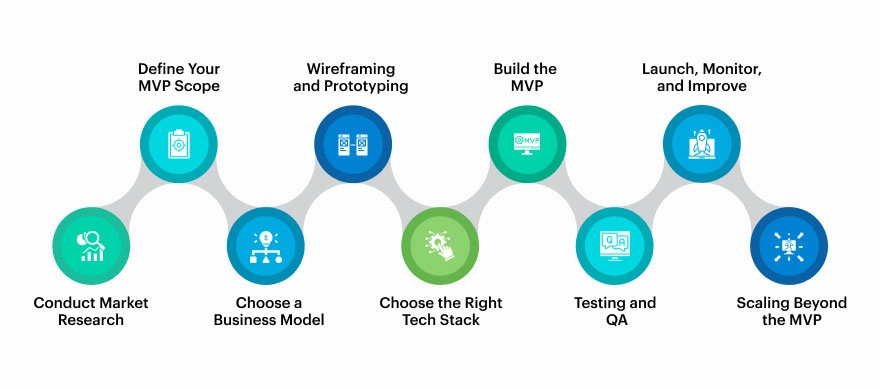


    Related Articles

  • The Six Most Popular Cross Platform App Development Frameworks

    The Six Most Popular Cross Platform App Development Frameworks

    Cross-Platform-App-Development-Frameworks
    [ez-toc]

    We all live on our phones these days. From ordering your favourite cuisine to catching up on the latest episodes, apps have become part of our daily routine. And even as it would appear to be magic whilst an app works seamlessly on both your iPhone and your mate’s Android, there’s a smart bit of tech behind it, making that manifest: cross platform app development frameworks.

    Gone are the days whilst groups had to build completely separate apps for iOS and Android. Now, with smarter mobile app development frameworks around, builders can write one codebase and roll it out anywhere. It’s faster, extra value-effective, and best for manufacturers seeking to reach a broader target audience without overspending.

    In this blog, we’re diving into the 6 most popular cross-platform app development frameworks that everyone’s talking about in 2025. Whether you’re a startup founder, a techie with big ideas, or a business owner curious about the next app for your brand, we’ve got you covered.

    Curious Which Framework Fits Your Business Best?

    Let our experts assess your goals and recommend the right tech stack tailored to your vision.


    Book Your Free App Consultation

    What is the Need for Cross-Platform App Development?

    Maybe it’s a wellness tracker, a foodie community, or even the next big dating app for dog lovers. If your app simply works on iPhones, you’re instantly slicing off half of your potential audience. And let’s be actual, nobody was given time to build two separate apps from scratch.

    Also, Cross-platform mobile app development is quite helpful in this case. It saves developers a good amount of time, money, and effort by allowing them to create apps that characteristic flawlessly on iOS, Android, or even the internet. Instead of juggling codebases and hoping they live in sync, you just placed the whole lot up and assemble as speedy as you can.

    For UK businesses, startups, and creators, a cross-platform app development company means faster launches, broader reach, and more consistent user experiences. Whether your customers on the latest iPhone or a budget Android, they get the same vibe, no one’s left behind.

    What are the Key Benefits of Cross-Platform App Development?

    We somehow got the idea of what cross-platform app development is. But why is everyone in the tech world so obsessed with it? Here are some real reasons why businesses across the UK and beyond are depending on cross-platform app development services and its benefits:

    1. Save Big on Development Costs

    Hiring two separate teams to build for iOS and Android? That’s like paying double for the equal outfit. Cross-platform mobile app development frameworks will let you build once and run anywhere, which means that extra cash in your pocket that you may invest in the budget for commercials, advertising and marketing, and coffee.

    2. Faster Time to Market

    Technology is advancing right away; even if you blink, you could miss a trend. With cross-platform tools, you can get your software to more devices faster than if you designed it twice. Less waiting and more launching.

    3. Wider Audience Reach

    Your app can reach everybody irrespective of whether they use a Samsung or an iPhone. Cross-platform programming guarantees that your concept isn’t restricted to a single tool or OS.

    4. Consistent User Experience

    Nobody likes an app that works like a dream on iOS but crashes every second on Android. One codebase approach fewer inconsistencies, smoother updates, and higher entertainment all around.

    5. Easier Maintenance & Updates

    Updating features, fixing bugs, or rolling out something new? Do it once, and it displays throughout all systems. Less hassle, less confusion, and a happier dev team.

    6. Great for Startups & Growing Brands

    If you’re a business in the UK looking to scale fast without draining resources, cross-platform is a no-brainer. It helps you test the waters, get real feedback, and adapt without burning cash.

    Which Factors to Consider When Choosing a Framework?

    Hold your horses before you jump in and install the first sparkling cross-platform framework that appears on Google! Choosing the correct cross-platform app development framework is difficult: it must match your style, comprehend your requirements, and grow with you in the long run.

    Here’s what you seriously need to think about before swiping right on a framework:

    Factors-to-Consider-When-Choosing-a-Framework

    1. Performance & Speed

    If your program takes time to load or lags like it is stuck in 2012, human beings will abandon it. Some frameworks (inclusive of Flutter or React Native) offer close-to-local performance, while others might also feel slightly heavier. If your app could have image-heavy factors, inclusive of games, animations, or real-time functions, performance has to be your number one consideration.

    2. Programming Language Compatibility

    Are you or your developer team already professional in JavaScript, Dart, C#, or Kotlin? Picking a framework that works along with your crew’s existing skillset can save masses of time on training or hiring.

    3. Native Feature Integration

    Need to access the digicam, GPS, Bluetooth, or other phone hardware? Not all frameworks are created equal about deep native integrations. Some offer plugins and bridges that make life easier, while others might need a bit more custom coding. It’s crucial to check how smoothly your chosen framework talks to native device features.

    4. Community Support & Resources

    This one’s a bit underrated but super important. A strong developer community means more libraries, quicker computer virus fixes, and useful boards when you hit a wall. Flutter and React Native have massive, energetic groups, which is brilliant for finding answers and staying updated. Think of it as becoming a member of a club where every person’s work was given your returned.

    5. Business Goals & Target Audience

    Are you building an MVP to test an idea? A full-scale retail app for UK shoppers? Or maybe something niche like an AR fashion tool? Your commercial enterprise dreams and your target audience’s expectations should assist in steering your choice. For instance, a high-give-up style brand might demand glossy animations and a sophisticated UI, whilst a B2B tool simply wishes to run speedily and stay solid.

    6. Budget & Resources

    Last but not least, always consider your budget. Some frameworks require extra dev time, others want paid licences or third-party tools. Choose a setup that suits your finances these days, but can grow with you day by day.

    Want a Single App for iOS, Android & Web?

    Build once, deploy everywhere. Our cross-platform app development services deliver speed, quality, and reach.


    Talk to Our Experts Now

    Six Most Popular Cross-Platform App Development Frameworks

    Alright, we’ve talked about the why and the how, now it’s time to spill the tea on the who’s who of the cross-platform app development world. These six frameworks are dominating the scene in 2025, and for good reason. Whether you’re building a slick startup app or scaling a business, these tech tools are leading the charge.

    1. Flutter

    Flutter

    Language: Dart

    Best For: Well-designed UIs, fast performance, native-like experience

    If Flutter were a person, it’d be that stylish friend who’s usually on-trend and in some way precise at the whole lot. Backed by Google, Flutter has quickly become a move-to framework thanks to its smooth performance, warm reload characteristic, and beautiful UI designs.

    It’s specifically popular in the UK startup scene, in which time and polish count. There are no bizarre design flaws or pixel drama in apps created with Flutter; they appear and behave identically on iOS and Android.

    Popular Apps Built with Flutter: Google Ads, BMW, Alibaba.

    2. React Native

    React-Native

    Language: JavaScript

    Best For: Reusable components, large communities, quick launches

    Created by Meta, React Native is loved for how fast and developer-friendly it is. If your team already knows JavaScript, this one’s a no-brainer. You can write once and reuse code like a pro, while still getting access to native modules when needed.

    It’s where given a big network support, lots of pre-built components, and performs nicely with third-party plugins, fantastic for brief MVPs or apps on a budget.

    Popular Apps Built with React Native: Instagram, Uber Eats, Pinterest

    3. Kotlin Multiplatform

    Kotlin-Multiplatform

    Language: Kotlin

    Best For: Code sharing across Android, iOS, backend & web

    Kotlin Multiplatform isn’t about building UIs across platforms; it’s about sharing core logic like networking, data management, and authentication across iOS, Android, and even the web. It’s gaining popularity among UK enterprise teams who want better consistency in their app logic without fully ditching native UI frameworks.

    Think of it as a clever middle ground, modern, efficient, and backed by JetBrains (the people who built IntelliJ and the Kotlin language itself).

    Popular Apps Built with Kotlin Multiplatform: Backend logic sharing, Fintech and enterprise apps.

    4. Xamarin

    Xamarin

    Language: C#

    Best For: Enterprise-level apps, .NET developers, native API access

    Microsoft develops and maintains Xamarin, which is a feasible opportunity for organisations that have already made investments within the .NET environment. It allows you to write apps in C# and get get admission to to neighbourhood APIs, which means fewer boundaries whilst integrating advanced competencies.

    Xamarin isn’t as popular as Flutter or React Native nowadays; however, it’s still a dependable choice for large-scale, solid projects, especially in corporate sectors.

    Popular Apps Built with Xamarin: Alaska Airlines, The World Bank.

    5. Ionic

    Ionic

    Language: HTML, CSS, JavaScript

    Best For: Progressive Web Apps (PWAs), hybrid apps, fast prototyping

    If your development team has strong internet records, Ionic is probably the best springboard into cross-platform mobile app development framework. It uses familiar web tech and wraps it in a local-like shell using Capacitor, so it feels right at home on mobiles.

    It’s now not satisfactory for heavy-duty performance apps, however, ideal for immediate MVPs, internal tools, or any app that prioritises pace to market and extensive accessibility.

    Popular Apps Built with Ionic: JustWatch, MarketWatch, Sworkit

    6. Unity

    Unity

    Language: C#

    Best For: Game development, AR/VR apps, 2D/3D experiences

    Yes, Unity isn’t only for gaming anymore; it’s speedy becoming the darling of AR/VR builders and brands constructing immersive tales. If your app needs animations, 3D images, or an interactive vibe (like fitness video games or digital tours), Unity is the satisfactory choice.

    Plus, it runs across 20+ platforms, such as mobile, desktop, console, and web, and has an approximate reach.

    Popular Apps Built with Unity: Pokémon Go (AR), Monument Valley 2.

    Emerging Trends in Cross-Platform App Development

    Cross-platform app development isn’t only a tech shortcut anymore; it’s shaping the future of how apps are constructed and experienced. As we pass deeper into 2025, the any cross-platform app development company is increasing rapidly.

    Here are the top trends turning heads in the app world right now:

    • Rise of Progressive Web Apps (PWAs)
      Not every user wants to download another app just to check out a service. That’s where PWAs come in; they behave like apps but run directly in your browser. Frameworks like Ionic are leading the charge here, especially for e-commerce, media, and SaaS brands looking to deliver smooth app experiences without app store drama.
    • Increased Code Sharing Across Platforms
      Frameworks like Kotlin Multiplatform are redefining the concept of “write once, run everywhere.” Instead of just sharing UI, builders can now percentage core good judgment, APIs, or even backend techniques across iOS, Android, web, and desktop, all whilst preserving local UIs intact. This modular approach is gaining significant traction, specifically in organisational setups.
    • AI-Powered Development Tools
      AI isn’t just writing poems and generating memes; it’s now embedded in mobile development, too. Tools like GitHub Copilot let developers write smarter, cleaner code across all frameworks. AI is also boosting testing, debugging, and performance optimisation, resulting in more efficient cross-platform processes than before.
    • Gamification & AR Integration
      With apps moving beyond basic features, developers are leaning into interactive experiences from loyalty apps that feel like games to virtual try-on tools in fashion. Frameworks like Unity are booming in industries far beyond gaming, especially for UK brands in retail, education, and fitness, looking to stand out.
    • Micro-frontend Architectures
      Design is turning into an increasing number of modular and thing-driven. Rather than developing a single monolithic venture, developers are dividing it down into smaller, more plausible frontends ideal for groups working throughout many frameworks or converting factors of an app without downtime. It is scalable, sleek, and modern.
    • Growing Adoption in Fintech & Healthcare
      Industries that rely on local-handiest development, like finance and healthcare, are embracing move-platform equipment because of more advantageous safety capabilities, stricter testing protocols, and quicker deployment cycles. Kotlin Multiplatform and Xamarin are mainly popular right here for code reliability and platform compliance.
    • Privacy & Compliance-Ready Frameworks
      With GDPR and user data being a big deal in the UK and EU, frameworks are now offering built-in tools for data encryption, user consent management, and compliance-ready structures. React Native and Flutter both have growing plugin ecosystems addressing these needs.
    • Cloud-Native Mobile Development
      Apps are no longer simply neighbourhood gear; they’re cloud-primarily based ecosystems. Cross-platform frameworks now permit real-time syncing, dynamic updates, and stepped forward offline skills thanks to extra integration with AWS, Azure, and Google Cloud. It’s all about making programs quicker, smarter, and greater dependable.

    Save Time & Money with Cross-Platform Development

    Why build twice? Launch your app faster with one codebase that works across all platforms.


    Start Your Project Today

    Conclusion

    The best move-platform app development framework is predicated on your objectives, finances, and audience. What matters the most is that you select a mobile app development framework that complements, as opposed to contradicts, your vision. One that simplifies improvement, improves consumer enjoyment, and makes updates some distance much less hard.

    In 2025, it’s no longer pretty much just mobile app development services; it’s about constructing it smart, rapid, and in a manner that scales along with your business. Cross-platform app development helps you to do all that without draining your wallet or your endurance.

    So whether you’re a tech-savvy startup founder in London or a developing logo up north seeking to move virtual, the gear is right here, the tendencies are in your favour, and now you already know precisely where to begin.

    FAQs


    1. What is cross-platform in app development?


    Cross-platform app development is the process of building mobile apps that run on multiple platforms (like iOS and Android) using a single codebase. It saves time, reduces value, and guarantees a regular consumer revel in.


    As of 2025, Flutter is considered the most popular cross-platform framework due to its high performance, stunning UI capabilities, and strong community backed by Google.


    Commonly used frameworks include Flutter, React Native, and Ionic, all of which let developers build apps for both iOS and Android using shared code, while offering varying levels of performance and native integration.

    Found this post insightful? Don’t forget to share it with your network!



    Related Articles

  • How Much Does it Cost to Develop an App in the UK?

    How Much Does it Cost to Develop an App in the UK?

    App-Development-Cost
    [ez-toc]

    An app idea can be about anything from tracking how many cups of tea you’ve had today, a local delivery service for Sunday roasts, or something giant like the next big social networking app to rival Instagram. But the big question that always hits is: “How much is the app development cost for it?

    Well, if you’ve been googling “What is the app development cost in the UK?”, you’re in the right place. This blog is here to break down exactly what it costs to build an app in the UK because what you’d pay for an app in London isn’t the same as what it might cost in, say, Bangalore or California.

    In the UK, the mobile app development companies are booming, with groups, creators, and beginners eager to get their ideas onto people’s phones. From easy booking apps for local salons to completely fledged e-commerce structures, there’s a huge variety of possibilities. But with great ideas come great invoices, and understanding what contributes to those invoices is crucial before diving headfirst into development.

    In this blog, we’ll walk you through the average mobile app development costs in UK and explain what factors influence those numbers. We’ll cover everything from the type of app you’re planning to build, the features you want to add, and the platforms you want it to run on, to those sneaky little hidden costs that nobody tells you about upfront.

    And because we know everyone loves a good deal, we’ll also include some practical tips on how to keep your costs under control without compromising quality.

    Worried about app development costs?

    We’ll help you plan smart and spend wisely—without compromising on quality.


    Get a Free Consultation

    What are the Key Factors Influencing App Development?

    It is important to understand what affects the cost of developing an app in the UK. The app improvement price relies on the extent of customisation of functions. The more features and performance you need, the better the fee.

    Advanced client communication systems, similar to AI call center solutions, also bear complex integrations, robotization workflows, and scalable backend structures.

    1. App Complexity & Features
      A simple app with simple capabilities (like a to-do listing or a climate checker) will be valued much less than a fully loaded app with real-time tracking, steady bills, and an integrated chat device. The extra complicated your app, the more hours builders need, and yes, those hours aren’t reasonably priced.
    2. Design Requirements
      If you want your app to appear like the Rolls-Royce’s app with smooth animations, custom icons, and a tailor-made person reveal, be prepared to pay more. A suitable layout isn’t just about looking first-class, either; it affects how users interact with your app.
    3. Development Platform (iOS, Android, or Both)
      Building for just iOS or just Android is more expensive than constructing for both. If you fancy a pass-platform app (which runs on both operating systems), equipment like Flutter and React Native can save money, but they’ve their boundaries to recollect.
    4. Developer Location & Hourly Rates in the UK
      Hiring an agency in Central London can cost you up to £120-£150 per hour, while a talented team in Manchester or Liverpool might charge closer to £50-£80 an hour. Same country, different rates.
    5. Third-Party Integrations & APIs
      Your app needs third-party tools to be integrated for payment gateways, social media, maps or any such additional services, that can add on to a huge amount.
    6. App Maintenance & Updates
      Once your app’s live, it’s not just a ‘one-and-done’ job. Regular updates, security patches, and feature improvements will all add to your running costs.

    How to Break Down App Development Stages and Their Costs?

    How-to-Break-Down-App-Development-Stages-and-Their-Costs

    App development is a series of carefully deliberate steps, each with its very own function and cost. Think of it like constructing a house: you wouldn’t begin redecorating the living room earlier than laying the foundation, right?

    Same with apps.

    Each step of the mobile app development process is broken out here, along with an estimate of the cost in the UK:

    • Step 1: Discovery & Planning (£2,000 – £10,000)
      Here, your concept is developed into a real plan. Developers will run market research, competitor analysis, technical feasibility checks, and define app features. It saves you from blowing your budget on pointless features or bad UX decisions later on.
    • Step 2: UI/UX Design (£3,000 – £20,000)
      Good design isn’t pretty much looking pretty, it’s approximately making your app clean and pleasing to use. Here, wireframes, consumer trips, and polished mockups are created.
    • Step 3: App Development (Frontend & Backend) (£15,000 – £100,000+)
      This is where the actual coding occurs. The frontend is the whole thing the user sees, even as the backend handles databases, servers, and all the in the back of-the-scenes magic.
    • Step 4: Testing & Quality Assurance (£3000 – £15,000)
      Before your app is launched and set for the public usage, it needs to be examined for bugs, crashes, and any smallest performance troubles. The last-minute checks include device compatibility tests, security checks, and user experience evaluations.
    • Step 5: Deployment & Launch (£1,000 – £5,000)
      In this stage you must launch your app on Google Play and the App Store. This includes the submission, store optimisation, and approval processes. Apple can be tricky sometimes, so leave room for rejections and revisions.
    • Step 6: Ongoing Maintenance (£500 – £5,000+ per month)
      Apps are not supposed to be launched and then left as it was launched. Regular updates, new functions, and computer virus fixes maintain your app running smoothly and securely. The fancier your app, the better your preservation fees.

    What is the Average Cost to Develop an App in the UK?

    What-is-the-Average-Cost-to-Develop-an-App-in-the-UK

    Well, as with most matters in existence (and particularly in Britain), the answer is: that it relies upon. It’s a chunk like asking, “How a good deal does it cost to buy a house?” Are we talking approximately a comfortable flat in Manchester, a townhouse in Birmingham, or a penthouse overlooking the Thames?

    On average, even though you’re seeking to develop an app right here in the UK, you’ll be spending anywhere between £20,000 to £150,000 and more. Yep, quite the range, however, that’s because it all boils down to what you want your app to do, how fancy you want it to look, and what number of capabilities you’re planning to include.

    To give you a rough idea:

    • A calculator, note-taking tool, or weather app are examples of basic app that might cost anywhere between £15,000 and £30,000.
    • Moderately complex apps, including fitness monitors, booking systems, and delivery apps, might cost anywhere from £30,000 to £70,000.
    • A complex app that includes real-time tracking, user accounts, payment systems, unique designs, and augmented reality capabilities may start around £70,000 and quickly reach £150,000.

    And that’s just the development part. You can’t ignore the extra costs like maintenance, updates, server hosting, and app store fees; they sneak up on you like that last unexpected pint at closing time.

    It’s also worth noting that fees can vary throughout the United Kingdom. Hiring a pinnacle-tier app development company in London will probably cost more than working with a group primarily based in Glasgow or Leeds. But alternatively, you are probably buying extraordinary levels of expertise, career, and pace.

    So, whether or not you’re brewing up the following viral social app or a simple booking tool in your nearby, understanding those ballpark figures will assist you in proposing and avoiding nasty surprises down the line.

    How Much Does App Development Cost in the UK?

    Understanding app development costs in the UK is crucial for businesses planning to build scalable digital products. Whether you’re a startup or an enterprise, the cost depends on multiple factors including features, platform, and development complexity.

    Hidden Costs to Consider in the App Development Process

    Now, here’s where it gets interesting. You’ve planned your budget for development, testing, and launch, and just when you think you’ve got it all covered, along come those sneaky little hidden app development costs. The kind that quietly pile up in the background.

    Let’s shed some light on what you might not have budgeted for, but should:

    1. App Store Fees
      Getting your app onto the App Store and Google Play isn’t free.
      Apple App Store: £99 per year (for a developer account).
      Google Play Store: One-time £25 fee.
      The fees of the platforms are not bank-breaking, but it is worth nothing, especially if you’re building multiple apps or need a business account.
    2. Hosting & Infrastructure
      You need to have stable servers and databases if your app wants to keep your customers’ statistics, images or run in real-time (like food delivery or journey-hailing apps). Services like AWS, Microsoft Azure, or Google Cloud typically price monthly, based on storage space, bandwidth, and security capabilities. Expect to pay everywhere from £20 to £500 per month, depending on your app’s needs.
    3. Marketing & Promotion
      Your program is unlikely to succeed if you release it without any promotion. As a result, the promotions consist of sponsored ads, influencer partnerships, social media campaigns, and PR outreach. The cost of an extensive marketing campaign that covers the whole UK may be £10,000. The price range for a simple local marketing campaign is £500 to £1,500.
    4. Regular Updates & Security Patches
      Technology and hackers are on a roll and update as fast as they can. So, regular upgrades, performance improvements, and security fixes are necessary to keep your software current and safe. Some app development companies in UK offer month-to-month renovation applications starting from £500 according to month.
    5. Legal & Compliance Costs
      If your app collects non-public information or approaches payments (which maximum do in recent times), you’ll need to comply with UK GDPR and other local policies. This may involve prison consultations, privacy coverage drafts, and compliance audits.

    AI-Powered App Solutions That Work

    Whether it’s automation, smarter UX, or intelligent backends—we develop systems that think, learn, and evolve with your business.


    Schedule a Strategy Call

    How to Reduce App Development Costs Without Compromising Quality

    While we’d all love an app with all the bells and whistles, not everyone has £150,000 lying around. But the good news is, you don’t have to empty your bank account to build a good working app. There are plenty of smart, practical ways to keep your app development costs in check without ending up with a half-baked app.

    • Start with a Minimum Viable Product
      Rather than making your dream app with every feature at start, begin with a basic version that has your key functions. Once it’s stay and you’ve got comments, you could regularly upload capabilities human beings need, not what you watched they might fancy.
    • Choose Cross-Platform Development
      Developing separate apps for iOS and Android will double your costs. You might want to think about cross-platform frameworks like Flutter or React Native to develop a common app for both. You will save money in development hours while still getting a good-performing app (unless your app is very complicated).
    • Prioritise Must-Have Features Over Nice-To-Haves
      List every feature you want and then ruthlessly trim it down to what’s essential for launch. Do you need AR filters on your local takeaway ordering app? Probably not. Focus on what will make your app helpful and compelling from the beginning.
    • Work with Regional UK Developers
      While London agencies are top-notch, they often charge premium rates. Consider agencies or freelance developers in Manchester, Liverpool, or Edinburgh. Same skills, lower hourly rates and you’re still supporting homegrown talent.
    • Use Pre-Built Solutions Where Possible
      You don’t need to build all parts from the start. Using steady third-party tools for stuff like payment, user verification, or analysis work can cut time and cost.

    Cutting your app development costs can sometimes by wallet heavy after a chunk of time is spent, so make sure it doesn’t cost you more to save some amount. The idea is to get away sensibly rather than inexpensively. Prioritise wisely, design strategically, and you’ll have an app to be proud of without squandering your life savings.

    App Development Cost in UK: Comparison with Other Regions

    Ever wondered how mobile app development costs in the UK stack up against the rest of the world? Spoiler alert: we’re not the cheapest, but for good reason. UK developers offer high-quality work, stable security, top-notch communication, and get entry to to a number of the sector’s excellent technical expertise.

    However, it is nevertheless beneficial to evaluate pricing in exceptional areas. Whether you’re thinking about outsourcing abroad or staying local, here’s a comparison of what you would possibly pay in different places of the world for comparable offerings.

    Average App Development Cost by region (Per Hour)

    Region Average Cost (Per Hour) Project Cost Range (Simple to Complex App)
    United Kingdom £50 – £120 £20,000 – £150,000+
    United States £70 – £150 £25,000 – £200,000+
    Western Europe £50 – £100 £20,000 – £140,000+
    Eastern Europe £25 – £60 £10,000 – £70,000+
    India £15 – £40 £5,000 – £50,000+
    Southeast Asia £15 – £35 £5,000 – £45,000+
    • UK and US developers face higher costs due to better residing expenses, commercial enterprise taxes, and strong regulatory frameworks; however, you frequently get better results, local marketplace expertise, and smoother project management.
    • Eastern Europe and Asia developers provide app development services in lower charges, and whilst many businesses there are notably skilled, demanding situations like time zone variations, communication gaps, and data protection issues can every now and then pop up.

    Is Cheaper App Development Price Always Better?

    Not always. Many UK groups select working with neighborhood developers for peace of thoughts, faster collaboration, and higher after-sales support in particular whilst dealing with consumer information and GDPR compliance.

    Ready to Build Your App in the UK?

    From MVP to enterprise-grade solutions, our UK-based app development team turns your idea into a powerful digital product.

    Average App Development Cost in the UK

    • Basic App: £10,000 – £25,000
    • Medium Complexity App: £25,000 – £60,000
    • Advanced App: £60,000 – £150,000+

    Key Factors That Affect App Development Cost

    1. App Complexity

    Simple apps cost less, while feature-rich apps with integrations increase development time and cost.

    2. Platform (iOS, Android, or Both)

    • Single platform → Lower cost
    • Cross-platform → Better ROI

    3. UI/UX Design

    A well-designed interface improves engagement but adds to development cost.

    4. Development Team Location

    UK-based agencies cost more than offshore teams but offer better communication and quality control.


    Book an Appointment

    Cost Breakdown by Features

    Feature Estimated Cost
    Login/Auth £1,000–£3,000
    Payment Integration £2,000–£5,000
    Real-time Chat £3,000–£8,000
    Admin Panel £5,000+

    How to Reduce App Development Costs?

    • Start with an MVP (Minimum Viable Product)
    • Use cross-platform frameworks
    • Prioritize core features first

    Why Choose Chimpare?

    • UK-focused development expertise
    • Scalable solutions for startups & enterprises
    • End-to-end support from idea to launch

    Conclusion

    To make a good app for less money and a better feel, plan smart, pick key stuff, and use the best way to make it. This lets you have a great app without spending too much.

    Also, don’t forget those hidden app development costs we flagged up earlier. They won’t seem much of a cost; however, they could quietly pile up over the years and cost additionally to your app development budget.

    If you’re extremely approximately bringing your app idea to life, the best thing you can do is to establish a realistic budget prematurely, leave a little room for surprises, and work with a team that is well acquainted with your goals and your market.

    Ask for an in-depth cost breakdown from the app development company before signing any document. When you hire app developer or choose a good app development company will happily explain where your money’s going, and if they haven’t, that’s your cue to look for some other place.

    In the end, your app is funding for your business, your concept, or your brand. And like every true investment, it’s worth spending a bit extra for excellent safety and peace of mind.

    FAQs


    1. How much does it cost to develop an app?


    The cost to develop an app in the UK typically ranges from £10,000 to £150,000+, depending on the app’s complexity, features, and platform choice.


    App maintenance usually costs around 15%–20% of the initial development cost per year, covering updates, bug fixes, server costs, and performance improvements.


    Building an app can take anywhere from 2 to 9 months, based on the app’s complexity, feature list, and the development approach.


    Key factors include app complexity, feature set, platform choice (iOS, Android, or both), UI/UX design, developer location, third-party integrations, and ongoing maintenance needs.

    Found this post insightful? Don’t forget to share it with your network!

    Related Articles

  • ChatGPT Meets Shopify: How AI Checkout Could Disrupt E-commerce and Advertising

    ChatGPT Meets Shopify: How AI Checkout Could Disrupt E-commerce and Advertising

    Shopify-ChatGPT-integration
    [ez-toc]

    The world of online buying is changing fast, and AI is key to these big changes. Lately, AI development has moved into many areas, including making personal product picks to helping chatbots support customers. But one tech has caught all eyes: Shopify ChatGPT integration with AI checkout systems. Think of visiting your top online shop. But now, skip the long look through tons of goods and the big, slow buy step. You just chat with an AI assistant. It helps you pick, adds deals, and sorts your buy in one quick and easy talk. This is what Shopify integeration with AI tools like ChatGPT Checkout aim for. They are set to bring big change to the old ways of e-commerce services and web ads.

    This blog will explore how AI-powered checkout systems are reshaping the online shopping experience, making it more personalised than ever. We’ll dive into how Shopify ChatGPT integration is done, the features that make AI checkout different from conventional processes, and what this means for online retailers, advertisers, and customers alike.

    This shift is also driving the rise of conversational commerce, where guests can discover products, ask questions, and indeed complete purchases directly within a conversational interface. 

    We’ll also look at how this AI innovation could change the future of conversational commerce, reduce cart abandonment, improve conversion rates, and even alter the way digital e-commerce advertising works by shifting the focus to AI-driven, real-time purchase decisions.

    By the end of this blog, you’ll have a clear picture of how ChatGPT Checkout and AI in e-commerce development are paving the way for a new era of online shopping and why businesses should start paying attention right now. 

    AI Solutions That Drive Real Results

    We build intelligent systems that adapt to your business and scale with your growth.


    Get a Free Consultation

    What is ChatGPT Checkout and How Does it Work?

    The ChatGPT Checkout is a smart, AI-powered checkout system that allows customers to shop and place an order through a user-friendly interface-like chat with a real person. Powered by OpenAI ChatGPT technique, this system can assist shoppers in real time, and help them find products, answers to questions, apply discounts and even make full payments all through a smooth, AI-operated interaction.

    Similar conversational systems are also used in customer service, where businesses deploy AI call center solutions to handle large volumes of support conversations automatically.

    It is part of a big movement, called Conversational Commerce, where shopping happens via chat, voice assistant or message app instead of traditional product pages and checkout carts. And with ChatGPT Shopify integration, the store owners can now add this powerful tool to their online stores to offer a more personalised buying experience.

    What-is-ChatGPT-Checkout-and-How-Does-it-Work

    How Does it Work?

    Here’s a quick look at how ChatGPT checkout works for Shopify stores:

    • Product Discovery Through Chat
      Customers can start a chat session on the website or app. Instead of browsing categories, they describe what they’re looking for, like “I need a black formal dress for under ₹3000.” The AI then recommends suitable options instantly.
    • Answering Questions in Real-Time
      If a client asks approximately product details, sizing, delivery timelines, or return policies, the AI solutions them immediately, just like a live sales associate would.
      Similar real-time AI response capabilities are now widely used in customer service environments where AI systems handle support conversations and resolve customer queries instantly.
    • Smart Recommendations and Upselling
      Depending on client preferences, order history and popular trends, AI improves the possibilities of high order values, suggests add-ons or better alternatives.
    • Applying Discounts and Offers
      No need for coupon codes! The AI detects available discounts or offers and applies them automatically during the conversation, making checkout more convenient.
    • Streamlined Checkout and Payment
      Once the purchaser confirms their items, the AI guides them through a secure, brief payment process all within the chat interface, without redirecting to a separate checkout page.
    • Order Confirmation and Follow-ups
      To keep the purchaser engaged after the transaction, the AI sends order confirmations, delivery updates, and submit-buy care suggestions.

    Key Features of AI-Powered Checkout Systems

    Key-Features-of-AI-Powered-Checkout-Systems-1

    The concept of an AI-powered checkout system sounds futuristic, but it’s already here, and it’s changing the policies of online purchasing. These intelligent systems, like ChatGPT Checkout for Shopify, aren’t making payments easier. They’re designed to offer a personalised shopping journey from start to finish.

    Let’s break down the standout capabilities that make AI checkout systems a real game-changer within the world of e-commerce.

    1. Natural Language Purchase Assistance
      Unlike traditional checkout pages, where shop owners have to click through several menus, the AI boxes let customers communicate naturally. You can write or talk whatever you want, and AI responds immediately with relevant options. It saves individual, interactive and valuable time, especially for mobile and one-stop stores.
    2. Personalised Product Recommendations
      AI checkout systems use customer preferences, purchase history, browsing behaviour, and even real-time trends to suggest products that fit you just right. For example, if you often get skin care products, the AI may suggest new sunscreens or moisturisers that upsell or cross-sell during checkout conversations.
    3. Automated Discounts & Smart Upselling
      The smart AI systems apply automatically available discounts, promotional codes and package agreements during the checkout. In addition, they can recommend supplementary products (for example, a telephone bag if you buy a new phone) or suggest options for better value that lead to high order values that feel like push fields.
    4. Seamless Payment Suggestions
      When it’s time to pay, AI checkout systems provide tailored payment alternatives based on customer location, past preferences, and order size. Whether it’s UPI, credit card, EMI, or PayPal, the AI suggests the maximum handy selections, making the process quicker and decreasing drop-offs at payment gateways.
    5. Real-Time Query Resolution
      One of the largest motives for cart abandonment is unanswered queries. AI checkout assistants cope with this efficaciously with the aid of resolving customer doubts right away, whether or not it’s about product specifications, shipping timelines, return policies, or payment safety. A brief solution could make the difference between a lost sale and a loyal customer.
    6. Instant Order Confirmation & Tracking
      AI provides instant order confirmation upon placement and provides real-time order tracking links and shipment updates through email or chat. This continuous, active commitment informs customers and builds trust.
    7. Voice & Multilingual Support
      Many AI-powered checkout systems now feature multilingual chat assistance and speech-based ordering as voice commerce and local shopping preferences develop. A greater variety of customers, including those who do not understand English and would rather chat with a person than type, can now access e-commerce.

    How ChatGPT Checkout is Disrupting Traditional E-Commerce Workflows?

    Online shopping had been consistent for many years. After perusing items and adding them to your cart, you proceed to the checkout page to complete your information and make your payment. This way works, but it’s not always quick or simple, mainly on phones where many folks quit before finishing.

    Now, ChatGPT Checkout is changing the game. It brings AI chat to checkouts, changing how we buy things online. It makes old e-commerce development steps better by speeding them up and making them smarter and more personal.

    Let’s look at how ChatGPT Checkout is helping with a better ecommerce workflow:

    • From Search to Purchase in One Seamless Conversation
      Instead of searching product classes and navigating through multiple pages, customers can now locate, pick out, and buy products within a single chat session. The AI assistant handles everything from information product possibilities to placing the order, getting rid of the need for clients to click through countless listings or fill out lengthy paperwork.
      This conversational way mimics the revel in of purchasing with a personal assistant in a physical store, making online transactions experience tons greater natural and interactive.
    • Reducing Cart Abandonment Rates
      One of the largest challenges in e-commerce is cart abandonment. Studies showed that over 70% of online shopping carts are deserted earlier than checkout. Common motives consist of complicated checkout forms, unclear shipping details, or last-minute doubts about the product.
      ChatGPT OpenAI powered checkout tackles these problems by using answers to customer queries, providing shipping estimates, making use of discounts in real-time, and simplifying payments, all in the chat window. This reduces decision-making friction and keeps consumers engaged as much as the payment step.
    • Enhancing Mobile and Voice Shopping
      With a huge number of online customers using cellular gadgets and voice assistants, AI checkouts like ChatGPT Checkout are optimised for these platforms. Shoppers can also place orders by their voice commands, without coping with small displays, slow-loading pages, or perplexing navigation.
      This makes online buying faster, in particular for everyday purchases or impulse buys, and expands to users who prefer voice-based or mobile-friendly solutions.
    • Simplifying Complex Purchases
      Certain purchases, like custom products or bundle offers, traditionally involve complex drop-downs and options on e-commerce sites. ChatGPT-powered checkout systems make this process easier by letting customers explain their requirements conversationally.
      For example, instead of selecting individual items for a skincare bundle, a customer can type “I need a skincare set for oily skin under ₹2000”, and the AI will curate the perfect bundle, apply relevant discounts, and check it out instantly.
    • Real-Time Personalisation at Checkout
      Generic discount codes or static upsell banners are frequently used in traditional e-commerce workflows. Conversely, ChatGPT Checkout offers dynamic, real-time personalisation. It suggests products, applies offers, and provides payment options based on individual shopping behaviour, previous purchases, and live browsing context.
      This level of instant personalisation improves customer experience while increasing the chances of higher order values for merchants.

    Build AI That Understands Your Users

    Deliver personalised, real-time experiences with our advanced AI tools.


    Schedule a Strategy Call

    Impact on Digital Advertising and Paid Campaigns

    As AI checkout systems like ChatGPT Checkout reshape the e-commerce world, they’re also having a substantial effect on the way digital advertising and paid campaigns work. Traditionally, online ads have been designed to direct traffic to a website, wherein customers browse, add to cart, and checkout.

    But with AI-led conversational checkouts, the complete adventure can now arise interior a single chat window, and that’s changing how brands technique advertising, and marketing, focused on, and conversion techniques.

    Let’s break down the most important shifts that are occurring within the digital marketing landscape, especially in areas like SEO services.

    1. Changing the Role of Paid Ads in AI-Led Transactions 
      In the past, the goal of paid ads was to drive visitors to a landing page or product listing. With ChatGPT-powered checkout systems, commercials can now trigger direct conversations with AI assistants, both on a brand’s website, social media platform, or messaging app.
      For example, clicking on a Facebook or Instagram ad may open a chatbot where the consumer can ask questions, explore alternatives, and make a buy, skipping the conventional web page at all. This reduces the variety of steps between ad engagement and purchase, making transactions faster and greener.
    2. AI Checkout’s Effect on Ad Targeting and Attribution 
      Conversational commerce systems like AI checkouts collect valuable information in real-time during interactions, along with customer options, popular product queries, and the buying reason. This permits advertisers to create especially centered campaigns based on real conversations, not just website behaviour.
      When purchases are done in a chat window, it’s simpler to tune ad-to-sale conversions accurately, without the chance of customers dropping off between a click and a checkout page. This improves ad attribution fashions and facilitates entrepreneurs to better measure the ROI of their campaigns.
    3. How It Could Reduce Customer Acquisition Costs 
      ChatGPT-powered AI checkouts boost the possibility of a transaction taking place soon after an ad contact by providing immediate assistance, personalised offers, and speedier checkout times.
      As fewer customers fall through the gaps, organisations may be able to spend less on remarketing efforts, cart abandonment emails, and retargeting adverts. E-commerce enterprises profit from lower customer acquisition costs and increased e-commerce advertising ROI.
    4. Impact on Influencer and Social Media Advertising 
      Initiatives for social commerce and influencer marketing are changing, and conversational checkouts are now accessible on Facebook Messenger, Instagram, and WhatsApp.
      Instead of directing followers to a website, influencers can now guide customers to begin a conversation with a logo’s AI assistant, making impulse buys and time-limited offers less complicated to transform within social media itself. This creates a more interactive shopping experience on the platforms where audiences spend the maximum of their time.

    Key Benefits of Mobile App Development for Businesses

    Benefits-for-Shopify-Merchants-and-E-Commerce-Businesses

    ChatGPT-powered checkout systems aren’t just about convenience for shoppers; they deliver business benefits too. Here’s how Shopify merchants and online stores can benefit:

    • Higher Conversion Rates: By offering on-the-spot product hints, quick answers, and seamless checkouts, AI checkouts lessen drop-offs and inspire quicker decision-making.
    • Lower Cart Abandonment: With real-time question coping with and cut price charge packages, customers are less possibly to abandon their carts mid-checkout.
    • Personalised Shopping Experiences: AI makes use of patron data and possibilities to tailor product suggestions and gives, developing a buying experience that feels private and applicable.
    • Increased Average Order Value: Through clever upselling and move-promoting inside the route of chat-based transactions, traders can increase the full charge of every order.
    • Time and Resource Savings: AI assistants can deal with multiple consumer interactions concurrently, reducing the need for stay sellers and guiding order control.
    • Better Customer Retention: Personalised conversations, immediate aid, and follow-up messages help improve customer delight and loyalty over the years.
    • Improved Inventory and Order Management: AI systems track well-known products and patron preferences in real-time, helping e-commerce companies manage inventory and destiny promotions greater effectively.

    Real-World Examples & Early Adopters of AI Checkout

    Several forward-thinking brands and online stores have already started experimenting with AI-powered checkout systems to streamline their customer journeys.

    Here are 3 standout examples you ought to recognise:

    Shopify’s Own AI-Integrated Checkout

    Shopify itself has been the way of integrating AI-powered chatbots and conversational checkout tools within its platform. Through partnerships with AI developers and its in-residence AI capabilities, Shopify traders can now offer AI assistants on their websites that help with product recommendations, order assistance, and real-time checkout.

    What makes it special:

    • Real-time product suggestions based on browsing behaviour. 
    • Automated upselling and coupon application. 
    • Multilingual and voice support for global shoppers.

    Sephora’s AI Shopping Assistant

    Global beauty brand Sephora has included AI-driven chatbots on its website and mobile app that help clients in locating merchandise, giving beauty tips, and finishing purchases via conversational checkout.

    What makes it special:

    • Personalised product suggestions are primarily based on pores and skin type, colour options, and past purchases. 
    • Conversational order placement and real-time fee alternatives. 
    • AI-driven makeup tutorials and recommendations are linked directly to in-stock products.

    Coca-Cola’s AI-Powered Messenger Store

    Coca-Cola tested an AI-controlled purchasing experience on Facebook Messenger so users could detect, order and pay for drinks without leaving the chat. It became one of the first demonstrations of AI conversational commerce combined with checkout.

    What makes it special:

    • Quick product selection through keyword-triggered conversations. 
    • Instant order placement and payment within the chat window. 
    • Limited-time deals and combo offers delivered via AI conversations.

    Future-Proof Your Business with AI

    We help startups and enterprises bring powerful AI ideas to life.


    Book an Appointment

    Conclusion

    The world of e-commerce services is transforming, and AI-powered checkout systems like ChatGPT Checkout are at the centre of this interesting shift. What started as a manner to enhance customer service has now advanced into a device that could manage everything from product discovery and real-time recommendations to instant payments and personalised order confirmations, all within a single, conversational interface.

    For Shopify merchants and online retailers, this is more than just a tech upgrade. It’s a possibility to offer personal shopping reviews that clients absolutely experience. With the capability to reduce cart abandonment, lower purchase acquisition charges, and improve conversion rates, AI checkouts are becoming vital equipment for current e-commerce businesses.

    At the same time, those innovations are also changing how digital advertising and online marketing campaigns work. As greater brands and developers into this fashion, we’re likely to see a future in which conversational commerce lives along traditional websites, mobile apps, and social media stores, giving shoppers more desire and convenience than ever before.

    In short, AI in e-commerce is no longer a distant dream; it has arrived. And for groups that need to plan ahead of time, now is a great moment to try out ChatGPT-powered checkouts and AI-powered shopping experiences.

    FAQs


    1. What is ChatGPT's latest shopping feature?


    OpenAI ChatGPT now has a built-in shop feature. You can ask for items in simple words and see product lists with pictures, information, prices, reviews, and links to buy them right in the chat.


    It delivers personalised product suggestions, pulling structured metadata (like price, reviews, ratings) and using user context and memory (for Plus/Pro users) to tailor results based on preferences and past interactions.


    No, results are currently organic and ad-free; OpenAI has emphasised that there are no sponsored placements or paid ads as of now, though future affiliate links or “tasteful” monetisation models might be explored.

    Found this post insightful? Don’t forget to share it with your network!


    Related Articles

  • Mobile Application Development for Businesses – A Complete Guide

    Mobile Application Development for Businesses – A Complete Guide

    Mobile Application Development for Businesses Complete Guide
    [ez-toc]

    When almost everyone uses a phone first, all kinds of businesses, from small local ones to big worldwide ones, are making mobile apps to keep up and stay important. The global app market is ready to grow to $430.9 billion by 2025 and then increase by $614.4 billion by 2026. Mobile Application Development has become a must-have, not just a choice.

    In 2025 alone, more than 300 billion app downloads are estimated globally. On the whole, people use mobile apps for 3 hours and 15 minutes on average each day, turning these apps into a key place for genuine connection with customers.

    In short, this mobile app development guide shows you all you must do well: app types, top tips, app development steps, must-have tools, and what’s new in the field. In the end, you’ll see a clear path to creating a strong, ready-for-the-future mobile app that brings real work wins.

    Got an app idea in mind? Let’s bring it to life!

    Our skilled mobile app team makes easy-to-use, growing, and strong apps shaped for your company needs.


    Get a Free Consultation

    What is a Mobile Application?

    A mobile app is a type of software made just for mobile devices like phones, tablets, and smartwatches.

    A mobile app is placed right where customers can see it often: on their home screen. It draws them in again and again by offering a smooth experience with features such as push notifications, live updates, and special offers.

    On the operational side, a mobile app can make internal processes simpler. Various fields, from shops to big businesses, use apps for tracking orders, managing stock, and working together as a team, often seeing their work speed increase by 25-30%.

    Plus, built-in tools for analytics help companies gather and study data on how users act right away, aiding in improving features, marketing, and how customers feel.

    Mobile commerce is another central growth area. By 2025, m-commerce might top $4 trillion. Over 60% of buyers choose apps more than mobile sites as they find checkout simpler, get rewards, and see custom tips. Buying inside apps, paying for regular use, and ads bring in many ways to make money. This changes your app into a money maker, not just a way to show ads.

    Why Businesses Need Mobile Applications?

    Why Businesses Need Mobile Applications

    With smartphones so big in our lives, a mobile app development companies can’t just overlook the force of mobile apps. Here’s the truth: a mobile app isn’t just helpful, it’s a must-have.

    1. Increased Accessibility:  
      Mobile apps place your business right in users’ hands, no matter when or where, even offline. This means when they are travelling to work, resting at home, or on the go, your customers can get to your mobile app development services or content fast. This continuous availability builds stronger connections and convenience.


    2. Enhanced Customer Engagement: 
      Apps help firms reach out to people right away and in a direct way. With tools like pop-up messages, in-app texts, talk bots, and point clubs, you can push out quick tips, notes, deals, or made-just-for-you ideas. According to statistics, pop-up messages are opened 90% of the time, whereas emails are only 20% of the time. This is a powerful method of attracting customers back.


    3. Improved Brand Visibility & Recognition: 
      The icon of an app on a person’s device is a steady sign of your brand. Each time they swipe their main screen, they see your logo, which boosts your image. Also, a good app shows off your brand style using known colours, text types, and the way you talk, making your firm seem known and safe.


    4. Competitive Advantage: 
      Being unique is vital when many are around. An app shows that your business looks ahead and puts the customer first. It lets you give extraordinary things, like AR view, live help, or a smooth in-app experience that others might not have.


    5. Revenue Generation: 
      Mobile apps open new ways to make money. Whether selling things in the app, subscriptions, ads, or special content, apps let people easily buy. They also often lead to more sales: people using apps tend to buy more than those just on the web, sometimes four times more and usually spend more each time.


    6. Operational Efficiency & Data Insights: 
      Apps benefit internal processes too. Firms use apps for easy jobs, like tracking orders, checking stock, chatting with the team, or booking spots. This speeds up work and lowers errors. Also, apps collect data on users (like what they like and how long they stay), helping to make new products, ads, and user experiences.


    A mobile app is not just for ads; it’s key for good plans. It boosts how easy you are to reach, makes ties stronger, lifts your brand, and powers both the edge over others and money-making. It also backs up better work inside and guides choices with data.

    In the next part, we’ll look at types of mobile apps and how to pick the right one for your business aims.

    Types of Mobile Applications

    Picking the correct type of mobile app is key for firms that want to hit their aims well. Let’s look at the three main kinds: Native, Web, and Hybrid, and talk about them in simple terms, with more in-depth info and keywords from new sources:  

    Types of Mobile Applications​

    1. Native Apps

    Native apps are designed specifically for a single platform, such as iOS (using Swift or Objective-C) or Android (using Kotlin or Java). They are available in places like the Apple App Store and Google Play.

    Advantages:

    1. High performance & smooth UI: Native apps run fast and smoothly since they are built for just one platform and use its parts. They are great for games and detailed animations.


    2. Full access to device hardware: These apps connect well with things on the phone like the camera, GPS, Bluetooth, body sensors, and storage when there is no internet, letting them do more.


    3. Superior security: They keep user data safe through special encryption, sandboxes, and permissions set by the operating system.


    4. Excellent user experience: They also stick to design rules specific to their platform, like Material Design or Human Interface Guidelines, which makes the app easy and known to use.


    Limitations:

    • Higher cost & time investment: Development time, expense, and maintenance effort are increased when distinct codebases are created for iOS and Android.


    • Complex updates: Each platform’s version needs individual updates and goes through separate app store approval processes.

    2. Web Apps

    Web apps are made of HTML, CSS, and JavaScript and can be used in a web browser without the need to get them first.

    Advantages:

    1. Cross-platform reach & accessibility: Any device with a web browser can run a web application. This eliminates the need to create multiple app versions for various devices.
    2. Instant updates and low maintenance: Changes on the server are immediately reflected, so you avoid app store delays and separate versioning.
    3. Cost-effective: Just one set of code cuts down on what it costs to make and run them great for basic products or content-driven ideas.
    4. Progressive Web Apps (PWAs): They have extras like alerts, which you can use without the web, and an icon to add to your home screen.

    Limitations:

    • Limited device access: Web apps cannot fully tap into device APIs, like Bluetooth, advanced camera tools, or background tasks.
    • Performance gaps: They might be slower than native apps, mainly with lots of media or when they need a lot of power.
    • Dependence on the internet: Without offline capabilities like those in PWAs, web apps require continuous connectivity.

    3. Hybrid Apps

    Using tools like React Native, Flutter, Ionic, or Cordova, hybrid applications combine web technologies (HTML, CSS, and JavaScript) with native layers. This enables businesses to use a single set of code for both Apple and Android.

    Advantages:

    1. Cross-platform development: Single code works on all devices, saving both time and money in making them.
    2. Access to native features via plugins: Hybrid apps can use phone parts like cameras, GPS, and keep info even when you’re not online.
    3. App store presence: Hybrid apps are installed like native ones, giving you visibility in app stores.
    4. Budget-friendly: Great for new firms and small ones wanting a quick start without losing much time.

    Limitations:

    • Slightly slower performance: Particularly apparent in situations with a lot of graphics or animation.
    • UX inconsistencies: UI may stray from the actual platform-specific look-and-feel.
    • Plugin dependency: Accessing advanced device features relies on third-party plugins, which can bring compatibility and performance issues.
    • Framework reliance: Your app’s functionality may occasionally change due to updates or problems with the framework.

    Key Benefits of Mobile App Development for Businesses

    Key Benefits of Mobile App Development for Businesses

    Mobile apps are strong tools that boost company work, brand love, ad reach, user feel, and data knowledge. They provide much more than just a digital listing.

    1. Better Customer Experience & Engagement
      Mobile apps feel seamless, snappy, and customised. Their user-friendly interfaces and quick speeds keep users satisfied, while well-designed apps encourage them to remain and do more. Things like made-for-you start-up steps, tips in the app based on what you look at, and fast buying help make using them easy and fun.
    2. Direct Marketing Channel via Push Notifications
      Push notifications help firms send fast, key news right to users’ devices—even when the app is closed. With click rates of 4–10% and keeping users up to 3 times more, they do better than email and SMS in drawing people in. Custom notes—showing deals, order news, or reminders aid in getting people to act, stay, and spend more.
    3. Stronger Brand Recognition & Loyalty
      An app icon on a home screen keeps your brand seen every day. Often, talking to users via your app helps boost the brand’s look and feel. App rewards, special tags, and made-for-you content make users feel important, building lasting loyalty.
    4. Enhanced Customer Engagement Tools
      Apps push for two-way interactions. Users can give fast thoughts, talk with help, get awards, and share views all inside the app. These tools make for more frequent, deep talks with users, which is key to turning first-time users into true fans.
    5. Access to Detailed Analytics & Insights
      Apps monitor user behaviour, including clicks, duration of use, and other details. This data aids in product creation, deciding which advertisements to display, and adding personal touches. With current data, businesses can enhance user experience, test new features with A/B testing, and extend and improve customer engagement over time.
    6. Operational Efficiency & Productivity
      Business and B2B apps make workflow smooth: sales folks check client info right now, field workers change orders while moving, and team tools work even with no web. One case showed that mobile business apps lift work results by up to 45% by cutting down admin work and making choices better right where the action is.

    Mobile App Development Process

    Mobile App Development Process​

    • Step 1: Idea Generation and Market Research
      Understand the business challenge or opportunity to improve the customer experience. Then, look at other apps out there to see which parts do great and where they don’t do well. Finally, get comments straight from future users to find out what they enjoy, need, and look for in an app. This knowledge will guide you to create a plan that really gives worth.
    • Step 2: Define Goals and Requirements
      Once the goal is set, note the main things your app must have to work well and give real worth to users. Finally, know who will use your app and pick where to launch it, like on iOS, Android, or both, taking into account where your likely users spend most of their time.
    • Step 3: Design and Wireframing
      It’s key to draw out wireframes for each page of the app. Wireframes are simple maps that represent the app’s elements and movement. After the wireframes are completed, you will construct a user-friendly UI/UX design.
    • Step 4: App Development
      Make wireframes for all its pages. Wireframes act like visual plans showing the design and function of the app. Once set, a straightforward UI/UX design comes next. A clean interface helps users enjoy navigating the app easily.
    • Step 5: Testing and Quality Assurance
      Many testing runs are made to ensure the app works well and is safe. To see if the app is easy to use, test how quick and smooth it is, make sure it’s safe for user info, and check if it works fine on all devices and systems. After these checks, developers fix issues, handle tech troubles, and improve the app for a stable, safe experience.
    • Step 6: Deployment and Launch
      Once your app is made and tested, the big step is to launch it on sites like the Apple App Store and Google Play. Make sure it fits all the store rules, has right details, pictures, and sticks to privacy laws for easy okay.
      It’s key to have a strong ad plan when you put out the app. This should have ads, posts on social media, work with influencers, emails, and app store setup to get downloads and start buzz.
    • Step 7: Post-Launch Maintenance and Updates
      Check how the app does to make sure it runs well on all devices. Keep getting feedback from users to see what’s good and what needs work. Keep updating the app to make it better, fix issues, and up the safety. This keeps your app working well, easy to use, and fresh over time.

    Apps Built for People, Powered by Ideas

    Whether it’s iOS, Android, or cross-platform, we turn your concepts into beautifully crafted apps that captivate users and fuel business growth


    Get a quote from Chimpare

    Essential Tools & Technologies

    For Native App Development:

    • iOS: Swift, Objective-C, Xcode.
    • Android: Kotlin, Java, Android Studio.

    For Hybrid App Development:

    • React Native
    • Flutter
    • Xamarin
    • Ionic

    For Back-End Development:

    • Node.js
    • Python (Django, Flask)
    • Ruby on Rails
    • Firebase

    For App Testing:

    • Appium
    • Selenium
    • TestFlight
    • Espresso

    For Analytics:

    • Google Analytics for Mobile Apps
    • Firebase Analytics
    • Mixpanel

    Costs of Developing a Mobile Application

    The expense of developing a mobile application is high. The following outlines exactly what determines the cost and the possible amount you may pay:

    1. App Features & Complexity

    • Simple Apps: (just basic tasks like adding and creating information sheets): between $10,000 and $50,000; developed in two to four months.
    • Moderately Complex Apps: (such as sign-ins, connections to other services, chat, and payments) cost between $50,000 and $150,000 and take four to eight months to develop.
    • Complex Apps: (with cutting-edge technologies like AI, AR/VR, real-time updates, e-commerce, and enterprise systems) cost between $150,000 and $300,000+ and take more than eight months to complete.

    2. Design & User Experience (UI/UX)

    A well designed mobile application makes users stay longer and come back (studies show better use might raise sales).

    • Simple Templates: Between $5,000 and $10,000
    • Personalised, Fluid UI/UX with Animations: Between $10,000 and $50,000

    3. Platform Choice

    • Native apps (made independently for iOS and Android): cost more because you have to maintain two codebases, sometimes by 30 to 40%.
    • Although performance may differ, cross-platform apps (using React Native or Flutter) use a single codebase, saving 25–35% on expenses and effort.

    4. Development Team Location

    The cost per hour is greatly impacted by the location of your developers:

    • North America: $100 to $250 per hour.
    • Europe: $50 to $150 per hour
    • Asia (such as Southeast Asia and India): $20–70 per hour

    5. Maintenance, Updates & Third-Party Fees

    • Continuous support and updates: usually 15% to 20% of the original development cost annually.
    • App store fees: $25 one-time (Google), $99 annually (Apple).
    • The pricing of APIs and services (such as payment gateways, mapping, and analytics) varies according to usage.

    Approximate Cost Ranges:

    App Type 

    Development Cost 

    Simple MVP App 

    $10,000 – $50,000 

    Moderate Complexity 

    $50,000 – $150,000 

    High-End Enterprise 

    $150,000 – $300,000+ 

    Common Challenges in Mobile Application Development

    Building a good mobile app is hard. You can always look out for a mobile app development company in UK like Chimpare or hire mobile app developers in UK.

    Here are the significant issues businesses deal with and how to overcome them:

    1. Platform Compatibility & Device Fragmentation
      Your app must perform well across various devices, screens, and operating systems. Testing on real devices, not just simulations, can expose layout or speed issues. Developers must also keep up with new and old OS versions to get more users.
    2. Data Security & Privacy
      Apps often deal with private and key data, so safety is key. Poor defence can lead to costly breaches and violations of laws such as GDPR. Use safe coding, encrypt data on devices and when sent (with HTTPS/AES), and do steady safety checks. Things like two-step checks help keep user accounts safe.
    3. User Retention & Engagement
      Getting users to install an app is the first step; keeping them is tougher. Without good value, users may leave quickly. To keep them, often add new parts to the app, fix problems, and use things like custom notes, games, and reward plans to pull them back.
    4. App Store Approval & Compliance
      App Stores (like Apple’s and Google’s) have firm rules for checking an app. They look at its quality, what it does, how it looks, and if it meets legal rules. Common problems like not guarding user info or doing the same thing as other apps often mean your app won’t get in.
    5. Budget Constraints & Cost Overruns
      Costs can rise from extra work, higher demands, or adding new parts as you go. Many projects go over budget by up to 45%, says Gartner. Set clear budget limits and main aims (like the MoSCoW method), use Agile for quick feedback, and make a simple first version of the app to cut down on risks.
    6. Integration with Existing Systems & APIs
      Your app must often work with old systems (like ERP or CRM) or services from others (like payment systems). This can lead to data mix-ups and safety issues. Having a solid plan for your APIs, using middleware, and planning well are crucial. Always test how it all joins up to keep data moving well.

    Future Trends in Mobile Application Development

    Want a powerful app that grows with your business?

    Let us help you build a future-ready mobile app with the latest technologies and secure, scalable features.


    Contact Chimpare Team

    The way we make phone apps keeps changing as new tech shows up and what users want changes. Here are some trends that are making a big mark on its future and check what should be mobile app development business should look out for:

    • 5G: This means faster internet, which makes apps work better and do more.
    • AI and Machine Learning: These helps make things easier for you, with smart chat and smart guesses.
    • Internet of Things (IoT): Apps enable control of devices like smart home gadgets.
    • Augmented Reality (AR) and Virtual Reality (VR): They enhance gaming and shopping apps.
    • Mobile Commerce: More people seek a secure and simple way to shop using their phones.
    • Blockchain: This keeps money moves safe and clear to see.
    • Instant Apps: These let you try out apps without having to add them to your phone.

    Conclusion

    Mobile apps have changed how firms work and talk with their people. Whether you run a small shop or are in a big group, putting money into making a phone app can lead to significant gains in how happy customers are.

    By knowing the many kinds of apps, perks, how to make them, tools, and new trends, firms can make wise choices and keep up in the online market world.

    If you are thinking about making a phone app for your work, this guide is a solid start for laying out, doing, and running your phone plan for lasting wins. 

    FAQs


    1. Why is it that in the current digital world, mobile app development is so important for businesses?


    Mobile apps let firms talk right to buyers, make their brand more seen, and give easy, made-for-you mobile app development services. In our world that loves smartphones, they’re needed to stay in the game and get more people involved.


    How long it takes to make a mobile app depends on how tricky it is. A basic app might take 2 to 4 months, while more complex ones might need 4 to 8 months, and the top-level ones could take 8 months or longer.


    The cost required to construct an app varies depending on its features, appearance, and platform. A basic app may cost $10,000–$50,000, a moderate app $50,000–$150,000, and a complex enterprise app $150,000 or more.

    Found this post insightful? Don’t forget to share it with your network!



    Related Articles

  • Top 15 App Development Companies in the UK Transforming the Technological Landscape

    Top 15 App Development Companies in the UK Transforming the Technological Landscape

    Top 15 Application Development Companies in the UK Transforming the Technological Landscape
    [ez-toc]

    Selection for your preferred one among all these given best app development companies in UK is a bit tough task initially. Building a great mobile app these days isn’t just a fancy extra; it’s often how businesses truly connect with people and make their mark. To make sure your innovative application concept transferred into a tangible and successful product, the selection of a suitable development partner is a key factor.

    In United Kingdom, an impulsive ecosystem of highly skilled professionals, popular for their excellence in developing applications for- iOS and Android platforms.

    But among various best app development companies out there, how to do the selection to get what you are planning for? That’s why we are elaborating this list together. We’ve done the digging to make your search easier, highlighting some of the very best application development companies in the UK.

    Our insights here should help you feel much more confident picking a developer who can turn your idea into a stunning, useful app that really shines in a crowded market.

    What Do UK App Developers Actually Do?

    At its heart, a UK app developer is someone who’s good at creating mobile apps that perfectly fit what businesses need, no matter what industry they’re in. They work side-by-side with clients like you, really listening to your goals – whether that’s making things smoother for users, getting more people engaged, or boosting sales.

    Using the latest tech and smart ways of working, these developers build apps that aren’t just practical; they’re also beautiful and super easy to use. Beyond the technical stuff, app development companies in the UK also offer fantastic advice, helping you make sure your app fits perfectly with your bigger business picture. They keep an eye on what’s trending, how users behave, and what features will truly appeal to your audience. This guidance is a huge help, from that very first spark of an idea all the way to launching your finished product.

    UK app developers are expertise in developing apps working smoothly on both Apple (iOS) and Android phones. You can reach them easily. These skilled forces bring adaptability in their app design initially. Your application exhibits an excellent appearance, along with smooth functionality, for various devices. The objective is to provide a fluid and engaging experience for every user, regardless of their chosen hardware. Furthermore, their commitment extends beyond the initial launch; UK app developers frequently offer ongoing support, meticulously managing updates and ensuring the continuous, smooth operation of your application. This dedication helps to safeguard your investment and maintain user satisfaction over time. This ongoing help ensures your app stays relevant and successful as the digital world keeps changing.

    Searching for a fantastic app development company?

    Let’s collaborate to bring your vision true.


    Book a Free Consultation

    Why to Select a UK App Development Partner?

    Going for the best UK App development company can bring Exceptionally performing app with latest market dynamics, fabulous appearance and technically sound functionalities.

    These companies provide innovative design ideas, back up with technical excellence, which leads to a successful project of App Development for any business.

    This exceptional mix offers finest advantages, making a resourceful partner for your digital ventures.

    They are as follows:

    • They Understand Both Global Trends and Local Vibes
      UK developers have a cool advantage – they get what’s happening worldwide and what’s unique about the local market. This balanced view helps them create apps that can succeed anywhere, while still feeling right for specific local needs.


    • High-Quality Standards Are Their Thing
      When you go for hiring UK app developers, you are approaching into a group of people who really value high standards and paying deep attention to detail.
      They’re popular for providing seasoned, reliable apps working seamlessly across all devices. This commitment to quality giving your app will provide a good user experience. Your customers will be happy and engaged always.


    • Communication Is Clear and Collaborative
      Good communication is required at the time of App building, and UK developers are the best at it. They are well-known for talking consistently, clear. This makes the entire app development journey smooth and more powerful. They work along with you, passing on valuable thoughts and suggestions along the way to make sure your vision comes to life.


    • Get Complete Talent
      The UK has become a technical hub and diverse bunch of app developers, everyone with their own specialities. In case you need someone highly specialized in a particular platform, industry, or type of application development, you may likely to find the perfect match.


    • The Long Haul
      Getting UK app developer for your business is not only for your app development task but a step towards a long-term business association. Various offers for maintenance and updates are there, assuring that your app stays updated and performs well as technology and what people want. This class of commitment gives your app a market value and successful over time.

    How to Pick Your Perfect App Developer

    Finding just the right app development company can sometimes feel like searching for a specific book in a huge library.

    Find below mentioned valuable inputs:

    • Look at What They’ve Done (Their Portfolio)
      Don’t just count how many apps they’ve made. Really look at the kinds of industries they’ve worked for. An app for a quirky social network will have different challenges than a complex business tool. Experience in a certain field is equally vital to their technical skills.


    • Listen to Recommendations and Ratings
      Ask around! People in your industry who’ve launched successful apps are a goldmine for recommendations. Also, check out independent reviews and ratings to see what other clients have said about their experiences.


    • Think About the Fit (and the Cost)
      While UK app development costs reflect the high quality you get, they’re often quite reasonable for the value. Look for a balance of price and a proven track record of bringing visions to life. 

    Search the suitable application development company in UK

    Explore our expertise, Find your solution.


    Get a quote from Chimpare

    Our Most Acclaimed List of Top 15 App Development Companies in UK

    Here’s a closer look at some of the leading app development companies in the UK, known for being innovative, delivering high quality, and keeping clients happy:

    1. NMG Technologies

    NMG Technologies

    1. What they do: A diversified application development company offering all from web and mobile app development to e-commerce solutions and customised software. They’re good at designing technical solutions, which enhances a business’s online presence.
    2. Why they Stand Out: Their work with HealthPlus Solutions, where they turned an old patient system into a smooth mobile app, really shows how they can improve digital experiences and help clients hit their goals. They genuinely care about how well an app performs and how easy it is to use

    2. Chimpare

    Chimpare

    1. What they do: Chimpare has expertise in mobile app development and artificial intelligence solutions, IoT integration, and blockchain applications apart from Web development. Their team is of more than 80 experienced developers, provides high-performing digital solutions in many sectors, like healthcare, retail, education, and logistics.
      Chimpares customer –specific, renowned mobile app projects are LivWell, H.E.L.P, Mandarin Nanny, MetaDate Appointly. From Appointment management App to Health and Fitness App. The Portfolio is very diversified since 2012.
    2. Why they stand out: Chimpare has Proven track record with over 500 client’s case studies. They have Excellent client satisfaction, as evidenced by the 5.0 Clutch rating. The Team has Knowledge of modern frameworks and technologies. They use the agile development approach guarantees on-time delivery. Their Data security and GDPR compliance are much emphasised. Bespoke solutions fit for both startups and major corporations.

    3. Intellectsoft

    Intellectsoft

    1. What they do: This one is a custom software development company helping businesses with digital transformation and software engineering. They’re famous for making tedious, scalable solutions that leave customers satisfied.
    2. Why they stand out: Intellectsoft’s success story of building a single platform for patient data and medical records, including a fully functional mobile app, shows their dedication to quality and fresh thinking in tough areas like healthcare.

    4. Slashdev.io

    Slashdev.io

    1. What they do: This app development company links businesses with top remote software engineers, offering flexible contracts at good rates. They help companies build awesome development teams without the usual hiring process headaches.
    2. Why they stand out: They quickly helped Acrostrong.ai, a fitness startup, put together a mobile app development team (Flutter, backend, UI/UX). This proves how efficient they are at building strong teams and offering ongoing support.

    5. Uinno

    Uinno

    1. What they do: Uinno focuses on custom software, with a big emphasis on app development, digital transformation, and IT advice. They aim to help businesses innovate and create high-performing software that can grow.
    2. Why they stand out: Their project with a UK video streaming platform, where they managed to stop over 80% of fraud before it happened, truly highlights their deep skill in building secure, effective solutions that save money.

    6. 3-Sided Cube

    3-Sided Cube

    1. What they do: A digital agency famous for creating impactful and innovative mobile apps, especially for projects that aim to do good for society and the planet.
    2. Why they stand out: Their work with the Red Cross on a mobile app that helped find missing blood types and registered donors in real-time perfectly shows their mission to use technology to make a positive social difference.

    7. ELEKS

    ELEKS

    1. What they do: This software development company provides custom software engineering, consulting, and tech services. They implement innovative technical and digitally transforming ideas and designs.
    2. Why they stand out: ELEKS supported a big global fashion retailer brand to develop a cross-platform mobile app with React Native, which smoothly connected in-store and online shopping. This exhibits their domain expertise for delivering smarter retail solutions.

    8. Limeup

    Limeup

    1. What they do: A leading app development company in London, known for creating custom digital solutions for startups and growing businesses, boasting a high rate of returning clients.
    2. Why they stand out: Their success with Healthway, building a patient recovery app that was widely downloaded and highly rated, speaks volumes about their commitment to understanding clients’ needs and delivering effective apps that resonate with users.

    9. Glance

    Glance

    1. What they do: Glance is a UK-based Android app development company with an integration of psychology and emotions into building web and mobile apps genuinely connecting with users. They focus on high quality and quick delivery.
    2. Why they stand out: Their work on The Times newspaper app, creating a smooth user experience to draw in new readers, shows how they skilfully blend psychological insights with technical expertise to create engaging user experiences.

    10. Hedgehog Lab

    Hedgehog Lab

    1. What they do: A web app development company that has been crafting digital solutions for over twenty years, always putting the end-user first to minimize risks for businesses.
    2. Why they stand out: Their long history and focus on user-centred design, like their collaboration with Madinah Development Authority on a cutting-edge mobile application, underscore their dedication to creating reliable and user-friendly software.

    11. Novoda

    Novoda

    1. What they do: Novoda’s Mobile app developers find innovative business ideas for creating innovative mobile applications, with a deep focus on mobile engineering.
    2. Why they stand out: They’re known for their “Mobile First Mastery” research, which highlights their deep understanding of why mobile is so strategically important. Their work with global companies like Glovo, helping to scale their strategy, showcases their expertise in practical mobile innovation.

    12. Red C London

    Red C London

    1. What they do: One of the longest-running iOS app development companies, with decades of experience in mobile solutions, custom software, and digital strategy advice.
    2. Why they stand out: With over 200 apps developed and many industry awards, their proven track record, as seen in their projects for Orienjo or Shop St. (creating custom iOS and Android apps), clearly shows their top-tier quality and vast experience.

    13. SoftBlues

    SoftBlues

    1. What they do: Experienced UK-based app developers with two decades of expertise in helping brands grow through cutting-edge app solutions, especially strong in AI.
    2. Why they stand out: Having delivered over 700 projects, their focus on trust and openness, like improving customer engagement for beauty retailers, highlights their dedication to growing brands with innovative tech solutions.

    14. Sonin App Development

    Sonin App Development

    1. What they do: An iPhone app development company that puts mobile solutions first, ensuring high-quality apps from their in-house UK team. They’re known for truly understanding client needs.
    2. Why they stand out: Their deep knowledge of the Apple ecosystem, dating back to the first iPhone, and their work on apps like Scrap Metal (with in-app transactions), demonstrate their skill in delivering polished, high-performing native apps.

    15. Zenibyte Creative Ltd

    Zenibyte Creative Ltd

    1. What they do: A reliable React Native app development company in the UK, they’re known for successfully completing many projects with a strong focus on mobile apps, web development, and design.
    2. Why they stand out: A strong portfolio of more than 110 completed projects their strong expertise in React Native, gives flexible and high-quality cross-platform solutions helping drive engagement and business growth.

    Anxious about full-service app development?

    Discover all our app development services in minimum cost.


    Contact Chimpare Team

    Ready to Bring Your Vision to Life?

    Selecting the right partner for your application development voyage is a big decision. but this transforms your business for the better result. The UK is a central point to an exceptional group of talented app development and product outsourcing companies, everyone among them carrying unique strengths ready to work on your idea towards its reality.  

    We hope this comprehensive list gives you a complete confidence to select a leading mobile app development company in UK as your next step! 

    For making fantastic mobile app in UK, you can hire Chimpare as one of the best leading mobile app development companies in UK. For such queries and requirements  

    You can drop an email to us on – info@chimpare.com

    FAQs


    1. Why Should You Hire an App Development Company?


    Hiring an app development company like Chimpare can be a great option for businesses searching to create high-quality, user-friendly apps meeting their specific needs. They provide specialized expertise, rapid development times, and consistent support, all with saving costs and resources.


    Approximately, the basic app development cost in the UK ranges from around £10,000 to £50,000. The critical apps carry modern features, backend integration, user authentication, and customized designs ranging from £50,000 to £200,000 or more.


    All these above companies are top 15 mobile app development companies in UK.They do develop apps for both – iOS and Android.


    UK app development companies use a wide array of technologies, including both developed platforms and upcoming innovations like AI, blockchain, and IoT. Also, Popular programming languages include Swift, Java, and Kotlin. Use of cross-platform development tools like Flutter, React Native, and Xamarin is also in practise. AWS, Azure, and Google Cloud are frequently used for cloud services.


    The time to build an app is completely variable. Timelines are from a few weeks for simple apps to many months or a year for complicated apps. Factors such as complexity level, features included, integrations, and the development team’s experience also decided the timeline.

    Found this post insightful? Don’t forget to share it with your network!



    Related Articles