
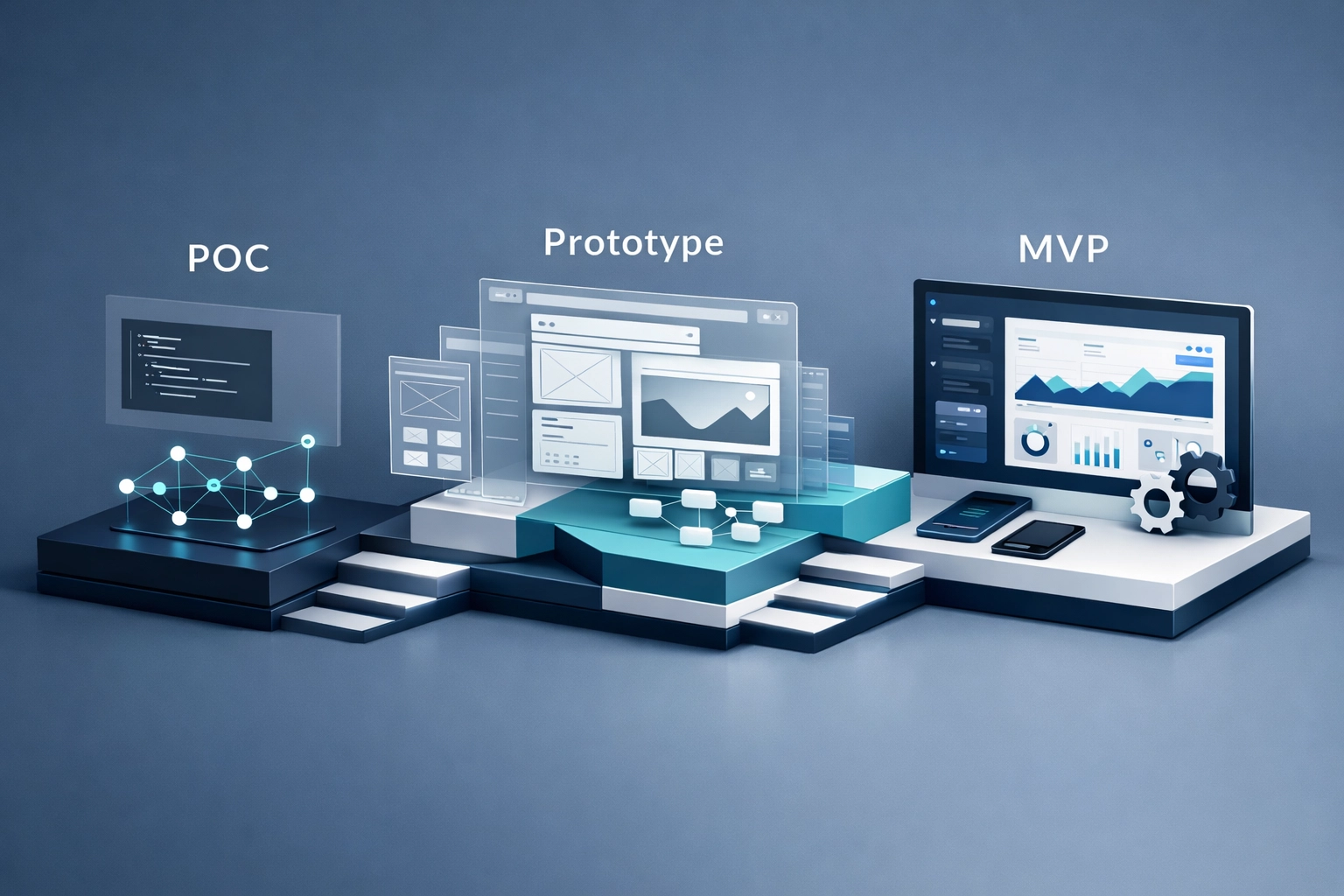
Introduction
The tech world loves alphabet soup. Before you start building your dream app, you will likely hit a wall of acronyms: POC, Prototype, and MVP.
First things first, let’s clear the air—the poc full form is Proof of Concept.
These terms get mixed up all the time, but they are not the same. Choosing the wrong one can waste time, money, and momentum. This guide is here to help you pick the right starting line.
Problem: Teams jump into development without knowing what they need to validate first.
Solution: Use the right starting stage to reduce risk, save budget, and build smarter.
Table of Contents
- Introduction
- POC: Proof of Concept
- Prototype
- MVP: Minimum Viable Product
- POC vs Prototype vs MVP: Quick Comparison
- Which One Do You Need?
- Common Mistakes
- Conclusion
- FAQ
POC: Proof of Concept
The poc full form is Proof of Concept.
A POC is a small-scale exercise used to test technical feasibility. In simple terms, it answers one question: can we actually build this?
This stage is not about polished design, launch readiness, or complete features. It is about validating whether a technical idea is possible before investing heavily in development.
What a POC is meant to do
- Validate feasibility: Check whether the core idea can work technically.
- Test a new API, AI model, system architecture, or integration.
- Confirm whether performance, reliability, or compatibility targets are realistic.
- Reduce technical risk: Identify blockers early.
- Surface hidden dependencies.
- Expose security, compliance, or infrastructure challenges.
- Support better planning: Give decision-makers confidence before committing larger budgets.
- Help founders estimate effort.
- Help developers assess implementation complexity.
- Help business owners understand delivery risk.
When to use a POC
Use a POC when:
- You are trying a brand-new or unproven technology.
- You need to test whether a complex feature is technically possible.
- You want evidence before investing in full product design and development.
- You are exploring AI, IoT, AR/VR, or other cutting-edge software initiatives.
What a POC usually includes
- A narrow technical experiment
- Limited functionality
- Internal testing only
- Minimal or no polished interface
- Fast iteration focused on learning
Key Components of a Proof of Concept
- Clear Objectives & Hypothesis: Define the exact technical challenge you are trying to solve.
- Ask what specific system, integration, workflow, or capability needs validation.
- Write a simple hypothesis such as, “This AI model can classify support tickets with acceptable accuracy.”
- Keep the goal tightly focused on feasibility rather than broad product success.
- Success Criteria: Set measurable KPIs that tell you whether the POC is a win.
- Define thresholds for performance, speed, accuracy, latency, reliability, or compatibility.
- Agree on what “good enough” looks like before testing begins.
- Make the criteria clear for developers, business owners, and decision-makers alike.
- Minimal Scope: Focus only on the core “will it work?” question.
- Remove extra features, polished UI, and non-essential workflows.
- Limit the build to the smallest experiment that can produce a useful answer.
- Avoid turning the POC into a hidden MVP.
- Resource Evaluation: Identify what is needed to test the concept properly.
- Review the tools, frameworks, infrastructure, APIs, and environments required.
- Assess whether you have the right engineering talent, domain expertise, and delivery capacity.
- Estimate the likely effort and constraints before moving to the next stage.
- Feedback & Documentation: Capture what you learned and what should happen next.
- Record technical results, blockers, assumptions, and open questions.
- Document whether the idea should move forward, be revised, or be dropped.
- Use the findings to guide the transition into a Prototype, MVP, or a different technical approach.
How to Create a Proof of Concept in 7 Steps
- Identify the Core Challenge: Pinpoint the specific technical unknown you need to solve.
- Focus on the single biggest feasibility question.
- Define the risk clearly before writing code.
- Define Success Metrics: Decide how you will know the POC works.
- Set measurable benchmarks such as response time, accuracy, throughput, or reliability.
- Example: “The API responds in under 200ms.”
- Assemble Your Dream Team: Bring together the right engineers and stakeholders.
- Include the technical experts who can build and test the concept.
- Involve decision-makers early so everyone aligns on goals and outcomes.
- Build the Bare Minimum: Create only the code needed to test your hypothesis.
- Skip polished interfaces and non-essential functionality.
- Keep the experiment lean, fast, and focused.
- Test in a Controlled Environment: Run the POC against the criteria you defined in step 2.
- Validate performance under expected conditions.
- Capture objective results rather than relying on assumptions.
- Review and Document: Gather the data, feedback, and technical findings.
- Record what worked, what failed, and what needs refinement.
- Use the learnings to shape the next development decision.
- The Go/No-Go Decision: Decide what happens next based on the evidence.
- Move to a Prototype if the concept is viable and the UX needs validation.
- Go back to the drawing board if the technical assumptions do not hold up.
Problem: You assume the technology will work because the idea sounds strong.
Solution: Build a POC first and confirm feasibility before scaling effort.
Prototype
A Prototype is about the look and feel of the product and the user journey.
Unlike a POC, a Prototype is usually not built to prove technical feasibility. Instead, it helps teams explore how the product should work from a user experience perspective. In many cases, it is created without heavy back-end code.
What a Prototype is meant to do
- Visualize the experience: Show how screens, flows, and interactions will work.
- Map navigation.
- Clarify layout and content structure.
- Make the product easier to understand for non-technical stakeholders.
- Test usability: Check whether users can move through the journey smoothly.
- Identify confusing steps.
- Improve onboarding and task completion.
- Refine the interface before development begins.
- Gain buy-in: Help secure support from investors, leadership teams, clients, or internal stakeholders.
- Present a realistic product direction.
- Align product, design, and development teams.
When to use a Prototype
Use a Prototype when:
- You need to secure stakeholder buy-in.
- You want to test usability before writing production-grade code.
- You need to clarify product requirements visually.
- You want feedback on layout, navigation, and user flow.
What a Prototype usually includes
- Clickable screens or design mockups
- Simulated interactions
- Core user journeys
- Limited or no real back-end logic
- A stronger focus on UX than engineering depth
Problem: Stakeholders struggle to support an idea they cannot see or experience.
Solution: Use a Prototype to make the product tangible and test the user journey early.
MVP: Minimum Viable Product
MVP stands for Minimum Viable Product.
An MVP is the first functional version of the product with just enough features to satisfy early customers and provide feedback for future development.
This is the stage where the product moves beyond concept and design into real-world use. Unlike a POC or Prototype, an MVP is built for actual users. It is not the final version of the product, but it is a working one.
What an MVP is meant to do
- Launch fast: Get a real product into the market without waiting for a full feature set.
- Focus on core value.
- Avoid overbuilding.
- Shorten time to market.
- Collect real feedback: Learn from actual user behavior instead of assumptions.
- Measure adoption.
- Track engagement.
- Prioritize future improvements based on evidence.
- Create a foundation for scaling: Start small, then improve based on what matters most.
- Build feature roadmaps from real demand.
- Reduce waste.
- Improve product-market fit.
When to use an MVP
Use an MVP when:
- You are ready to launch to real users.
- You want to validate market demand.
- You need early customer feedback.
- You are preparing to scale gradually and strategically.
What an MVP usually includes
- A working product
- Core features only
- Real user access
- Basic but reliable architecture
- Analytics and feedback loops for future iteration
Problem: Teams spend months building every possible feature before launch.
Solution: Start with an MVP, release faster, and let users guide the next phase.
POC vs Prototype vs MVP: Quick Comparison
| Aspect | POC | Prototype | MVP |
|---|---|---|---|
| Full form | Proof of Concept | Prototype | Minimum Viable Product |
| Main goal | Test technical feasibility | Test look, feel, and user journey | Launch a functional product to real users |
| Focus | Can we build this? | How should it work and feel? | Will users use and value it? |
| Audience | Internal technical teams, decision-makers | Stakeholders, testers, users, designers | Early customers, market, investors |
| Back-end development | Minimal or limited | Usually minimal or none | Yes, functional back-end is typically required |
| User-facing quality | Low | Medium to high visually | Functional and usable |
| Market launch ready | No | No | Yes |
| Best use case | Unproven technology | Buy-in and usability testing | Real-world validation and growth |
Which One Do You Need?
Here is the simplest way to decide:
- Use a POC if you are trying a brand-new, unproven technology.
- Use a Prototype if you need to secure stakeholder buy-in or test usability.
- Use an MVP if you are ready to launch to real users and start scaling.
If your product is complex, you may need all three stages. That is often the smartest path for high-risk or high-value software initiatives.
A practical way to choose
- Start with the risk: Define the biggest unknown first.
- If the technical side is unclear, begin with a POC.
- If the product flow is unclear, build a Prototype.
- If the value proposition is clear and you need market proof, launch an MVP.
- Match the stage to the stakeholder:
- Developers usually need feasibility clarity.
- Business owners usually need budget and growth clarity.
- Hiring managers and delivery leaders usually need execution clarity.
- Avoid overcommitting too early:
- Do not build an MVP when a POC would answer the real question.
- Do not spend on full development when a Prototype can validate UX first.
Problem: You pick a development path based on habit, not product risk.
Solution: Choose the stage that answers your biggest question first.
Common Mistakes
Many teams misuse these terms and that leads to poor planning. Watch out for these common mistakes:
- Calling every early build an MVP: A slide deck or clickable design is not an MVP.
- Skipping the POC for complex technology: This increases the chance of expensive technical surprises later.
- Treating the Prototype like production software: Prototypes are for testing experience, not supporting scale.
- Overloading the MVP with features: This slows launch and weakens learning.
- Ignoring feedback loops: The goal is not just to build something quickly, but to learn quickly too.
Conclusion
POC, Prototype, and MVP each serve a different purpose. A POC tests whether something is technically possible. A Prototype explores the look, feel, and user journey. An MVP is the first functional version released to real users for feedback and growth.
The right choice depends on what you need to validate next.
At Chimpare, we help businesses move through every stage with confidence — from the first POC to user-focused prototypes, scalable MVPs, and full-scale digital transformation. Whether you are validating a new idea or building a modern product for growth, our team helps you reduce risk, move faster, and build with clarity.
FAQ
What is the difference between POC and Prototype?
A POC tests technical feasibility. A Prototype tests design, interaction, and user journey.
What is the difference between Prototype and MVP?
A Prototype shows how a product may look and behave, often without full back-end development. An MVP is a working product released to real users.
Is a POC the same as an MVP?
No. A POC checks whether an idea can be built. An MVP checks whether users want and use the product.
Do all software projects need a POC, Prototype, and MVP?
Not always. Some projects only need one or two of these stages. It depends on the level of technical uncertainty, UX complexity, and market readiness.
Validation Path Snapshot
Project Success Probability by Validation Path
(Based on internal Chimpare data and industry benchmarks)
Path A: Straight to Full Development (No POC/MVP)
[██░░░░░░░░░░░░░░░░░░] 15%
Path B: MVP Only (No POC/Prototype)
[████████░░░░░░░░░░░░] 40%
Path C: Prototype + MVP
[██████████████░░░░░░] 70%
Path D: POC + Prototype + MVP (The Gold Standard)
[██████████████████░░] 92%