
If you feel like your IoT strategy is hitting a glass ceiling, you aren’t alone. As we navigate through 2026, the “Cloud-First” mantra that dominated the last decade is officially showing its age. Between the global semiconductor memory shortage and the sheer volume of data generated by billions of connected devices, sending every single bit of information to a centralized server isn’t just inefficient, it’s becoming a financial liability.
At Chimpare, we’ve seen a massive shift. Our partners are no longer asking “How do we connect this device to the cloud?” but rather “How do we make this device smart enough to work without it?”
The answer is Edge AI.
In this comprehensive guide, we’ll explore why Edge AI is the definitive missing piece of your IoT strategy, how it’s driving digital transformation, and why your business needs to make the leap today to remain competitive in an increasingly autonomous world.
Table of Contents
- The State of IoT in 2026: Why the Cloud is Overloaded
- What Exactly is Edge AI?
- The Three Pillars of Edge AI Success
- Problem-Solution: Navigating the Efficiency Gap
- Comparative Analysis: Cloud IoT vs. Edge AI
- Industry-Specific Transformations
- The Tech Stack: Powering Local Intelligence
- Common Mistakes in Edge AI Implementation
- How to Build Your Edge AI Roadmap
- The Future: Beyond 2026
- Frequently Asked Questions
The State of IoT in 2026: Why the Cloud is Overloaded
The digital landscape of 2026 is vastly different from that of 2022 or even 2024. We are currently facing a “Cost Crisis” in the IoT sector. Research indicates that the global memory shortage, fueled by the insatiable demand for AI data centers, has restructured the economics of semiconductors. DRAM and NAND production are being diverted to massive LLM (Large Language Model) clusters, leaving IoT manufacturers with higher component costs.
If your device relies on sending raw, uncompressed data to the cloud for processing, you are essentially paying a “latency tax” and a “bandwidth premium” that your competitors are likely avoiding. Furthermore, enterprise buyers now view “dumb” sensors as commodities. To maintain pricing power and justify subscription models, your hardware must offer immediate, localized value.
The Problem: Sending raw data to the cloud creates high latency, massive bandwidth costs, and security vulnerabilities.
The Solution: Edge AI processes data at the source, ensuring lightning-fast responses and keeping sensitive information on-premise.
What Exactly is Edge AI?
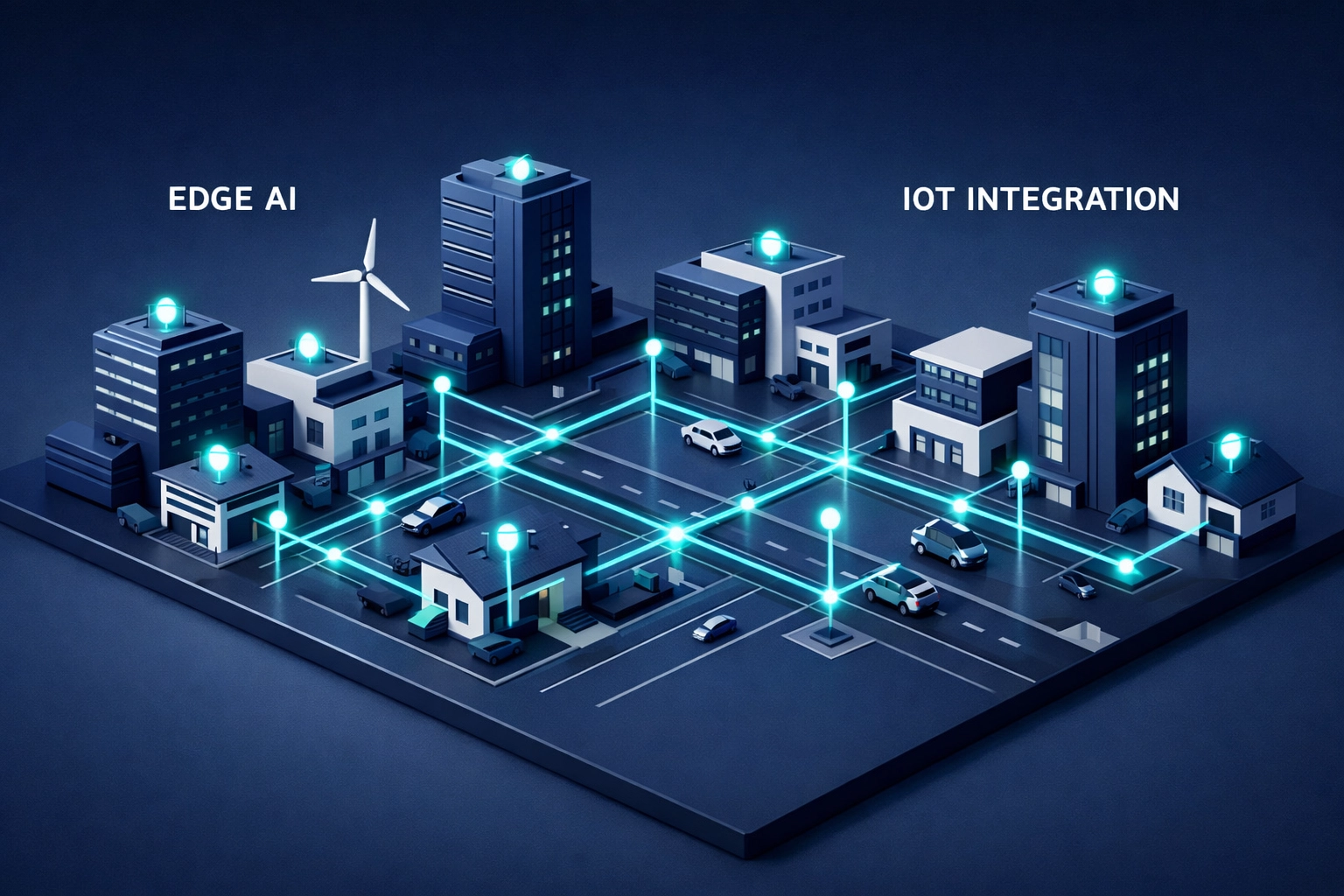
Edge AI is the deployment of machine learning models directly onto hardware devices (the “edge”) rather than relying on a centralized cloud server. Instead of a camera sending a video feed to a server to detect a person, an Edge AI-enabled camera identifies the person locally and only sends a notification.
This shift represents a move from Centralized Intelligence to Distributed Autonomy. By empowering individual devices to make decisions, you create a more resilient, scalable, and cost-effective ecosystem.
The Three Pillars of Edge AI Success
To understand why Edge AI is transformative for enterprise software development, we look at three core pillars:
1. Real-Time Decision Making
- Specialty: Sub-millisecond latency for mission-critical tasks.
- Release Date: Standardized across industrial sectors in late 2025.
- Key Features:
- Instant anomaly detection in manufacturing lines.
- Real-time collision avoidance for autonomous warehouse robots.
- Immediate biometric authentication for secure access points.
2. Enhanced Security and Privacy
- Specialty: Data localization and reduced attack surfaces.
- Release Date: Integral to the Zero Trust Blueprint since early 2026.
- Key Features:
- Processing PII (Personally Identifiable Information) locally to meet GDPR and CCPA.
- Eliminating the need for constant data transmission, reducing interception risks.
- Creating isolated “security cells” within a microservices architecture.
3. Bandwidth and Cost Optimization
- Specialty: Drastic reduction in cloud storage and egress fees.
- Release Date: Widely adopted by SMEs in 2026 to combat rising cloud costs.
- Key Features:
- Filtering “noise” data so only relevant insights are uploaded.
- Lowering the hardware requirements for constant high-speed internet connectivity.
- Extending the battery life of IoT devices by reducing radio usage.
Problem-Solution: Navigating the Efficiency Gap
The Scalability Wall
- Problem: As your fleet of IoT devices grows from 100 to 10,000, your cloud bills grow exponentially, often outpacing revenue.
- Solution: Implement Edge AI to handle 95% of data processing locally. This ensures your cloud infrastructure scales linearly (or even stays flat) while your device count explodes.
The Connectivity Nightmare
- Problem: Your smart devices are deployed in remote locations (oil rigs, rural farms, or underground mines) where 5G or Wi-Fi is intermittent.
- Solution: Use Edge AI to ensure the device remains fully functional and “intelligent” even when offline, syncing only high-level summaries when a connection is restored.
Comparative Analysis: Cloud IoT vs. Edge AI
When deciding on your next mobile application development or IoT project, understanding these differences is crucial.
| Feature | Cloud-Centric IoT | Edge AI-Enabled IoT (2026) |
|---|---|---|
| Response Time | 100ms – 2s (Latency dependent) | <10ms (Immediate) |
| Bandwidth Usage | High (Raw data streaming) | Low (Metadata/Insights only) |
| Security Risk | High (Data in transit) | Low (Data stays at source) |
| Operational Cost | High (Monthly cloud fees) | Low (One-time hardware/Edge maintenance) |
| Reliability | Depends on internet connection | Independent of internet connection |
| Scalability | Expensive and complex | Seamless and distributed |
Industry-Specific Transformations
Smart Manufacturing and Industry 5.0
In the factory of 2026, Edge AI is the backbone of industrial decision intelligence.
- Predictive Maintenance: Sensors on a turbine don’t just record vibration; they analyze the frequency patterns locally to predict a bearing failure before it happens.
- Quality Control: High-speed cameras use Edge AI to spot microscopic defects on a PCB in real-time, triggering a mechanical arm to remove the item instantly.
Healthcare and Remote Monitoring
Patient privacy is paramount. Edge AI allows for:
- Fall Detection: Smart home sensors for the elderly can detect a fall and call emergency services without ever recording or transmitting video of the person’s private home.
- Vitals Analysis: Wearables process EKG data locally, only alerting a doctor if an arrhythmia is detected, significantly reducing the data load on healthcare providers.
Retail and Customer Experience
Retailers are using Edge AI to bridge the gap between physical and digital storefronts.
- Heat Mapping: Analyzing foot traffic patterns locally to optimize shelf placement without compromising shopper anonymity.
- Smart Checkout: Recognizing items in a cart instantly via computer vision at the edge, enabling “Just Walk Out” technology for smaller retailers.
The Tech Stack: Powering Local Intelligence
Building an Edge AI solution requires a specialized stack. In 2026, we’ve seen a consolidation of high-performance, low-power hardware.
- Silicon Pioneers: Companies like MediaTek and Texas Instruments are leading the charge. TI’s latest platforms are specifically designed for cost-sensitive applications, allowing businesses to integrate AI without the “premium” price tag.
- Software Frameworks: We utilize tools like TensorFlow Lite, PyTorch Edge, and specialized TinyML libraries to compress complex models into footprints that fit on microcontrollers.
- Connectivity: While the processing is local, the communication often happens via high-performing microservices using MQTT or CoAP protocols for efficiency.
Common Mistakes in Edge AI Implementation
Even the most seasoned software development teams can stumble when moving to the edge. Here are the pitfalls to avoid:
- Over-Engineering the Model: Trying to run a full-scale LLM on a small sensor.
- The Fix: Use model quantization and pruning to tailor the AI to the specific hardware constraints.
- Neglecting Over-the-Air (OTA) Updates: Assuming the model is “set and forget.”
- The Fix: Implement a robust OTA strategy to update models as you gather more “ground truth” data from the field.
- Ignoring Edge Security: Focusing so much on processing that you forget to secure the physical device.
- The Fix: Use Hardware Security Modules (HSMs) and follow the Zero Trust Blueprint.
- Data Siloing: Processing everything at the edge but failing to send high-level insights back to the central strategy team.
- The Fix: Ensure your architecture allows for “Federated Learning,” where local insights improve the global model over time.
How to Build Your Edge AI Roadmap
If you’re ready to integrate Edge AI into your digital transformation, follow these imperative steps:
- Identify the Latency-Critical Path: Determine which part of your UX or operational process suffers most from delay. This is your first candidate for Edge AI.
- Audit Your Data Costs: Look at your cloud storage and transit bills. Pinpoint the “noise” that doesn’t need to be there.
- Select Your Hardware Wisely: Don’t just pick the most powerful chip; pick the one with the best power-to-performance ratio for your specific use case.
- Develop a Pilot Program: Start with a localized deployment to prove ROI. At Chimpare, we specialize in helping brands move from pilot to production safely.
- Focus on UX: Ensure the localized intelligence actually improves the end-user experience. A smart app is only smart if it’s faster and more reliable.
Data Trends: The Explosion of Edge AI
Below is a representation of the projected growth of the Edge AI market, highlighting the inflection point we are currently experiencing in 2026.
Projected Edge AI Market Value (Billions USD)
| Year | Market Value (Est.) | Growth Driver |
|---|---|---|
| 2024 | $18.5B | Early Adoption/Research |
| 2025 | $24.9B | Industrial IoT Pilots |
| 2026 | $36.2B | Mass Market IoT Integration |
| 2028 | $62.4B | Autonomous Systems Ubiquity |
| 2033 | $118.7B | Global Standard Implementation |
Source: Internal Market Analysis and 2026 Industry Reports.
The Future: Beyond 2026
As we look past 2026, the distinction between “IoT” and “AI” will likely disappear. We are moving toward a world of Ambient Intelligence, where our environment responds to us in real-time, powered by invisible, localized processing.
For business owners and hiring managers, this means the demand for developers who understand both hardware constraints and machine learning will skyrocket. For CTOs, it means a fundamental shift in how infrastructure is budgeted, moving from OpEx-heavy cloud subscriptions to strategic CapEx investments in intelligent hardware.
Adaptation is no longer optional. If your IoT strategy doesn’t include the “Edge,” you’re building for the past.
Frequently Asked Questions
Is Edge AI more expensive than Cloud AI?
Initially, the hardware costs (CapEx) are higher because you need more powerful chips at the edge. However, the long-term operational costs (OpEx) are significantly lower due to reduced cloud fees and bandwidth usage. Most businesses see a return on investment within 12–18 months.
Can existing IoT devices be upgraded to Edge AI?
It depends on the chipset. Some devices can be updated with “TinyML” models if they have sufficient processing overhead. However, for a true Edge AI experience, a hardware refresh using 2026-standard NPUs (Neural Processing Units) is usually recommended.
How does Edge AI impact battery life?
Counter-intuitively, it often improves battery life. While processing uses power, transmitting data over Wi-Fi or 5G is the biggest battery drain. By processing locally and transmitting less, the overall energy consumption of the device decreases.
Does Chimpare provide bespoke Edge AI solutions?
Yes. We specialize in bespoke software development that integrates localized intelligence for various sectors, including retail, charity, and industrial manufacturing.
Ready to revolutionize your IoT strategy?
Whether you’re looking for iOS and Android app development or a complete digital transformation, Chimpare is here to help you navigate the future. Contact our team today to start your Edge AI journey.