
While chatbots talk, AI Agents act. They don’t just suggest a route; they cross-reference visa regulations, secure the booking, and manage real-time logistics. They are digital employees, not just interfaces.
Strategic. Autonomous. Built for conversion.
For UK SMEs, this isn’t just an upgrade: it’s the engineering muscle required to reclaim market share from global giants. Transitioning from conversation to execution is the only way to eliminate booking bottlenecks and drive genuine ROI.
Table of Contents
- The Paradigm Shift: From Conversation to Action
- What is Agentic AI? The Technical Evolution of 2026
- Beyond Search: The Four Pillars of Agentic Travel
- The Engine Room: Model Context Protocol (MCP) & Data Integration
- Agent-to-Agent Commerce: The New B2B Reality
- Strategic Implementation: A Guide for Travel Enterprises
- Data Insights: Efficiency Gains in Agentic Systems
- Common Mistakes in AI Travel Integration
- Comparison: Traditional Chatbots vs. Agentic AI
- Securing the Journey: Privacy in the Age of Autonomous Booking
- The Future of Travel: Digital Transformation with Chimpare
- Frequently Asked Questions
1. The Paradigm Shift: From Conversation to Action
For over a decade, the travel industry has been chasing the “seamless journey.” We moved from physical travel agents to online booking engines, and eventually to the first generation of AI chatbots. However, those early chatbots were often little more than glorified FAQ search bars dressed up in shiny UX. They could tell you the weather in Mallorca or confirm your flight time, but when it came to actually getting the job done, they fizzled out fast.
In 2026, the industry has reached a genuine tipping point. The era of passive assistance is fading into the background. We have entered the age of Agentic AI.
Unlike a standard chatbot, an Agentic AI system has the autonomy to execute complex tasks with lightning-fast precision. It doesn’t just suggest a hotel; it checks your corporate travel policy, cross-references your loyalty points, applies a discount code, and completes the reservation while you sleep. That is the difference between advice and action—and it is a seriously powerful leap for businesses chasing scalable growth, smoother UX, and standout customer satisfaction.
Problem: Customers are tired of AI tools that talk a big game, then dump the real work back in their lap.
Solution: Agentic AI takes ownership of the task, transforming a polite conversation into a seamless execution engine.
2. What is Agentic AI? The Technical Evolution of 2026
To understand why this is a game-changer, we must define what Agentic AI actually is in the context of bespoke software development. At its core, an AI Agent is an autonomous system powered by a Large Language Model (LLM) that has been granted “tools”, APIs, browsing capabilities, and database access, to interact with the world.
Key Technical Characteristics:
- Reasoning and Planning: The agent breaks down a high-level goal (e.g., “Get me to the conference in Tokyo on a budget”) into sub-tasks.
- Memory: It retains context across long-term interactions, remembering that you prefer aisle seats and have a nut allergy.
- Tool Use: It can interact with external software, such as GDS (Global Distribution Systems), payment gateways, and CRM systems.
- Self-Correction: If a booking fails due to a timeout, the agent doesn’t just error out; it tries an alternative route or a different provider.
As UK enterprises build custom AI agents, the focus has shifted from “How do we make the AI sound human?” to “How do we make the AI reliable and autonomous?”
3. Beyond Search: The Four Pillars of Agentic Travel
Agentic AI transforms the travel lifecycle through four distinct pillars of execution. Each pillar marks a bold shift away from clunky manual steps and toward smooth, automated resolution that actually feels futuristic.
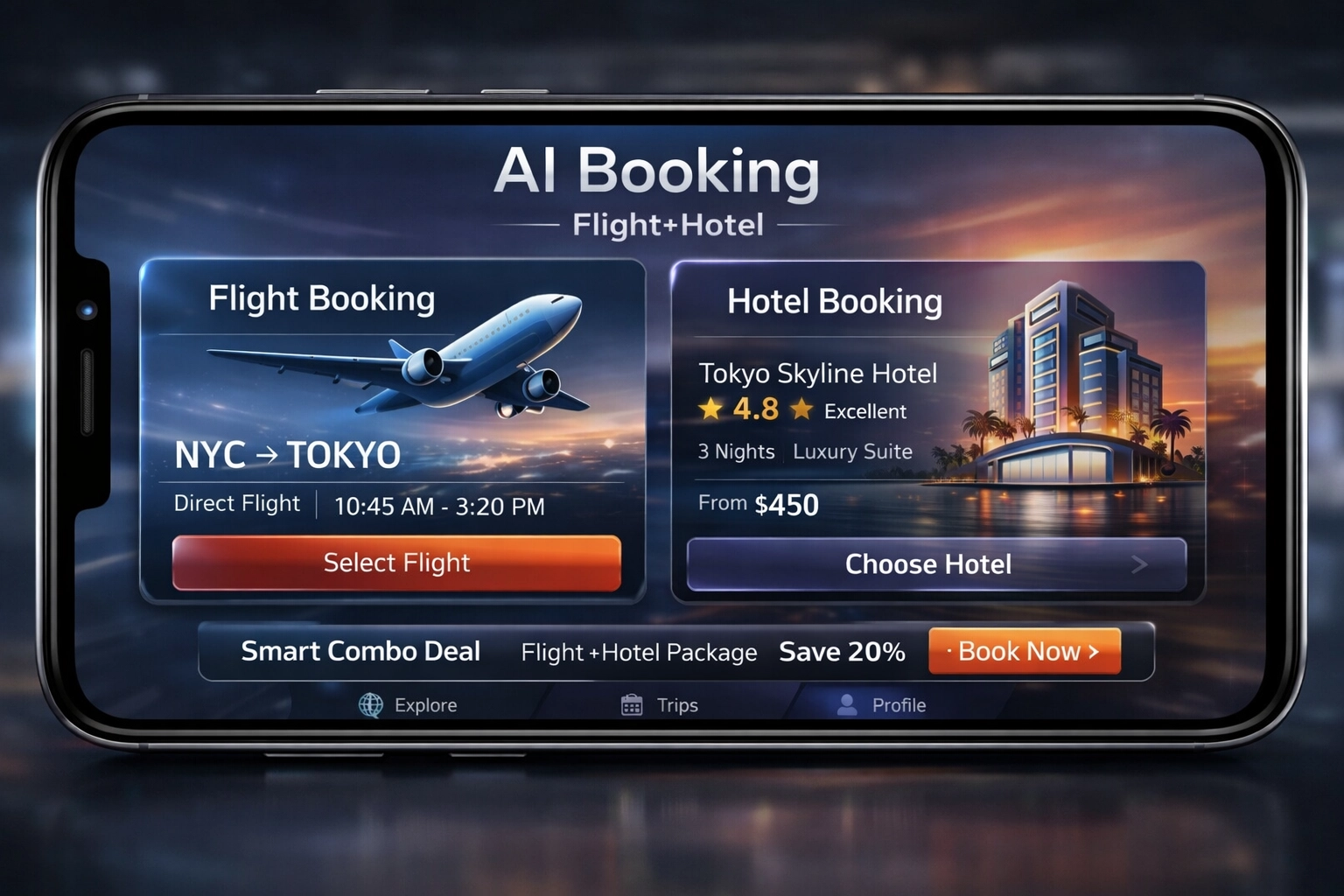
I. Autonomous End-to-End Booking
The “search-and-click” model is dying. In an agentic workflow, a user provides a prompt, and the agent executes the rest.
- Specialty: Multi-modal transaction handling.
- Key Features:
- Synchronized flight, hotel, and car rental bookings.
- Automated seat selection based on historical preferences.
- Instantaneous application of loyalty credentials across multiple platforms.
II. Proactive Disruption Management (Rebooking)
This is where Agentic AI proves its ROI. When a flight is canceled, a traditional app sends a push notification. An Agentic AI agent, however, identifies the next three available flights, checks their prices, ensures they fit your schedule, and asks, “I’ve found a flight leaving in two hours that gets you there on time. Should I book it?”
- Specialty: Real-time problem solving.
- Key Features:
- Automatic luggage tracking updates.
- Seamless re-routing of ground transportation.
- Instant hotel voucher generation during delays.
III. Dynamic Price Tracking and Automated Refunds
Instead of users manually checking for price drops, agents monitor fares 24/7.
- Specialty: Financial optimization.
- Key Features:
- “Cancel and Rebook” logic to capture lower rates post-purchase.
- Automated filing of “Price Match” guarantees.
- Tracking of delayed flight compensation (EU261/UK261) and filing claims automatically.
IV. Hyper-Personalized Itinerary Curation
Itineraries are no longer static PDFs. They are living documents managed by an agent that adjusts based on real-time data, such as weather shifts or local events.
- Specialty: UX-driven personalization.
- Key Features:
- Integration with local NFC-enabled services for seamless entry to attractions.
- Real-time restaurant reservations based on live availability and user taste profiles.
Problem: Travel disruptions cost the industry billions and lead to massive customer churn.
Solution: Agentic AI provides 24/7 proactive monitoring, resolving issues before the customer even realizes there is a problem.
4. The Engine Room: Model Context Protocol (MCP) & Data Integration
One of the biggest hurdles in AI development has always been the “silo” problem. Data lives in scattered systems, airlines use one API, hotels use another, and your personal calendar is off in its own little universe.
In 2026, the Model Context Protocol (MCP) has emerged as the gold standard for solving this mess elegantly. MCP is an open standard that enables AI models to quickly and securely connect to data sources and tools. At Chimpare, we use MCP to ensure that our enterprise software development projects are not just powerful, but deeply interoperable, scalable, and ready for real-world execution.
Why MCP Matters for Travel:
- Standardized Data Access: Agents can pull real-time inventory from any provider supporting the protocol without custom, brittle integrations.
- Contextual Awareness: By connecting to a user’s work calendar and email via MCP, the agent understands the purpose of the trip, allowing for smarter decision-making.
- Security: MCP allows for granular control over what data an agent can see and “act” upon, which is vital for high-performing digital transformation.
5. Agent-to-Agent Commerce: The New B2B Reality
We are rapidly moving toward a world of Agent-to-Agent (A2A) Commerce. In this next-gen scenario, your personal AI travel agent doesn’t just browse a website like a digital tourist; it communicates directly with a “Supplier Agent” at an airline or hotel chain.
How A2A Commerce Works:
- Negotiation: Your agent can negotiate a late checkout or a room upgrade by communicating the value of your loyalty to the hotel’s agent.
- Frictionless Payments: Using secure tokens, agents can execute payments without the user having to re-enter credit card details for every micro-transaction.
- Instant Settlement: Transactions happen in milliseconds, reducing the overhead of traditional booking funnels.
This level of automation requires a robust backend. Developers must focus on scaling microservices to handle the surge in automated API traffic that A2A commerce generates.
6. Strategic Implementation: A Guide for Travel Enterprises
For business owners and CTOs, the transition to Agentic AI is not an “all-or-nothing” move. It requires a smart, tiered approach to mobile application development rather than a chaotic leap into the deep end.
Step 1: Audit Your Data Infrastructure
Before an agent can act, it needs clean data. If your current systems are fragmented, your AI will be unreliable. Ensure your APIs are robust and follow modern standards like REST or GraphQL.
Step 2: Define “Guardrails”
Autonomy must be controlled. Businesses need to define what an agent cannot do. For example, an agent might have the authority to rebook a flight within a 10% price variance but must ask for permission for anything higher.
Step 3: Choose the Right Architecture
Deciding between native iOS/Android development and hybrid models is crucial. Agentic AI requires low latency and high reliability, often making native development the preferred choice for performance-heavy AI features.
Step 4: Focus on User Trust
The UI/UX must clearly communicate what the agent is doing. Users should see a “Reasoning Log” or a summary of actions taken to build confidence in the system.
7. Data Insights: Efficiency Gains in Agentic Systems
To visualize the impact of moving from a chatbot-led system to an agentic-led system, consider the following performance metrics based on 2026 industry benchmarks. The numbers paint a pretty vivid picture: less friction, faster bookings, and a far more polished customer journey.
Comparison of Travel Tech Efficiency
| Metric | Traditional Search/Web | LLM Chatbot (v1) | Agentic AI (Current) |
|---|---|---|---|
| Time to Complete Booking | 22 Minutes (avg) | 12 Minutes (avg) | < 45 Seconds |
| Customer Touchpoints | 15+ Clicks | 5-8 Chat Exchanges | 1 Initial Prompt |
| Disruption Resolution | Manual (Hours) | Assisted (30 Mins) | Automated (< 2 Mins) |
| User Satisfaction (CSAT) | 62% | 74% | 91% |
Infographic Data: The Cost of Manual Intervention
A line graph would illustrate the following trend over a 12-month period:
- Operational Costs: Decreases by 40% as AI agents handle 80% of routine rebookings and refund requests.
- Booking Volume: Increases by 25% due to the reduced friction in the “impulse booking” phase.
- Error Rates: Human entry errors drop from 4% to 0.01% with automated data synchronization.
8. Common Mistakes in AI Travel Integration
As an expert software development partner, we’ve seen plenty of brands stumble during digital transformation. Here are the pitfalls to avoid before your sleek AI vision turns into a clunky operational headache:
- Treating AI as a “Plugin” rather than a Core Architecture: You cannot just “bolt on” an AI agent to a 10-year-old legacy system and expect it to work. It requires a fundamental rethink of your data flow.
- Neglecting Latency: If your agent takes 30 seconds to “think” before responding, the user will leave. High-performing apps require optimized Android development tools and efficient backend scaling.
- Lack of Human-in-the-Loop (HITL): For high-value transactions (e.g., luxury travel or complex group bookings), there must be an easy way for a human agent to take over the conversation.
- Poor Security Protocols: Storing user credentials or passport data within the AI’s “memory” without Zero Trust security is a recipe for disaster.
Problem: Attempting to build AI agents on top of messy, unorganized data leads to “hallucinations” and incorrect bookings.
Solution: Invest in “Industrial Decision Intelligence” and clean your data pipelines before deploying agentic features.
9. Comparison: Traditional Chatbots vs. Agentic AI
| Feature | Traditional Chatbots | Agentic AI (2026) |
|---|---|---|
| Core Goal | Provide Information | Execute Tasks |
| Connectivity | Static Knowledge Base | Real-time API / MCP Integration |
| Autonomy | Zero (Requires User Clicks) | High (Can operate on “Commander Intent”) |
| Payment Handling | Links to Payment Page | Secure, Direct Transaction Execution |
| Problem Solving | Gives “How-to” steps | Executes the solution (e.g., rebooks) |
| Personalization | Name-based (“Hello Satakshi”) | Context-based (Predicts needs based on data) |
10. Securing the Journey: Privacy in the Age of Autonomous Booking
When an AI agent has the power to book flights and spend your money, security becomes the number one priority. In 2026, the industry has moved toward Edge AI to process sensitive user data locally on the device, rather than sending everything to a central cloud server. It is a smarter, tighter, and far more trustworthy way to power autonomous booking.
Security Best Practices for Travel Agents:
- Tokenization: Never store raw credit card data. Use secure tokens that are only valid for specific transactions.
- Ephemeral Memory: Ensure the AI agent “forgets” sensitive personal details once the specific task is completed.
- Multi-Factor Authorization (MFA): For any transaction over a certain threshold, the agent must trigger a biometric check (FaceID/Fingerprint) on the user’s device.
11. The Future of Travel: Digital Transformation with Chimpare
The travel landscape is changing fast, and staying competitive means moving well beyond the basic chatbot. Whether you are an OTA (Online Travel Agency), a boutique hotel group, or a corporate travel provider, the integration of Agentic AI is no longer optional; it is quickly becoming essential for survival in a digital-first economy.
At Chimpare, we specialize in the bespoke software development required to bring these smart agents to life. From building the robust microservices that power them to designing the lightning-fast mobile interfaces users genuinely enjoy, we help businesses turn bright, ambitious AI ideas into practical, high-performing digital products.
Our approach combines:
- Expert AI Engineering: Leveraging the latest in LLMs and the Model Context Protocol.
- Seamless UX Design: Creating interfaces where AI and humans work in harmony.
- Scalable Infrastructure: Ensuring your app can handle thousands of autonomous agents operating simultaneously.
The journey to the future of travel starts with a single step: moving beyond the chatbot and into a brighter, faster, more intelligent booking experience.
12. Frequently Asked Questions
What makes Agentic AI different from ChatGPT?
While ChatGPT is a powerful conversational model, an “Agent” is a wrapper around that model that gives it the ability to use tools. ChatGPT can write a flight itinerary; an Agent can book the flights, pay for them, update your calendar, and handle the fiddly bits in between.
How much does it cost to implement Agentic AI in a travel app?
The cost varies depending on the complexity of the integrations and the scale of the deployment. For a detailed breakdown of development costs, check our guide on how much app development costs in the UK.
Is Agentic AI safe for processing payments?
Yes, provided it is built on a “Zero Trust” architecture. By using tokenization and encrypted API channels, Agentic AI can be more secure than traditional manual entry, as it reduces the risk of human-in-the-middle attacks.
Can Agentic AI handle multi-city, complex itineraries?
Absolutely. This is where Agentic AI excels. It can reason through complex logic, such as “Find a hotel near the train station in Berlin, but only if the flight from London arrives before 6 PM.”
Do I need to rebuild my entire app to use AI agents?
Not necessarily. Many enterprises choose to integrate AI agents as a layer on top of their existing microservices. However, a high-performing digital transformation often involves optimizing the backend to ensure the AI has the speed and data access it needs.
What is the Model Context Protocol (MCP)?
MCP is an open standard that allows AI models to connect to various data sources and tools seamlessly. It simplifies the development of AI agents by providing a universal “plug-and-play” framework for data integration.